 Semiahmoo Exterior
 Birch Bay Roofs Take a Different Kind of Beating
Birch Bay sits right on the water, and that changes what a roof has to survive. It isn't just rain — it's wind coming straight off the bay with nothing to slow it down, salt-laden air that works on metal fasteners and flashing year-round, and a moss season that can run from fall through spring in a wet Whatcom County winter. A roof spec'd for an inland neighborhood ten miles away often doesn't hold up the same way out here, and repairs that don't account for the exposure tend to fail again within a season or two.
We work storm damage calls in Birch Bay regularly, which means we're not guessing at what the wind and salt air do to a roof here — we've already seen it on the house down the street.
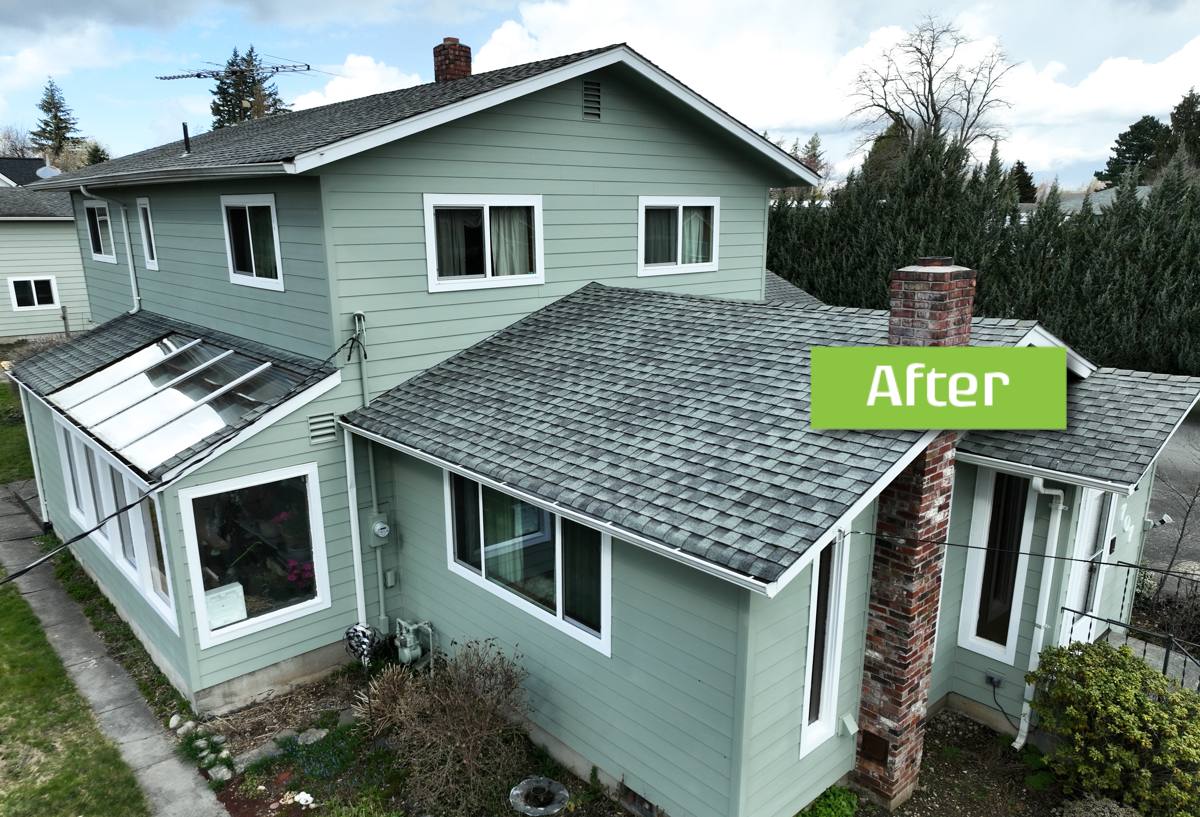
What Storms Actually Do to a Birch Bay Roof
Most storm damage isn't dramatic. It's rarely a tree through the ridge — it's smaller, cumulative damage that homeowners don't notice until water shows up inside.
Wind
Sustained wind off the water lifts shingle tabs and works sealant strips loose even when nothing visibly blows off. Once a shingle's seal breaks, it can flap in every subsequent wind event, loosening the nails underneath and widening the gap. Ridge caps and hip lines, which take the most direct wind load, are usually the first place we check.
Wind-driven rain
Rain that's moving sideways doesn't behave like rain falling straight down. It can be pushed up under shingle tabs, sideways through vent flashing, and into any gap around chimneys, skylights, or wall-to-roof transitions — spots that shed water fine in a normal shower but leak under a real Pacific storm. This is the single biggest cause of storm-related interior water damage we see in this area.
Debris impact
Branches and wind-carried debris can crack or puncture shingles, dent metal flashing, and knock granules loose from asphalt shingles, all of which shorten the roof's remaining life even if there's no active leak yet.
Moss and moisture over time
A long moss season doesn't cause storm damage directly, but it sets the roof up to fail worse when a storm hits. Moss holds moisture against the shingle surface, lifts shingle edges as it grows, and clogs the granule surface that's supposed to shed water. A roof with heavy moss going into storm season is more vulnerable to wind and rain intrusion than a clean one.
Signs Your Roof Needs a Storm Damage Inspection
Some damage is obvious. A lot of it isn't, especially from the ground. After any significant wind event, it's worth checking for:
- Shingles that look lifted, curled, or out of alignment with the rest of the field
- Granules collecting in gutters or at downspout outlets
- Bent, lifted, or missing flashing around chimneys, vents, and skylights
- Water stains on interior ceilings or upper walls, even faint ones
- Damp insulation or a musty smell in the attic
- Visible daylight through the roof deck when viewed from inside the attic
- Debris, branches, or granule buildup on the roof surface after a storm
None of these guarantee a major problem, but any of them are reason enough for a proper look before the next storm finds the weak spot.
What a Correct Storm Damage Repair Involves
The fastest fix isn't always the right one. A repair that only addresses the visible symptom — a missing shingle, a stain on the ceiling — without checking what's underneath tends to come back.
Emergency mitigation vs. permanent repair
If a storm has left an active leak or exposed decking, the first priority is stopping water intrusion — tarping, temporary flashing, or sealing exposed areas. That's a stopgap, not a fix. The permanent repair comes after, once we can properly assess the deck, underlayment, and surrounding material in dry conditions.
Checking what's under the shingles
Storm damage that reaches the underlayment or decking needs more than a shingle swap. We check for soft or delaminated decking, saturated underlayment, and whether the felt or synthetic underlayment beneath the damaged area is still doing its job. Replacing shingles over a compromised deck just hides the problem until the next storm.
Matching materials and technique
A patch repair only holds up if the replacement shingles and flashing are compatible with what's already on the roof — same profile, same fastening pattern, proper overlap and step-flashing at any wall or chimney transition. Rushed patch jobs that ignore proper shingle coursing or flashing overlap are one of the most common causes of repeat leaks we get called out for.
Documentation for insurance
If the damage is being submitted as an insurance claim, we document the damage with photos and a written scope before and after repair. That paper trail matters — adjusters want to see cause and extent of damage, not just a finished repair.
Repair or Replace? What Actually Drives That Decision
Storm damage doesn't automatically mean a new roof, and it doesn't automatically mean a simple patch either. The right call depends on a few concrete factors.
| Factor | Favors repair | Favors full replacement |
|---|---|---|
| Extent of damage | Isolated to one section or slope | Spread across multiple slopes or the whole roof |
| Roof age | Well within its expected service life | Already near the end of its expected life |
| Underlying deck condition | Solid, dry decking under the damaged area | Soft, delaminated, or water-stained decking |
| Moss and granule condition | Minimal moss, granules intact elsewhere | Heavy moss coverage, widespread granule loss |
| Shingle availability | Matching shingles still available or close match possible | Discontinued profile or badly weathered mismatch |
| Storm history | First significant storm event for this roof | Repeated storm damage over recent seasons |
We'll walk through these factors with you honestly rather than defaulting to whichever option is more profitable. Plenty of storm calls genuinely are a straightforward repair.
Our Process for Birch Bay Storm Damage Calls
1. Inspection and documentation
We inspect the full roof, not just the area you noticed damage on — storms rarely damage only one spot, and adjacent areas often show early signs that haven't leaked yet. We document everything with photos.
2. A clear, written scope
You get a plain-English explanation of what's damaged, what caused it, and what the repair involves — including whether we think it's a repair or a replacement situation, and why.
3. The repair itself
Work is done to match existing materials and proper flashing technique, not just the fastest way to close the roof back up. Decking and underlayment get replaced wherever they've been compromised, not just where it's convenient.
4. Follow-up
After the repair, we check that the fix is holding, particularly through the next round of weather. A repair that isn't checked after the first real storm is a repair nobody's actually verified.
Why a Crew That Already Works Birch Bay Matters
Storm damage repair has a time-sensitivity problem that other exterior work doesn't: every day a compromised roof sits exposed is another chance for a smaller leak to become a bigger one. A crew that's already familiar with Birch Bay's exposure, common roof types, and typical storm patterns can assess and prioritize faster than one seeing the area for the first time.
Local familiarity also matters for the less obvious things — knowing which flashing details tend to fail first on homes with this level of wind and salt exposure, understanding Whatcom County permitting requirements when a repair crosses into full replacement territory, and having a realistic sense of how fast moss and moisture reestablish themselves here so preventive recommendations aren't generic boilerplate.
Reducing Damage From the Next Storm
You can't storm-proof a roof, but you can reduce how much any given storm does to it.
- Keep gutters and downspouts clear so wind-driven rain has somewhere to go instead of backing up under the roof edge
- Address moss buildup before it lifts shingle edges and holds moisture against the roof surface
- Have flashing around chimneys, vents, and skylights checked periodically rather than waiting for a leak to reveal a failure
- Trim back branches that could become wind-borne debris in the next storm
- Get any storm damage assessed and repaired promptly — small unresolved damage is what turns a moderate storm into a major one
None of this eliminates storm risk on a bay-facing roof, but it narrows the gap between "this roof took a hit" and "this roof needs emergency repair."
Get a Straight Answer on Your Roof
If a recent storm has you wondering whether your roof needs attention, or you just want an honest read on where it stands before the next one hits, we're happy to take a look. The estimate is free, there's no pressure, and you'll get a clear explanation of what we find — repair, replacement, or nothing at all.