 Semiahmoo Exterior
 Laurel's Siding Problem Isn't Like a Typical Homeowner's
Homes in and around Laurel deal with a specific combination of stresses that a lot of siding products simply weren't built to handle for the long haul: salt-laden air drifting in off the water, wind-driven rain that gets pushed sideways into wall assemblies rather than falling straight down, and a long, damp shoulder season every year where surfaces stay wet enough, long enough, for moss and algae to take hold. Any one of those on its own is manageable. All three together, year after year, is what actually determines whether a siding job still looks good and performs well at year fifteen versus year five.
This page is about one service, in one area: installing James Hardie fiber cement siding correctly on Laurel homes. Not a general siding overview, not a sales pitch for every product on the market — just what this climate demands, what a correct Hardie installation actually involves, and why the details matter more here than they would in a drier, calmer part of the state.
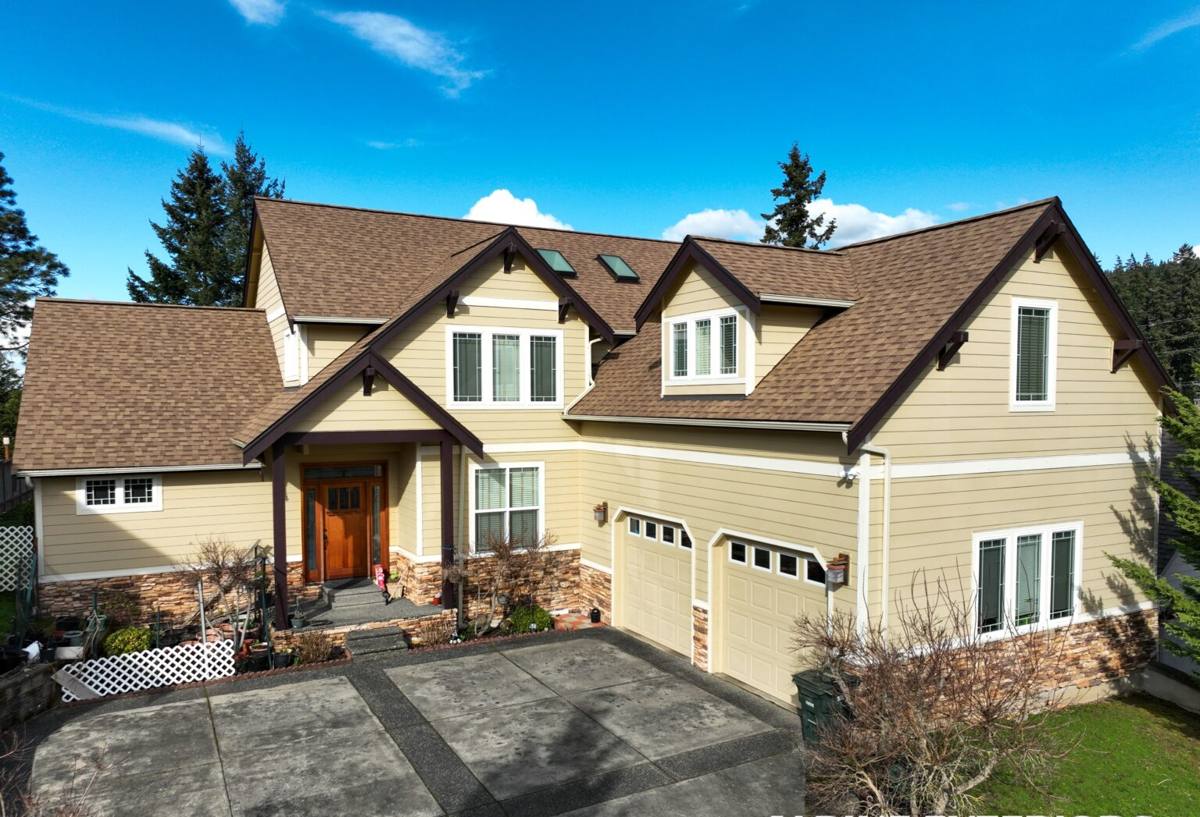
What Whatcom County's Marine Climate Does to a Wall
Salt air and metal fatigue
Salt in the air accelerates corrosion on anything metal — fasteners, flashing, trim, and the hidden hardware that holds a siding system together. A siding product can look fine on the surface while the fasteners or flashing behind it are quietly failing years ahead of schedule. This is why fastener spec and flashing material matter as much as the siding panel itself in a coastal-influenced climate.
Driving rain and wind-pressure moisture intrusion
Straight-down rain is easy to shed. Wind-driven rain is a different problem — it gets forced sideways and upward at laps, corners, and penetrations, testing every seam and every piece of flashing in the assembly. A siding system depends entirely on its water-management details (house wrap, flashing, gaps, sealant placement) to perform in these conditions. The siding material is only half the equation.
Moss, algae, and prolonged surface moisture
Whatcom County's long wet season keeps north-facing walls, shaded elevations, and anything near overhanging trees damp for extended stretches. That's exactly the environment moss and algae need to establish themselves on a surface. Some siding materials resist this better than others, and finish quality plays a real role in how much a wall stains over time versus how much it sheds.
Why We Only Install James Hardie — Not Vinyl, Not LP SmartSide, Not Cedar
We standardized on James Hardie fiber cement for every home we side, including in Laurel, for reasons that are specific to what this climate does to a wall over 20-plus years, not brand preference. Fiber cement is dimensionally stable in a way wood-based and vinyl products aren't — it doesn't swell, cup, or shrink the way engineered wood siding can when it takes on repeated moisture cycling, and it doesn't soften, warp, or become brittle in temperature swings the way vinyl can. It's non-combustible, which matters increasingly for insurance and building considerations in the Pacific Northwest. And James Hardie's HZ5 product line is engineered specifically for climates like this one — the Pacific Northwest's freeze-thaw and moisture cycling — rather than being a one-size-fits-all national product.
We're not going to tell you those other products are junk — that's not honest, and it's not our call to make about a manufacturer's engineering. What we will say is that we've made a professional decision not to install them, because the long-term maintenance burden, moisture behavior, or finish durability didn't meet the standard we hold ourselves to for homes in this specific climate. Fiber cement with a factory-applied finish does.
ColorPlus Finish: Why Factory-Applied Color Matters Here
James Hardie's ColorPlus finish is baked on at the factory under controlled conditions, rather than field-applied on site the way primed siding is typically painted after installation. That distinction matters more in a marine climate than almost anywhere else, because field-applied paint has to cure and bond in whatever weather Laurel happens to be delivering that week — which, for a good chunk of the year, means damp air and marginal drying conditions. A factory finish sidesteps that entirely and holds its color and sheen far more consistently against salt exposure and UV, which means less fading, less chalking, and a longer stretch before the siding needs any attention at all.
What Correct Installation Actually Involves
Buying the right siding product and installing it correctly are two different things. Hardie's own installation instructions are detailed for a reason — the material performs to spec only when the details underneath and around it are done right.
Clearances and gaps
Hardie specifies minimum clearances from grade, roofing, decks, and other flatwork, plus expansion gaps at butt joints and around penetrations. Skipping these is one of the most common ways an otherwise good installation traps moisture against the bottom edge of the siding.
Water-resistive barrier and flashing
A correctly lapped house wrap, plus properly integrated flashing at windows, doors, and every penetration, is what actually keeps wind-driven rain out of the wall assembly. The siding sheds the bulk of the water; the WRB and flashing system handle what gets past it.
Fastening
Corrosion-resistant fasteners, driven to the correct depth and spacing, are non-negotiable in a salt-air environment. Over-driven or under-driven fasteners are a common cause of both cosmetic damage and premature loosening.
Caulking and joint treatment
Hardie's warranty and performance depend on joints being treated according to spec — not oversealed, not left open, and not caulked with the wrong product for a coastal climate.
Comparing Siding Options for Laurel's Climate
| Factor | James Hardie Fiber Cement | Vinyl | Cedar / Wood | LP SmartSide |
|---|---|---|---|---|
| Salt air / corrosion resistance | Strong — inert material, HZ5 engineered for PNW | Moderate — can become brittle over time in temperature swings | Weak without diligent upkeep | Moderate — engineered wood core |
| Driving rain / moisture behavior | Dimensionally stable, doesn't swell or cup | Sheds water but joints can work loose | Absorbs moisture, prone to rot if detailing fails | Wood-based core vulnerable if edges are exposed |
| Moss / algae resistance | Strong, especially with ColorPlus factory finish | Moderate, surface can stain | Weak, organic surface invites growth | Moderate |
| Fire resistance | Non-combustible | Combustible, can melt/deform | Combustible | Combustible |
| Finish longevity | Factory-applied, long color retention | Color molded in, can fade/chalk | Requires repeated repainting/staining | Factory or field finish, variable |
Our Process, Start to Finish
- On-site assessment. We look at your home's exposure — which walls face prevailing wind and rain, where moss has already established itself, and where past moisture damage may be hiding under the current siding.
- Substrate check. Before any new siding goes up, we check the sheathing and framing underneath for rot or damage from the existing system's failures, and address it before it gets covered up again.
- Water-resistive barrier and flashing. This is installed and inspected before a single piece of Hardie board goes on — it's the layer that actually keeps water out, not the siding itself.
- Hardie installation to manufacturer spec. Correct clearances, fastening, and joint treatment, following James Hardie's published installation requirements for this climate zone.
- Trim, caulking, and final detailing. The places where most failures start — corners, penetrations, and butt joints — get the closest attention.
- Walkthrough. We go over the finished job with you, including what maintenance (if any) to expect going forward.
Maintaining Hardie Siding in a Marine Climate
One of the advantages of fiber cement with a factory finish is how little upkeep it needs compared to wood or field-painted alternatives — but "little" isn't "none," especially with Laurel's moss season working against you.
- Rinse siding (garden hose pressure, not a pressure washer) once or twice a year to remove salt residue and organic buildup before it takes hold
- Keep gutters clear so overflow doesn't run down the face of the siding and create a constant damp streak
- Trim back vegetation and tree cover that keeps particular wall sections shaded and damp longer than the rest of the house
- Check caulking at trim joints and penetrations every couple of years — caulk is the one component that wears out before the siding does
- Address any moss or algae growth early with a gentle cleaning approach rather than letting it establish and stain the finish
- Watch for any signs of moisture at the base of the wall near grade, decks, or walkways, where clearance issues tend to show up first
Why Hiring a Crew That Already Works Laurel Matters
Siding installation instructions are the same on paper anywhere in the country. What changes is judgment — knowing which elevations of a Laurel home take the worst of the wind-driven rain, which areas are shaded enough to need extra attention to moss resistance, and which flashing details matter most given how salt air behaves here over time. A crew that's done this work repeatedly in Whatcom County's marine climate isn't guessing at those calls; they're applying what's already worked on homes facing the same conditions yours does. That's the difference between a siding job that meets code and one that's actually built for where it sits.
If you're considering new siding for a home in Laurel, we're happy to walk the property with you, look at what your current siding is or isn't handling well, and give you a straightforward assessment of what correct James Hardie installation would involve for your home. There's a free, no-pressure estimate form below — reach out whenever you're ready.