 Semiahmoo Exterior
 Two Fiber Cement Products, Not a Fair-Fight Marketing Story
When homeowners in Semiahmoo ask us why we don't quote Cemplank, they usually expect us to trash it. We're not going to do that. Cemplank is a real fiber cement product, made by a legitimate manufacturer, and it holds up better than vinyl or wood in most respects. This isn't a "one product is junk" comparison. It's an explanation of why, after years of installing fiber cement siding in Whatcom County's specific climate, we made a business decision to carry one brand instead of two — and why that brand is James Hardie.
Fiber cement itself is the right category for this coastline. Salt air off the Strait of Georgia, driving rain that comes in sideways during winter storms, and a moss season that runs longer here than almost anywhere else in the state all punish materials that trap moisture or degrade under UV and humidity cycling. Both Cemplank and Hardie are cement-and-cellulose composites engineered to resist that punishment far better than vinyl or untreated wood. Where they differ is in the details — and on a coastal property, the details are what determine whether siding looks good in year 15 or needs touch-up paint by year 6.
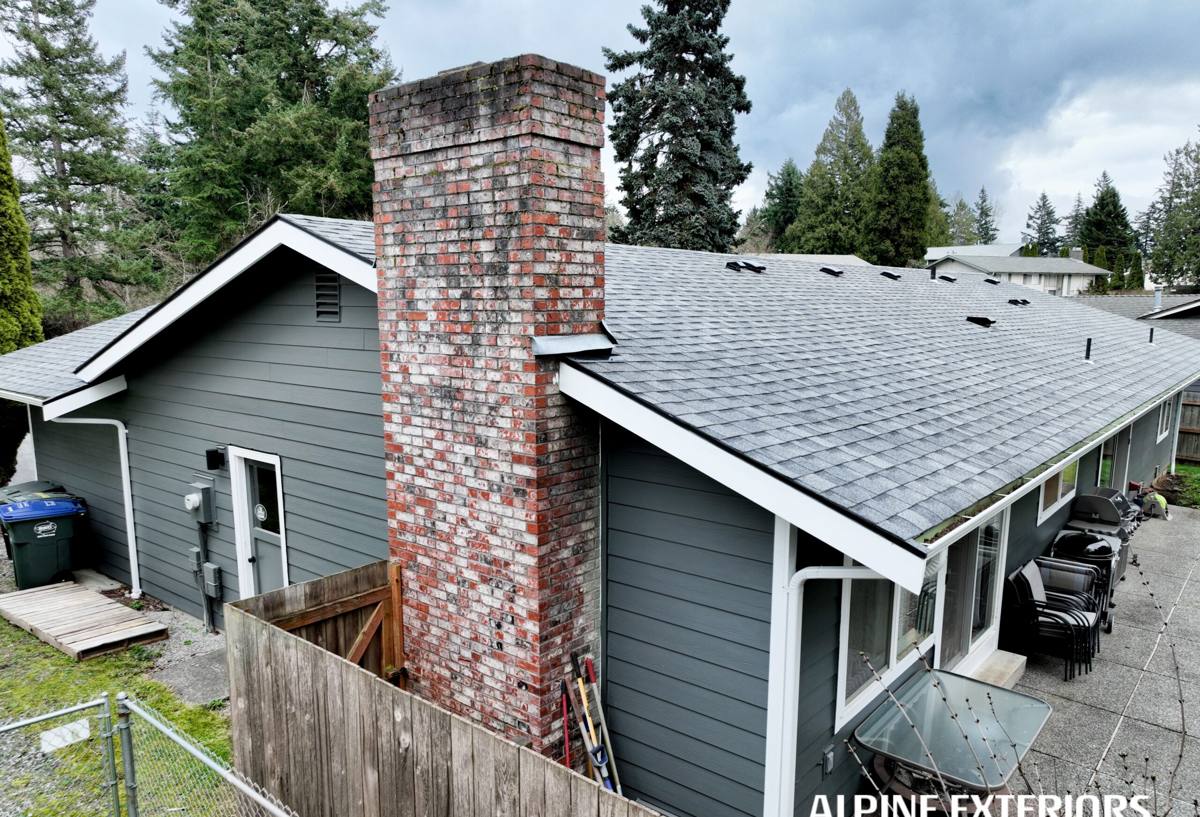
What Cemplank Gets Right
Fairness first. Cemplank fiber cement siding is non-combustible, resists pests, and doesn't rot the way wood lap siding does. It's manufactured to standard fiber cement dimensions, so in a lot of respects it installs similarly to Hardie boards, and it's typically priced a step below Hardie in material cost. For a homeowner on a tight budget who still wants to move up from vinyl, it's not an irrational choice. We don't tell people Cemplank is a bad product. We tell people it's not the product we've chosen to stand behind with our own labor and our own warranty commitments, and here's why.
Where the Comparison Actually Matters
The differences that matter to a homeowner aren't in the raw material chemistry — they're in manufacturing consistency, factory finish, regional climate engineering, and what happens five, ten, and twenty years after installation when something needs to be matched, repaired, or claimed under warranty.
Manufacturing Consistency and Regional Distribution
James Hardie has built out a dense distribution and installer-training network across the Pacific Northwest, which matters more than it sounds. When we order Hardie product for a job in Semiahmoo, we're getting boards, trim, and accessories from the same consistent supply chain that stocks lumberyards throughout Whatcom County — meaning color-matched trim, starter strips, and repair pieces are available years later if a homeowner needs a small section replaced after storm damage or a remodel.
Cemplank's regional presence in Northwest Washington is thinner. That doesn't mean it's unavailable, but it does mean a contractor working with it here is more likely to special-order components, wait longer for backordered trim, or substitute pieces that don't match as precisely. On a coastal home where board-and-trim contrast is part of the design, that gap shows.
Climate-Engineered Product Lines for This Exact Coastline
This is the piece that matters most for a Semiahmoo property. James Hardie engineers regional product lines — its HZ5 formulation for the Pacific Northwest is built specifically around the freeze-thaw cycling, prolonged moisture exposure, and humidity levels common to this climate zone. The board density, moisture-management coating, and factory-applied backer are tuned for exactly the kind of driving rain and salt-laden air that comes off the water here.
Cemplank does not offer the same degree of publicly documented, zone-specific engineering for the Pacific Northwest. That's not a knock on the underlying material — it's a real gap in how precisely the product is matched to local conditions versus a system built with this exact climate in mind. On a home exposed to salt air and long stretches of damp, low-sun weather, that engineering difference is the whole ballgame for how the siding looks and performs a decade in.
Factory Finish and the ColorPlus Question
Paint failure is the single most common siding complaint we see on older homes in this area, and it almost always traces back to field-applied paint that wasn't designed to bond and flex with the substrate the way a factory finish is. James Hardie's ColorPlus finish is baked on at the factory in a controlled environment, under a finish warranty that runs separately from — and typically longer than — a standard field-paint job, and it's engineered specifically to resist the fading, chipping, and moss staining that Whatcom County's damp, low-light winters are known for.
Cemplank's finish options vary more by supplier and region, and in our market it's more commonly installed primed, with the final color coat applied on-site by a painting crew after installation. Field-applied paint can look great initially, but its long-term bond and UV resistance depend heavily on surface prep, weather conditions during application, and the specific paint product used — variables a factory finish process removes almost entirely.
Side-by-Side: Where the Two Systems Diverge
| Factor | James Hardie | Cemplank |
|---|---|---|
| Base material | Fiber cement | Fiber cement |
| Pacific NW-specific engineering | Yes — HZ5 line built for this climate zone | No documented regional-specific formulation |
| Factory finish | ColorPlus, baked-on, separate finish warranty | Commonly primed; finish coat often field-applied |
| Regional stocking/parts availability | Deep PNW distribution network | Thinner regional presence; more special-order |
| Warranty transferability | Transferable, well-documented process | Varies by supplier and installer |
| Typical material cost | Higher | Somewhat lower |
Warranty Structure and What "Transferable" Actually Means
Every siding manufacturer offers some form of warranty, but the fine print is where they earn or lose that promise. James Hardie's warranty is well-documented, widely honored, and designed to transfer to a new owner if the home sells — which matters on the coast, where siding condition is a real line item in resale negotiations. It also pairs manufacturer material warranty with our own installation warranty, so a homeowner isn't stuck figuring out whether a problem is a product defect or a workmanship issue.
Cemplank warranties exist too, but coverage terms, transfer processes, and finish-specific coverage vary more by distributor and region than Hardie's does. For a homeowner planning to stay in a Semiahmoo home for decades, or one who wants a clean warranty story if they sell, that inconsistency is a real practical downside — not a theoretical one.
Why We Standardized on One System
Every contractor who tells you they install "everything" is really telling you they've mastered nothing to the same depth. Fiber cement installation has real technical requirements — proper fastening patterns, clearances, flashing details, and joint treatment — and those details shift slightly between manufacturers. By carrying one system, our crews install the same flashing details, the same fastener spacing, and the same joint treatment on every job, on every house, every time. That repetition is where installation quality actually comes from, and it's a big part of why manufacturer warranties hold up when it's time to make a claim.
We also don't want to sell a homeowner on a product's engineering, then hand the installation to a crew that split their attention across three different siding systems that week. One system means our crews know its quirks cold — how it behaves in a hard freeze-thaw week, how it should be gapped before a wet Whatcom County winter, and where the small mistakes that shorten a siding job's life tend to happen.
What to Ask Any Contractor Before You Sign
- Is the factory finish baked on, or will color be applied on-site after installation?
- Is the product engineered for this specific climate zone, or is it a general-purpose formulation?
- What is the manufacturer's warranty term, and is it transferable if you sell the home?
- How readily available are matching trim and repair pieces in this region, five years from now?
- Does the contractor install one siding system consistently, or several — and how much of their crew's experience is with the specific product on your quote?
- Is the installation itself separately warrantied, apart from the manufacturer's material warranty?
The Bottom Line for a Semiahmoo Home
Cemplank isn't a bad product — it's fiber cement, and fiber cement is the right family of material for this coastline's salt air and driving rain. But when we weighed regional climate engineering, factory finish consistency, warranty structure, and local parts availability, James Hardie came out ahead on every point that actually affects how siding performs and looks in this specific place, over the specific decades a homeowner plans to live behind it. That's why we install one system instead of stocking two, and why we can stand behind the installation with a level of consistency that spreading across multiple product lines wouldn't allow.
If you're weighing fiber cement options for a home in Semiahmoo or elsewhere in Whatcom County, we're happy to walk your specific property, talk through what the moss, rain, and salt exposure on your lot actually call for, and give you a straightforward, no-pressure estimate — no upsell, no scare tactics, just an honest look at what we'd put on the house.