 Semiahmoo Exterior
 Why Siding Estimates Vary So Much
Ask three contractors to price the same siding job in Semiahmoo and you'll often get three different numbers, sometimes further apart than homeowners expect. That's not because someone is padding the bid or someone else is lowballing it — siding pricing is genuinely a moving target, built from a stack of variables that don't show up until a contractor actually walks the house. Square footage is the easiest number to grab, but it's rarely the number that decides the final price.
This page walks through what actually moves the cost of a siding replacement up or down, so you can read a quote with some context instead of just comparing bottom-line totals. We won't quote you a price range here — every house on the Semiahmoo peninsula is different, and a number without a site visit isn't a real number. What we can do is explain the factors that matter.
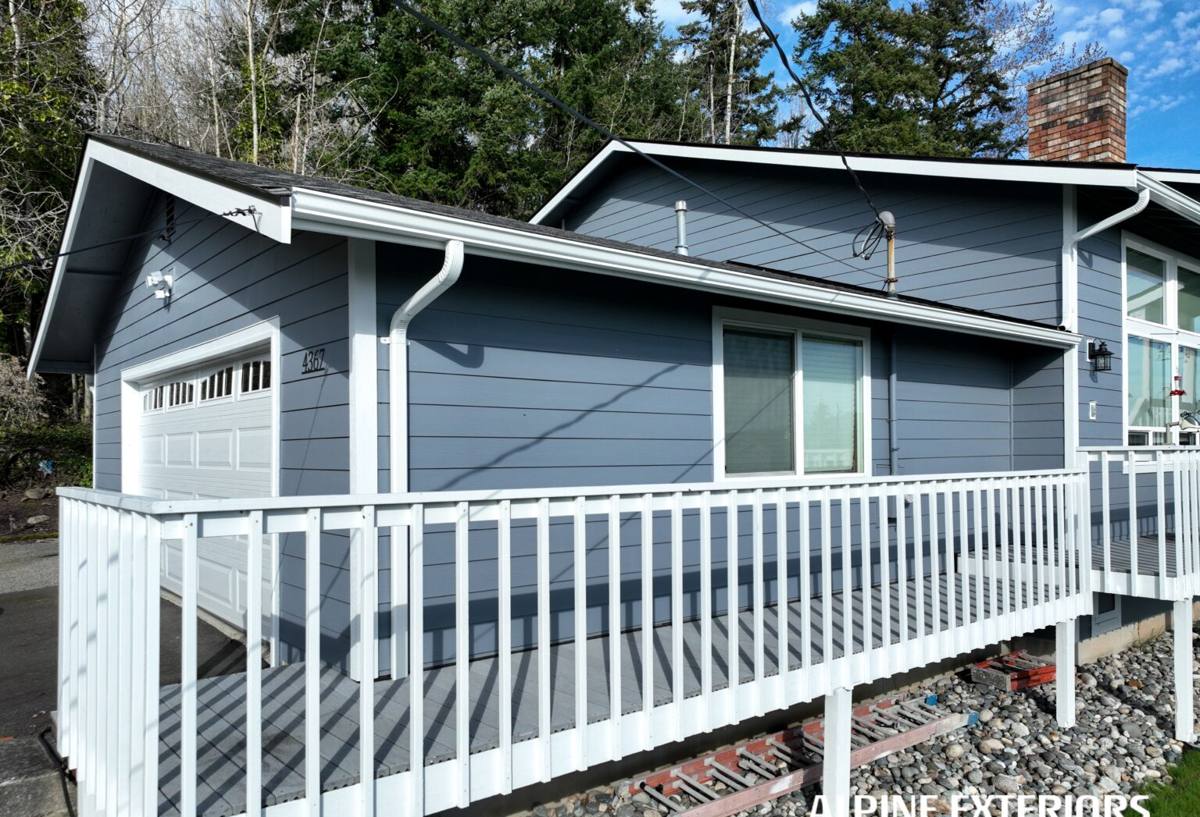
The Big Three: Size, Complexity, and Condition
Three variables do most of the work in any siding estimate, and they interact with each other rather than stacking neatly.
Square Footage
More wall area means more material and more labor hours, in a fairly direct relationship. But square footage alone tells you almost nothing about difficulty — a large, simple two-story rectangle can go faster than a smaller home with a lot of roofline breaks.
Complexity
Dormers, bump-outs, multiple gables, tall gable peaks, and a lot of trim detail all slow a crew down. Every inside corner, outside corner, and window casing is a cut, a fit, and a caulk line. A house with a complicated roofline can cost meaningfully more per square foot than a simple ranch of the same size, even with identical materials.
Condition Underneath
This is the variable that surprises homeowners most. A quote built from a curbside look is a guess. A quote built after pulling a few boards to check the sheathing is a real number. Rot, soft spots, or moisture-damaged framing behind the old siding turn a straightforward re-side into a repair-and-replace job, and that's where budgets move.
What's Underneath Matters as Much as What's On Top
Siding is a system, not a surface. Before new siding goes up, a house needs a sound water-resistive barrier, properly flashed windows and doors, and solid sheathing to fasten into. Skipping that step to save money is how a siding job that looks great for two years starts failing at year five.
On the Semiahmoo peninsula and around Drayton Harbor, we routinely find moisture damage behind older siding that had no visible sign of a problem from the outside — old caulk failures, missing flashing, or siding installed tight to grade where it had no way to dry out. Finding that during tear-off isn't a bad thing; it's the point of tear-off. Overlay jobs, where new siding goes directly over old siding or damaged sheathing, are cheaper up front and almost always cost more over the life of the house.
Material Choice: The Line Item That Moves the Whole Budget
The siding material you choose affects not just the purchase price but installation labor, finish costs, maintenance over the years, and how long the whole system lasts before it needs to be redone. We install exclusively James Hardie fiber cement siding, and we're upfront about why — but it's worth laying out how the major options actually compare, not just asserting it.
| Material | Relative Material Cost | Installation Sensitivity | Ongoing Maintenance | Typical Longevity |
|---|---|---|---|---|
| Vinyl | Lowest | Low — forgiving to install | Low, but cracks/fades and can't be repainted easily | Shorter, especially in coastal wind and UV exposure |
| LP SmartSide (engineered wood) | Low-mid | High — edge sealing and caulking are critical | Moderate to high — moisture intrusion at cut edges is the main failure point | Moderate, heavily dependent on installation and upkeep |
| Primed spruce / cedar | Mid-high | Very high — needs correct back-priming and regular refinishing | High — repainting/staining cycle is ongoing | Variable, shortened by rot in wet climates |
| James Hardie fiber cement | Mid | High — requires trained installers and correct fastening/clearances | Low — factory-baked ColorPlus finish, non-combustible core | Long, with a strong transferable warranty when installed to spec |
Vinyl's low price comes with a trade-off: it's a thin plastic product that expands, contracts, and can crack in impact or cold, and it can't be painted a different color without voiding its own warranty. Engineered wood products like LP SmartSide perform well when every cut edge and seam is sealed exactly to spec, but that installation sensitivity means the product's real-world performance depends heavily on the crew, not just the material. Primed spruce and cedar look great on day one but put the homeowner on a recurring repainting or restaining schedule for as long as they own the house.
James Hardie fiber cement isn't the cheapest option on the shelf, but it's non-combustible, holds its factory finish for years without repainting, and comes from a manufacturer that engineers specific product lines for specific climate exposures. That combination is why we standardized on it and stopped installing the alternatives above.
Why Semiahmoo's Climate Changes the Math
Whatcom County siding doesn't live an easy life. Salt air off the Salish Sea, driving rain that comes in sideways during winter storms, and a long moss season that keeps north-facing walls damp for months at a time all put real stress on exterior materials. A siding product that performs fine in a dry inland climate can behave very differently a few blocks from the water in Semiahmoo.
Salt-laden air accelerates corrosion on fasteners and trim hardware and speeds up UV and moisture breakdown on some finishes. Constant damp conditions feed moss and algae growth, which hold moisture against the siding surface longer than in drier regions. This is exactly the kind of exposure that James Hardie's HZ10 product line is engineered for — it's built and finished specifically for wetter, harsher climates like ours, rather than a generic siding spec pulled from a national average.
Labor and Installation Quality: The Cost You Don't See on the Quote
Two bids can list the identical siding product and still be very different jobs. Fiber cement, in particular, is unforgiving of shortcuts — correct fastener placement, proper clearances at grade and roofline, correctly lapped and caulked joints, and correct flashing details all determine whether the siding performs for decades or starts failing early. A lower bid built on faster, looser installation isn't actually a lower cost; it's a deferred one.
Labor also scales with crew size and schedule. A smaller crew working a complex home will take longer, which affects the number on the quote even before material cost enters the picture. When you're comparing bids, ask what's actually included in the labor line — tear-off, disposal, house wrap, flashing, trim work, and cleanup should all be spelled out, not assumed.
Finish and Warranty: Paying Once vs Paying Twice
Field-applied paint — the kind you get with primed wood, some engineered wood products, and touch-up work on any siding — is a recurring cost. It needs to be redone on a cycle, and the quality of that repaint depends on weather conditions the day it's applied. James Hardie's ColorPlus finish is baked on at the factory under controlled conditions, which is a meaningfully different product than field-applied paint and comes backed by its own finish warranty separate from the substrate warranty.
Warranty structure matters more than homeowners often realize when comparing quotes. A strong, transferable product warranty protects the investment if the house sells, and it reflects how confident the manufacturer actually is in the product's long-term performance. Read what's covered — substrate, finish, and labor warranties are often separate documents, and the gaps between them are where disputes happen later.
What a Fair Quote Should Include
Whoever you hire, a complete, comparable quote should spell out the following:
- Full tear-off vs. overlay, stated explicitly
- Sheathing and moisture inspection, with a plan for what happens if damage is found
- House wrap or weather-resistive barrier product and installation method
- Exact siding product, line, and profile — not just "fiber cement" or "engineered wood" generically
- Trim, fascia, and flashing scope — what's being replaced vs. reused
- Fastener type and spacing, especially for coastal/high-moisture sites
- Disposal and cleanup responsibility
- Written warranty terms, both product and labor, with what voids them
- Payment schedule and estimated timeline
If a quote is missing several of these, it's not necessarily dishonest — it may just be incomplete. Ask for the gaps to be filled in before comparing it against another bid.
Getting an Accurate Number for Your Home
The only way to get a real cost figure is a site visit — someone who will look at your home's size, roofline complexity, current siding condition, and exposure to weather and water, and price the job in front of you rather than off a phone call. That's the estimate that actually means something.
If you're weighing a siding replacement on a home in Semiahmoo or elsewhere in Whatcom County, we're glad to walk the property, check what's going on underneath the current siding, and put together a straightforward, no-pressure estimate. There's a form below to get that scheduled.