 Semiahmoo Exterior
 Why Bellingham Roofs Wear Differently
A roof in Bellingham doesn't fail the same way a roof does further inland. Sitting near the water on Semiahmoo Bay and the broader Puget Sound shoreline means homes here deal with a specific combination of stresses: salt-laden air that accelerates corrosion on fasteners and metal flashing, long stretches of driving rain that finds every weak seam, and a moss season that can run most of the year in shaded, north-facing sections of a roof. None of these problems are dramatic on their own. Together, over several winters, they turn small maintenance items into real leaks.
We work roofs in this part of Whatcom County regularly, which means we're not guessing at how a given roof type holds up here — we've seen how it actually performs after a few wet seasons.
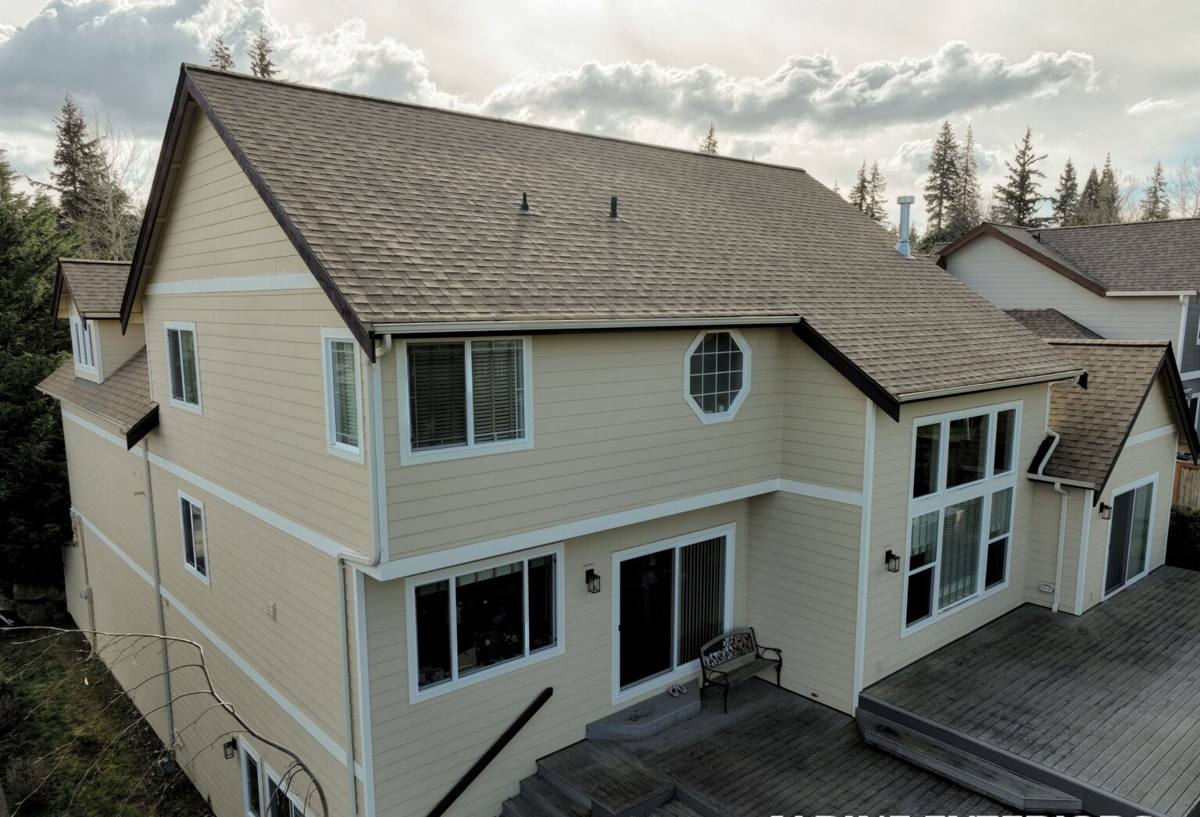
How the Local Climate Attacks a Roof
Salt Air and Corrosion
Proximity to the water means airborne salt settles on roofing surfaces and metal components. Exposed fasteners, cheap flashing, and unprotected metal edges corrode faster here than they would twenty or thirty miles inland. Corrosion usually starts small — a rusted nail head, a pitted flashing edge — but it's often the actual point where water gets in, long before the surrounding shingles show any damage.
Driving Rain
Whatcom County storms frequently come with wind-driven rain rather than straight-down rain. Wind-driven water pushes sideways and upward under laps, flashing, and shingle edges that would keep out a calm rain just fine. A repair that only patches the surface without addressing how water moves under wind pressure tends to fail again at the first hard storm.
Moss and Sustained Moisture
Shaded roof sections, north slopes, and areas under overhanging trees stay damp for extended periods much of the year. That's exactly the environment moss needs. Moss doesn't just look bad — it holds moisture against the roofing material, lifts shingle edges as it grows, and can work its way into seams over time.
Signs a Bellingham Roof Needs Repair
Most roof leaks don't announce themselves with an obvious hole. They show up as smaller signals first:
- Dark streaks, moss patches, or algae growth concentrated on shaded or north-facing slopes
- Granules collecting in gutters or at downspout outlets
- Soft or slightly spongy decking felt underfoot in the attic near valleys or penetrations
- Rust staining below metal flashing, vents, or exposed fasteners
- Water stains on interior ceilings that appear or worsen after wind-driven storms specifically
- Lifted, curling, or missing shingle tabs after a windy winter
- Daylight visible around chimney, vent, or skylight flashing from inside the attic
Any one of these on its own might just need a straightforward repair. Several together, especially combined with an older roof, are worth a full inspection before deciding what's actually needed.
What a Correct Repair Actually Involves
A roof repair done right isn't just replacing the shingles you can see. Given how much of the local damage starts at flashing, seams, and fastener corrosion rather than in the open field of the roof, a proper repair usually means:
- Pulling back surrounding material to inspect the decking and underlayment condition, not just patching over the visible symptom
- Replacing corroded fasteners and degraded flashing with materials suited to a coastal-influenced climate, not just the cheapest match
- Re-establishing proper laps and water flow paths so wind-driven rain has nowhere to get under the surface
- Matching shingle or roofing material closely enough that the repair doesn't become its own future weak point
- Checking valleys, penetrations, and transitions near the repair area, since these are the spots most likely to develop the next leak
A repair that skips the inspection step and just covers the visible damage often looks fine for a season and then reopens in the exact same spot once the next round of driving rain hits it.
Roofing Materials Common in the Area — How They Hold Up
Different roofing systems respond differently to salt air, sustained moisture, and moss pressure. This is a general comparison, not a recommendation to replace a roof that only needs a repair.
| Roofing Type | Salt Air Behavior | Moss/Moisture Behavior | Typical Repair Considerations |
|---|---|---|---|
| Asphalt composition shingle | Moderate — fasteners and metal flashing are the weak point, not the shingle itself | Granule loss accelerates where moss holds moisture | Match granule color/age where possible; focus on flashing and fasteners |
| Cedar shake/shingle | Handles salt air reasonably well when maintained | More susceptible to moss and rot in shaded areas without upkeep | Individual shake replacement, ventilation and moss treatment matter more here |
| Standing seam / metal | Requires corrosion-resistant fasteners and coatings near the coast | Sheds moisture well; least moss-prone when installed correctly | Repairs are usually about sealant, fastener, and seam integrity |
| Low-slope / torch-down or membrane | Seams and edge details are the vulnerable point | Ponding water on flat sections needs correction, not just patching | Drainage and seam integrity checked, not just the visible tear |
Our Repair Process
1. Inspection First
We start with a full look at the roof, not just the spot you called about. Given how often the real problem is a few feet from the visible symptom, especially with wind-driven water, we check flashing, valleys, penetrations, and fastener condition around the reported area.
2. Honest Diagnosis
We tell you plainly whether this is a straightforward repair, a repair that needs to address a larger underlying issue, or a situation where the roof's age means a repair is only buying limited time. We'd rather explain the trade-offs than oversell a fix that won't hold.
3. The Repair Itself
We use materials and fastening appropriate for a coastal-influenced climate — not just whatever is cheapest — and we address the underlying cause (a failed seal, corroded flashing, a moss-damaged section) rather than just covering the symptom.
4. Follow-Through
We explain what we found, what we did, and what to keep an eye on going forward, including any moss-prone areas that will need periodic attention.
Moss and Algae: What Actually Helps
Moss control on a Bellingham roof is an ongoing maintenance item, not a one-time fix, especially on shaded slopes near trees. A few things make a real difference:
- Physical removal without aggressive scraping that damages the shingle surface underneath
- Keeping gutters and valleys clear so water doesn't sit and feed regrowth
- Trimming back overhanging branches where practical to reduce shade and debris
- Zinc or copper strips near ridge lines, which release trace amounts that discourage regrowth over time as rain washes over them
- Avoiding pressure washing directly on shingles, which can strip granules and shorten the roof's life faster than the moss would
None of this eliminates moss permanently in a climate this wet — it manages it so it doesn't become a structural problem.
What Affects Repair Cost
| Factor | Why It Matters |
|---|---|
| Extent of hidden decking or underlayment damage | Repairs that require decking replacement cost more than surface-level fixes |
| Roof pitch and access | Steeper or harder-to-access sections take more time and equipment |
| Material match availability | Matching older or discontinued shingle colors/profiles can affect cost and appearance |
| Number of penetrations near the repair | Vents, chimneys, and skylights each add flashing detail work |
| Moss/algae remediation needed | Cleaning and treatment add to a repair that's otherwise straightforward |
Straightforward repairs are usually a modest, bounded cost. Repairs that uncover decking rot or widespread flashing failure cost more because they're addressing a bigger underlying issue — we'll always show you what we found before doing that work.
A Quick Homeowner Walk-Around Checklist
- Look at gutters for granule buildup after storms
- Check north-facing and shaded roof sections for moss or dark streaking
- Look inside the attic after a wind-driven storm for new stains or damp spots
- Check visible flashing around chimneys and vents for rust staining
- Note any shingles that look lifted or missing after high winds
Why a Local Semiahmoo Crew Matters Here
A repair crew that already works roofs around Semiahmoo and Bellingham has already seen how salt air, driving rain, and moss behave on roofs in this specific area — not a generic climate zone. That means we know which flashing details tend to fail first near the water, which slopes hold moss longest, and which materials are worth the extra cost versus which ones just add expense without solving the actual problem. It also means we're not learning the region's weather patterns on your roof.
If you've noticed moss buildup, a stain that only shows up after windy storms, or you just want a second opinion before committing to a bigger repair, we're happy to take a look. Estimates are free and there's no pressure — we'll tell you honestly what we see and what it would take to fix it right.