 Semiahmoo Exterior
 Why Laurel's Coastal Setting Changes the Siding Equation
Laurel sits close enough to Semiahmoo Bay and Drayton Harbor that salt-laden air, wind-driven rain, and long stretches of gray, damp weather are simply part of owning a home here. Whatcom County's marine climate is milder than most of the country, but "mild" does not mean "easy" on a house. Siding in Laurel deals with a slow, steady combination of salt exposure, moisture intrusion, and shade-driven moss growth that inland siding never has to handle. A product and installation approach that works fine forty miles east often falls apart faster out here.
This page focuses specifically on fiber cement siding for Laurel homes — what the local climate actually does to exterior walls over time, what a correct installation has to account for, and why we only install James Hardie fiber cement rather than the cheaper alternatives that get pitched around the county.
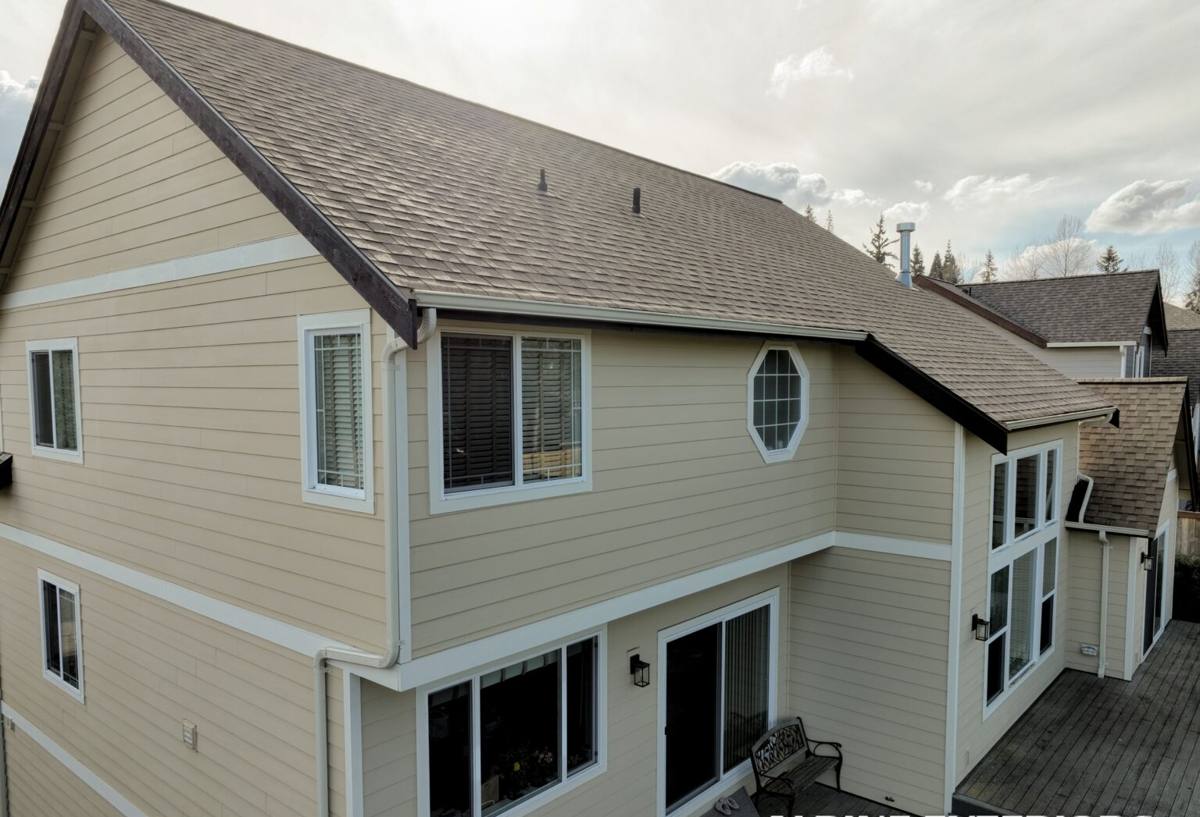
What Salt Air, Driving Rain, and Moss Actually Do to Siding
Salt Air and Corrosion
Airborne salt from the bay settles on exterior surfaces and fasteners year-round. On siding materials with exposed metal fasteners, painted wood, or lower-grade composites, salt accelerates corrosion of nail heads and trim fasteners, and it breaks down paint film faster than it would a few miles inland. Over years, that shows up as rust streaking, chalky or peeling paint, and soft spots where moisture has found a way in behind a failing finish.
Driving Rain and Wind
Storms coming off the Strait of Georgia and the Salish Sea don't just fall straight down — wind pushes rain sideways into wall assemblies, especially on west- and southwest-facing elevations. Any gap in flashing, caulk, or panel overlap becomes an entry point. Siding that relies heavily on sealant to stay watertight, rather than on proper lapping and flashing, tends to fail first in exactly this kind of exposure.
A Long Moss Season
Whatcom County's wet season runs long, and shaded, north-facing walls in tree-covered lots like many in Laurel rarely get a chance to fully dry out between rains. That's ideal for moss, algae, and mildew growth on siding surfaces. Beyond the cosmetic green-black staining, moss holds moisture against the wall longer than bare siding would, which matters most for materials that are sensitive to sustained dampness.
Why Fiber Cement Holds Up Where Other Materials Struggle
Every siding material handles this climate differently. The table below reflects general, well-established trade-offs — not brand-specific marketing claims.
| Material | Salt Air / Moisture | Moss & Algae Resistance | Long-Term Maintenance |
|---|---|---|---|
| Fiber Cement (James Hardie) | Non-combustible, dimensionally stable, resists moisture-driven warping | Factory finish resists staining better than bare wood; still needs periodic washing | Repaint cycle much longer than wood; ColorPlus finish reduces repainting need |
| Cedar / Primed Wood | Absorbs moisture, prone to swelling and rot at exposed edges | Porous surface holds moisture — moss and mildew take hold faster | Frequent repainting/staining, edge sealing, rot repair |
| Vinyl | Won't rot, but can warp or crack in temperature swings and impact | Smooth surface sheds algae somewhat better, but seams trap grime | Low maintenance but limited repair options; fades over time |
| LP SmartSide (engineered wood) | Wood-based core is more moisture-sensitive than true fiber cement | Requires diligent caulking and paint maintenance to prevent edge swelling | Moderate; edge sealing and paint upkeep is critical in wet climates |
Fiber cement's core advantage in a climate like Laurel's is stability. It doesn't absorb and release moisture the way wood-based products do, so it doesn't swell, cup, or split along its edges the way wood siding and some engineered wood products can after repeated wet-dry cycles. It's also non-combustible, which matters increasingly as wildfire smoke and dry-season risk become part of Pacific Northwest summers even in wetter coastal counties.
Why We Only Install James Hardie
We install James Hardie fiber cement exclusively — not LP SmartSide, not vinyl, not Cemplank or Allura, not primed spruce or cedar. That's a deliberate standard, not a sales preference, and it's worth explaining honestly.
LP SmartSide and similar engineered wood products can perform well when installed and maintained carefully, and they cost less upfront. But their wood-strand core is more sensitive to sustained moisture exposure than true fiber cement, which means the margin for error on caulking, flashing, and repainting schedules is smaller — and in a climate that stays wet for months at a stretch, that margin matters. Vinyl avoids rot entirely but can look and perform inconsistently in strong coastal wind and temperature swings, and it offers far less design flexibility. Bare or primed wood siding requires the most ongoing maintenance of any option and is the most exposed to moss, rot, and salt-driven paint failure.
James Hardie's HZ5 product formulation is engineered specifically for Pacific Northwest-type climates — colder, wetter regions where moisture cycling and freeze-thaw are real factors. Combined with the factory-applied ColorPlus finish, which is baked on under controlled conditions rather than field-painted, it holds color and resists the chalking and peeling that salt air accelerates on site-painted surfaces. James Hardie also backs its siding with a substantial, transferable limited warranty — useful if you sell the home before the siding's service life is up, which is common in a desirable area like Semiahmoo.
What a Correct Fiber Cement Installation Actually Involves
Fiber cement is only as good as its installation. Most siding failures we see on older homes in this area trace back to installation shortcuts, not the material itself. A correct job includes:
- A continuous water-resistive barrier behind the siding, properly lapped shingle-style so water is directed outward and down, never trapped behind the panels.
- Correct flashing at every window, door, roofline intersection, and horizontal trim piece — this is where driving rain finds its way in if it's skipped or done loosely.
- Proper fastening — hand-driven or pneumatic nails set to Hardie's specified depth and pattern, not overdriven (which cracks the board's edge) or underdriven (which lets the board move and eventually crack).
- Correct clearance from grade, roof lines, and decks — Hardie specifies minimum gaps to keep the bottom edge of the siding from sitting in standing water or snow.
- Caulked and sealed joints only where Hardie's install guide calls for sealant — not as a substitute for proper flashing and lapping.
- Painted or factory-finished cut edges on every field cut, since an unsealed cut edge is the fastest way for moisture to enter a fiber cement panel.
Skipping any one of these doesn't usually cause an immediate problem — it shows up two, five, or ten years later as staining, soft trim, or a section of siding that's failed while the rest of the wall is fine. That delayed failure pattern is exactly why installation quality matters more than the product spec sheet.
Our Process for Laurel Fiber Cement Projects
- On-site assessment. We look at your home's exposure — which walls take the worst of the wind-driven rain, where moss and staining are already showing, and where existing flashing or trim needs attention beyond just the siding itself.
- Product and color selection. We walk through James Hardie's HZ5 lines and ColorPlus palette options suited to this climate and to Laurel's mix of home styles.
- Written estimate. A clear scope covering removal of existing siding (if applicable), water-resistive barrier and flashing work, board installation, and trim.
- Installation to manufacturer spec. Every step above — barrier, flashing, fastening, clearances, sealed cut edges — done to James Hardie's published installation requirements, which is also what keeps the manufacturer warranty intact.
- Final walk-through. We review the completed work with you before calling the job done.
Maintaining Fiber Cement Siding in This Climate
Fiber cement is low-maintenance compared to wood, but "low-maintenance" isn't "no-maintenance" — especially with Laurel's moss season and salt exposure. A simple annual routine goes a long way:
- Rinse siding gently once or twice a year, focusing on shaded, north-facing walls where moss and algae take hold first.
- Inspect caulking around windows, doors, and trim annually and re-caulk any joints that have cracked or pulled away.
- Trim back vegetation and tree cover that keeps walls shaded and slow to dry.
- Check gutters and downspouts before the wet season — misdirected roof runoff onto siding is a common, avoidable cause of localized staining and moisture problems.
- Watch fastener heads and trim corners for early rust streaking, which can signal a fastener issue worth addressing before it spreads.
What Affects the Cost of a Fiber Cement Siding Project
| Cost Factor | Why It Matters in Laurel |
|---|---|
| Existing siding removal | Tear-off of old wood or vinyl adds labor and disposal costs versus siding over a prepped surface |
| Home size and wall complexity | Multiple gables, dormers, and trim details increase both material cuts and flashing work |
| Water-resistive barrier condition | Homes with damaged sheathing from prior moisture intrusion may need repair before new siding goes on |
| Siding profile and finish | Lap width, texture, and ColorPlus color selection affect material cost |
| Trim and accessory work | Corner boards, window trim, and fascia work are often bundled with a siding project |
We give straightforward written estimates rather than vague ranges, because every Laurel home's exposure, existing condition, and complexity is different.
Why It Matters to Hire a Crew That Already Works This Coastline
Installation manuals are the same everywhere, but judgment calls on site aren't. A crew that regularly works homes in Laurel and around Semiahmoo already knows which elevations typically take the worst wind-driven rain, how much clearance to leave given local moss and moisture patterns, and what existing sheathing damage from salt-air exposure tends to look like before it's fully visible. That local pattern recognition is what separates a fiber cement installation that looks fine on install day from one that's still performing correctly a decade later.
If you're weighing siding options for a home in Laurel or elsewhere around Semiahmoo, we're happy to take a look and talk through what your specific walls, exposure, and existing siding condition actually call for. Reach out for a free, no-pressure estimate using the form below.