 Semiahmoo Exterior
 Why Bellingham Decks Wear Out Faster Than the Manuals Say
Every deck manufacturer publishes a lifespan estimate, and almost none of those numbers were calculated with Whatcom County weather in mind. Bellingham sits close enough to the water that salt-laden air reaches framing and fasteners long before most inland homeowners would expect any corrosion at all. Add in months of driving rain that drives moisture sideways under railings and ledger boards, then a long stretch of low sun angles and shade that lets moss and algae colonize any surface that doesn't dry out fully between storms, and you have a climate that is genuinely hard on outdoor structures. A deck built to a generic national spec will often show real problems five to eight years sooner here than the same deck would in a drier region.
That's not a reason to panic about your deck — it's a reason to be specific about how a replacement deck for this area needs to be built, and to be honest about what "just replace the boards" actually fixes versus what it doesn't.
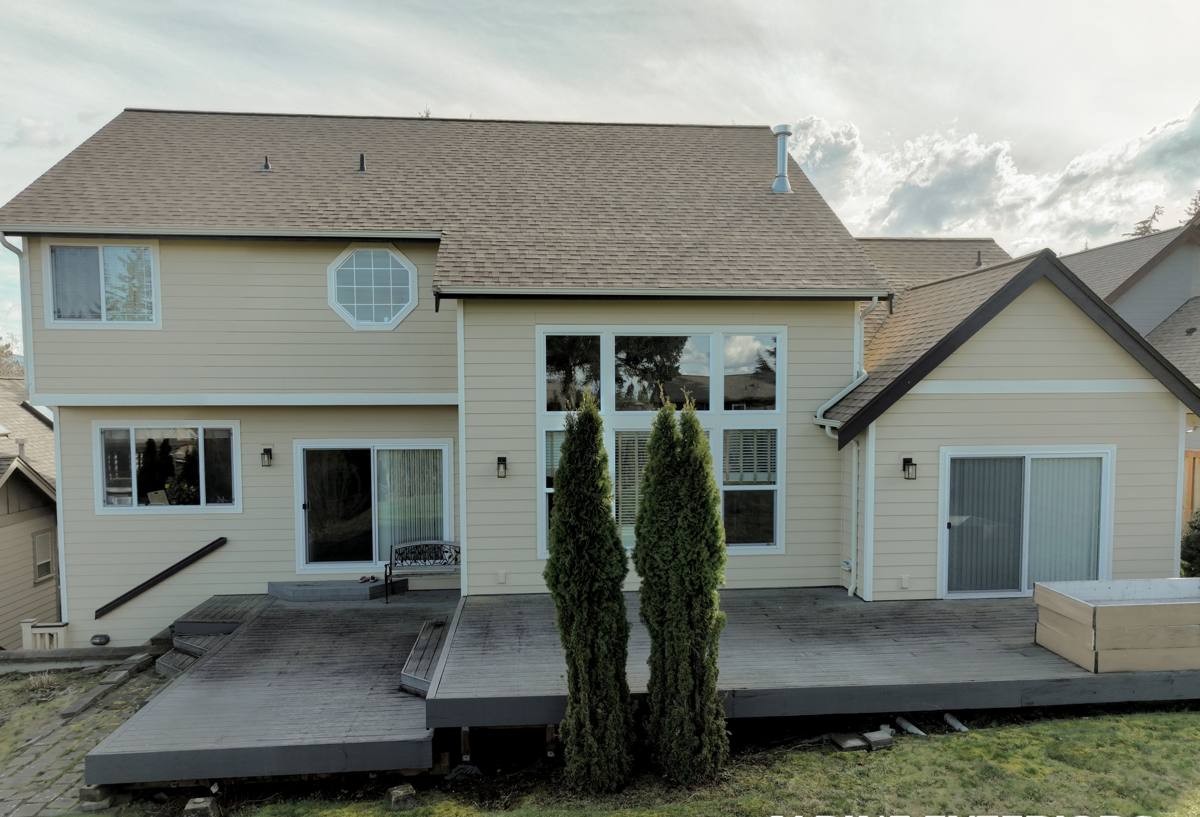
What "Replacement" Should Actually Mean
We draw a hard line between resurfacing and true replacement, because homeowners are often sold one when they need the other.
Resurfacing
New decking boards go down on the existing frame. This is a legitimate, lower-cost option when the substructure — joists, beams, posts, ledger connection — is still sound and was built correctly in the first place. It does nothing to fix a compromised frame.
Full Replacement
The deck comes off down to (and often including) the ledger and framing, and is rebuilt from the connection to the house outward. This is what we recommend whenever there's any doubt about the frame's condition, because in this climate, hidden rot at the ledger or post bases is the single most common reason decks fail structurally — and it's invisible from the surface.
Part of our estimate process is telling you honestly which one your deck actually needs. We don't upsell a full rebuild when resurfacing is sound, and we don't recommend resurfacing over a frame we don't trust.
The Ledger Connection: Where Most Failures Start
The ledger board — where the deck attaches to the house — is the single point most responsible for catastrophic deck failures nationwide, and it's also the point most exposed to the exact conditions Bellingham gets a lot of: water running down siding, driven by wind, finding its way behind the ledger and into the house's wall framing. A correct ledger installation uses proper flashing that sheds water away from the house, not just caulk or sealant as the only barrier (sealant fails; flashing doesn't rely on adhesion to keep water out). On a full replacement, we always address ledger flashing correctly, even when it means more work than the visible deck surface would suggest.
If your existing deck was built without proper ledger flashing — which was common practice in older construction and still shows up on decks we're asked to replace — that alone is a reason to do a full rebuild rather than a resurface, regardless of how the boards on top look.
Signs Your Deck's Frame Is the Real Problem
- Soft or spongy spots when you walk the deck, especially near the house
- Visible gaps or rust streaking where the ledger meets the siding
- Posts that feel loose or have visible checking (splitting) at the base
- Persistent moss or dark staining on the underside of the deck that never fully dries
- Fasteners that are rusted, backing out, or were never corrosion-rated to begin with
- A railing that flexes noticeably when leaned on
Material Choices for This Climate
There's no universally "best" decking material — there's a best fit for your budget, maintenance appetite, and how much sun versus shade the deck actually gets. In a region with this much rain and moss pressure, drainage and surface texture matter as much as the material itself.
| Material | How It Handles Bellingham's Climate | Maintenance Reality |
|---|---|---|
| Pressure-treated wood | Affordable, structurally solid when detailed correctly; needs consistent sealing to resist the wet/dry cycling that drives checking and rot | Annual inspection, re-sealing every 1-3 years |
| Cedar | Naturally rot-resistant and handles moisture well, but still needs finish maintenance to keep its color and resist moss uptake in shaded areas | Sealing/staining every 2-3 years |
| Composite decking | Doesn't rot or splinter; performance in constant damp shade depends heavily on the board's surface texture — smoother, well-drained profiles resist moss far better than deeply grooved ones | Periodic cleaning; no sealing required |
| PVC decking | Fully moisture-proof board itself; still requires correct framing and drainage underneath, since the frame is wood on most builds regardless of decking material | Low; occasional cleaning |
Whatever material you choose, the framing underneath is almost always pressure-treated lumber, and its longevity depends far more on airflow and drainage design than on the species or brand stamped on it.
Fasteners and Hardware: The Detail That Actually Matters Most
Salt air corrodes standard fasteners faster than most homeowners realize, and a deck is only as strong as its weakest connection. We use corrosion-rated structural hardware — hangers, screws, post bases — rated for the specific type of treated lumber and coastal exposure involved, not generic hardware-store fasteners. This is a case where the visible part of the job (the decking surface) can look identical whether it was done right or not, and the difference only shows up years later when hardware that wasn't rated for the exposure starts to fail.
Drainage and Airflow: Designing Out Moss Season
Moss doesn't grow because a deck is old — it grows because a surface stays damp longer than it should. A well-built replacement deck fights that on purpose:
- Proper board spacing so water drains through rather than pooling
- Joist spacing and blocking that don't trap standing water against the frame
- Enough clearance and skirting design underneath to let air actually move, so the underside dries out between rain events instead of staying wet for weeks
- Post bases set to keep end grain off standing water or damp soil contact
None of this is visible once the deck is finished, which is exactly why it's worth asking your contractor how they're handling it before the build starts, not after.
Our Process for a Bellingham Deck Replacement
- On-site assessment — we check the ledger connection, post bases, and framing condition, not just the surface boards, and tell you honestly whether you need a resurface or a full rebuild.
- Design and material selection — sized to your budget and how much sun, shade, and moisture exposure your specific yard gets.
- Permitting — deck replacements involving structural framing changes typically require a permit through the local building department; we handle that coordination.
- Demolition and disposal — old decking and, on full replacements, the old frame come out cleanly.
- Framing and ledger work — built with corrosion-rated hardware and correct ledger flashing, inspected before decking goes down.
- Decking, railing, and finish — installed to the drainage and spacing standards that actually matter in this climate.
- Final walkthrough — we go over maintenance expectations specific to the material you chose.
Why a Crew That Already Works Bellingham Matters
A deck built to a generic spec sheet is a deck built for somewhere else. A crew that works Whatcom County regularly already knows which ledger details fail here, which decking surfaces hold moss in a shaded, damp yard, and which fastener grades actually hold up against salt air over a decade rather than a season. That's not something you can fully substitute with a manufacturer's installation manual written for a national audience — it's built from doing this work, in this climate, repeatedly. It also means we're not guessing at permitting expectations or showing up once and disappearing; a local crew has a reputation in the area to stand behind.
What a Fair Estimate Should Include
A trustworthy deck replacement estimate should be specific about scope, not just a single number. Before you sign anything, make sure it spells out:
- Whether the job is a resurface or a full frame replacement, and why
- What decking material, fastener grade, and hardware are specified
- Whether ledger flashing work is included
- Who pulls the permit, if one is required
- What happens to old decking and framing material — hauled away and how
- A realistic timeline that accounts for weather delays, which are common here
If your deck in the Bellingham area is showing soft spots, moss that won't quit, or you're simply past due for a straight answer on resurface versus replace, we're happy to take a look. Reach out for a free, no-pressure estimate — we'll tell you what we actually find, not just what's easiest to sell.