 Semiahmoo Exterior
 Building Decks for California Creek's Shoreline Conditions
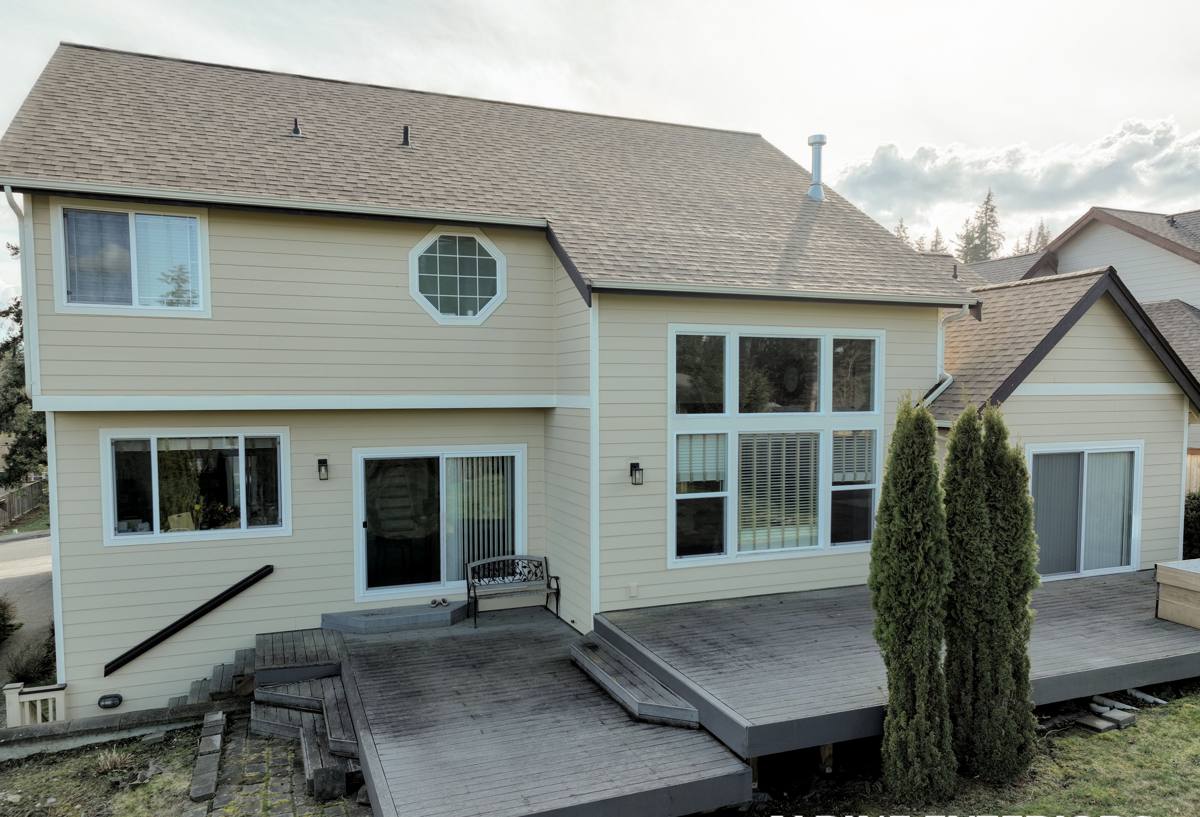
California Creek sits close enough to the water that every outdoor structure on a property has to answer to salt-laden air, wind-driven rain, and a moss season that can stretch from fall well into spring. A deck built to a generic spec sheet — the kind that assumes a dry inland climate — will show its age here faster than almost anywhere else in Whatcom County. Fastener corrosion, soft spots at ledger boards, and slick, moss-covered boards are not "eventually" problems in this area. They're a first-winter problem if the deck wasn't built for the site.
We build decks in and around Semiahmoo with that reality as the starting point, not an afterthought. That means material choices, fastener grades, drainage details, and ledger flashing all get selected for a marine climate rather than borrowed from a build sheet meant for a drier region.
What Salt Air Actually Does to a Deck
Salt air is corrosive to bare and low-grade coated metal, and a deck has a lot of metal in it that homeowners never see: joist hangers, structural screws, ledger bolts, post bases. Once corrosion starts on a hidden connector, the deck can look fine on the surface while losing real structural capacity underneath.
- Standard electro-galvanized fasteners and hangers corrode noticeably faster within a few miles of saltwater than they do inland.
- Corrosion is often invisible until a connector is loaded past what corroded metal can handle — inspection matters, not just appearance.
- Mixed metals (the wrong screw in the wrong hanger) can accelerate corrosion through galvanic reaction, which is a common mistake on decks not built specifically for coastal exposure.
Our standard for California Creek work is stainless steel or heavy-duty coated hardware rated for coastal/marine exposure on every structural connection — hangers, post bases, and ledger fasteners — not just the visible deck screws. It costs more up front than builder-grade hardware. It's also the single biggest factor in whether a deck's frame is still sound in fifteen years.
Driving Rain and Where Decks Actually Fail
Most deck failures we see in this climate don't start in the decking boards — they start at the ledger board, where the deck attaches to the house. Wind-driven rain pushes water sideways and upward, past the kind of simple flashing that works fine in calmer, drier regions. Once water gets behind the ledger and into the rim joist or wall framing, you get rot that's hidden behind the siding until it's a serious repair.
The ledger and flashing details that matter here
- Proper ledger flashing that sheds water forward, away from the house, not just a bead of caulk behind the board.
- A gap or drainage plane between the ledger and the wall sheathing so any water that does get behind can escape instead of pooling.
- Through-bolted ledger connections sized for wind and structural load, not just nailed or screwed on.
- Careful integration with existing siding and house wrap so the deck doesn't create a new path for water to enter the wall assembly.
Beyond the ledger, deck framing itself needs a real drainage strategy — slight slope away from the house, joist tape or equivalent protection on top of joists, and gapping between boards sized for the decking material so water moves off the deck instead of sitting in the wood.
Moss Season and Surface Safety
A long moss season is one of the most underestimated hazards on a coastal deck. Shaded areas, north-facing decks, and anything under tree cover can stay damp for months, and moss on a walking surface is genuinely dangerous — it's slick even when it doesn't look wet. Homeowners in California Creek often tell us moss is their biggest ongoing frustration with an older deck, more than fading or splintering.
How we design against moss, not just clean it later
- Decking profiles and finishes that shed water and dry faster between rain events, rather than trapping moisture in grooves or textured grain.
- Board spacing calculated for the material, so debris and moisture don't pack into narrow gaps and hold dampness against the wood.
- Layout choices — where practical — that reduce deep shade pockets where moss establishes first.
- Honest guidance on maintenance expectations for the specific material chosen, since every decking option needs some seasonal upkeep in this climate; the difference is how much and how often.
Choosing a Decking Material for This Site
There's no single "best" decking material for every California Creek property — it depends on sun exposure, tree cover, budget, and how much upkeep the homeowner wants to take on. What we won't do is recommend a product or install method just because it's cheaper or faster if it's a poor match for a shaded, damp, salt-exposed site. That's a maintenance headache and sometimes a safety issue we'd rather flag honestly up front.
| Material | How it handles this climate | Maintenance reality |
|---|---|---|
| Pressure-treated wood | Affordable, needs consistent sealing to resist moisture and salt exposure | Annual or biannual cleaning/sealing; more moss-prone if shaded |
| Cedar | Naturally rot-resistant, ages gracefully but still needs finish upkeep near saltwater | Periodic staining/sealing to maintain both looks and protection |
| Composite decking | Very good moisture resistance, consistent performance in wet, shaded areas | Low upkeep, but still needs cleaning — moss can grow on any surface if it stays damp |
| PVC decking | Excellent moisture and rot resistance, no wood fibers for moss to take hold in | Lowest maintenance, higher upfront cost |
Whatever material a homeowner chooses, the framing and fastener standards described above stay the same. The decking surface is what you see; the frame and connectors are what determine whether the deck is still safe to stand on a decade from now.
What a Correct Deck Build Actually Involves
A deck that's built right for this part of Whatcom County involves more steps than a lot of homeowners expect, especially on ledger-attached decks near the water. Here's the process we follow on California Creek projects:
- Site assessment — sun exposure, shade patterns, existing drainage, soil conditions, and how exposed the site is to wind-driven rain off the water.
- Design and material selection — matched to the site's actual exposure, not a one-size-fits-all default.
- Permitting — most deck work at this scale requires a permit; we handle that process rather than leaving it to the homeowner.
- Footings and framing — sized and positioned for local frost depth and soil conditions, with corrosion-resistant hardware throughout.
- Ledger attachment and flashing — the step where most long-term failures start if it's rushed, done with proper flashing and through-bolted connections.
- Decking installation — spacing and fastening matched to the chosen material's expansion, contraction, and drainage needs.
- Railing and finish work — including any code-required guarding for height and stair details.
- Final walkthrough — where we go over maintenance expectations specific to the material and site, so there are no surprises the first wet season.
Repair, Rebuild, or Full Replacement
Not every deck in California Creek needs to be torn out. Some just need corroded hardware replaced, a ledger reflashed, or a section of rotted framing repaired. Others — especially older decks built before coastal-grade hardware was standard practice, or ones with visible ledger separation, soft framing, or persistent rot — are past the point where patching makes sense.
We'll give a straight answer on which category a deck falls into. If a repair genuinely solves the problem, we'll say so. If the underlying framing is compromised, we'll explain why a rebuild is the safer and more cost-effective path over time, rather than sinking money into a structure that's already lost integrity.
Why Local Experience on This Shoreline Matters
Building decks correctly near saltwater isn't intuitive if a crew's regular work is inland. The flashing details, hardware grades, and drainage planning described above come from working this specific stretch of coastline repeatedly, seeing which details hold up and which ones fail early. A crew that already works in and around Semiahmoo has seen how California Creek properties age in this climate — which decks are still solid after a decade and which ones needed early intervention — and builds accordingly from day one instead of learning it the hard way on a homeowner's project.
If you're planning a new deck, or dealing with an aging one showing early signs of trouble in California Creek, we're happy to take a look and talk through what your specific site actually needs. Reach out for a free, no-pressure estimate using the form below.