 Semiahmoo Exterior
 Siding in Custer: A Different Set of Rules Than Inland Homes
Custer sits close enough to the water that homes here live under a different climate load than a house twenty miles inland in Whatcom County. Salt-laden air drifts off the Semiahmoo Bay area, driving rain comes in sideways during fall and winter storms, and the long, gray, low-sun season that stretches from October through April keeps north and shaded walls damp for weeks at a time. Siding that would hold up fine in a drier eastern Washington town gets tested constantly out here — and it shows on the homes where the wrong product or a shortcut installation was used.
We work Custer regularly, alongside the rest of the Semiahmoo area, and the patterns repeat house after house: caulk failing at butt joints, paint chalking and peeling on the weather side, moss creeping up from grade on shaded elevations, and in older vinyl or wood-sided homes, soft trim boards where water has been getting behind the cladding for years without anyone noticing until it's a repair job instead of a maintenance item.
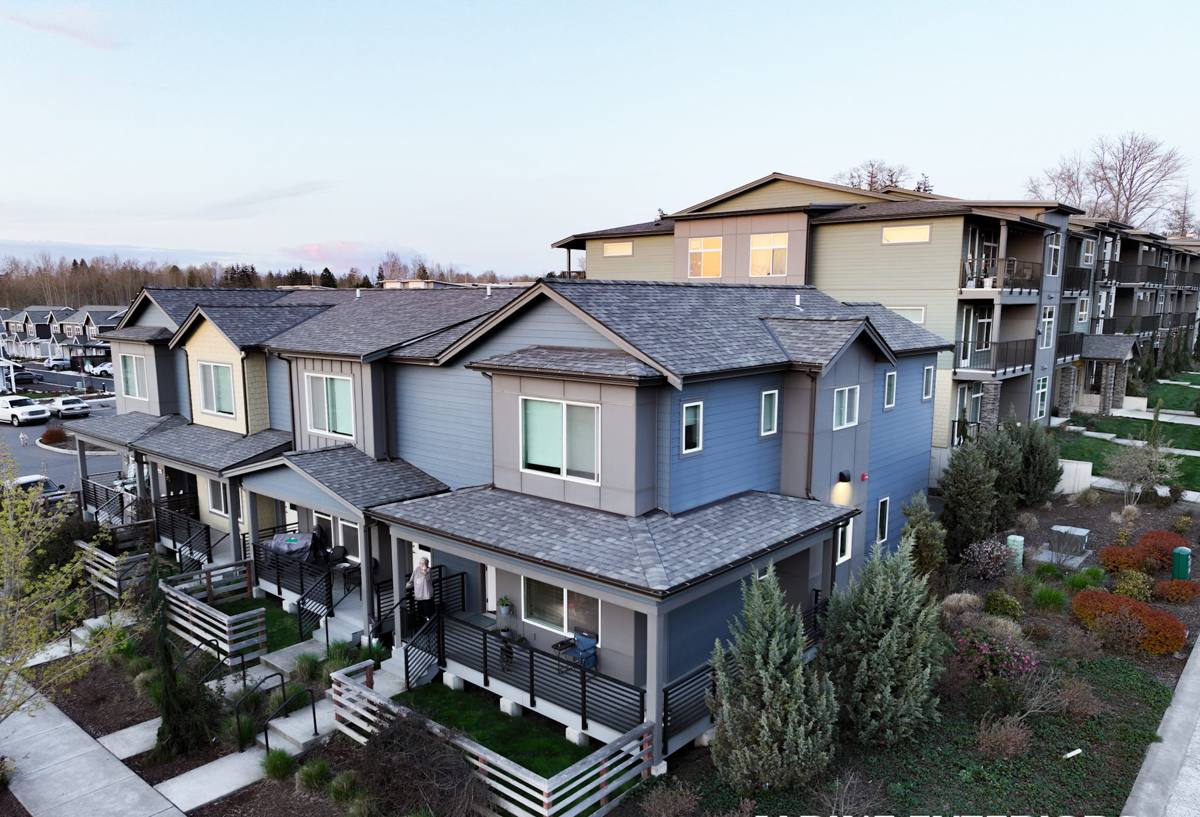
What Custer's Climate Actually Does to Siding
Salt Air
Proximity to Semiahmoo Bay means airborne salt settles on exterior surfaces more than it would further inland. Salt is hygroscopic — it pulls moisture out of the air and holds it against whatever surface it's sitting on. Over years, that accelerates corrosion on unprotected metal fasteners and trim, and it stresses paint and caulk faster than a dry climate would.
Driving Rain
Storms off the water don't just fall straight down — they push rain sideways into wall assemblies, which puts far more stress on the seams, laps, and penetrations of a siding system than a calm vertical rain does. A house-wrap and flashing detail that's "good enough" in a sheltered inland lot can be inadequate on a more exposed Custer lot.
Moss Season
Whatcom County's wet season runs long, and shaded north and east walls near trees or fences stay damp long enough for moss and algae to take hold. Moss holds moisture against the siding surface, and on a product that isn't dimensionally stable or properly sealed, that sustained dampness is where rot and swelling start.
Why This Matters More at Installation Than at Product Choice
Homeowners often assume the siding material is the whole decision. In practice, in a climate like this one, installation detail carries as much weight as the product itself. The same siding product installed correctly on one Custer home and installed with shortcuts on the house next door can age a decade apart. The details that matter most in this climate:
- Weather-resistive barrier lapped correctly, shingle-style, so water sheds outward at every seam
- Flashing at every horizontal penetration — windows, doors, hose bibs, electrical, deck ledgers
- Proper starter strip and clearance at the base of the wall so splash-back and grade moisture don't wick into the siding
- Correct fastener spacing and depth — over-driven nails crack the board's factory finish and create a moisture entry point
- Butt joints caulked and, where possible, backed with flashing rather than caulk alone
- Minimum clearance maintained between the siding's bottom edge and roof lines, decks, and grade
Skip any one of those on a Custer home and the climate will find it — usually within a few wet seasons, not decades.
What We Install and Why
We install James Hardie fiber cement siding exclusively. We don't install vinyl, LP SmartSide, Cemplank, Allura, primed spruce, or cedar, and that's a deliberate standard, not a lack of options. Fiber cement is non-combustible, dimensionally stable in wet-dry cycling, and holds up to salt air and driving rain without the swelling, warping, or repeated repainting cycles that wood-based and some engineered products need in this exact climate.
Hardie's ColorPlus factory finish is baked on and warranted separately from the substrate, which matters directly for a house dealing with the paint-stressing combination of salt air and UV. Hardie also engineers its HZ5 product line specifically for regions with sustained damp exposure — Whatcom County falls squarely into that category, and it's the specification we install here rather than a generic HZ10 product meant for drier, hotter climates.
Product Comparison for This Climate
| Factor | James Hardie Fiber Cement (HZ5) | Vinyl | Wood / LP-Type Composite |
|---|---|---|---|
| Salt air resistance | High — non-organic substrate, factory-sealed finish | Moderate — can chalk and become brittle over time | Lower — organic material, coatings degrade faster near salt |
| Driving-rain performance | Strong when flashed and lapped correctly | Moderate — laps can allow wind-driven infiltration | Depends heavily on coating maintenance |
| Moss/moisture on shaded walls | Doesn't swell or rot; surface can be cleaned | Doesn't rot but can trap moisture behind panels | Vulnerable — moisture is the primary failure driver |
| Fire resistance | Non-combustible | Combustible | Combustible |
| Repaint cycle | Long — factory finish, warranted separately | N/A (color is through-body, can fade/chalk) | Shorter — field-applied coatings weather faster |
How the Job Actually Runs
1. Walkthrough and Assessment
We walk the home's elevations and note the exposure differences — which walls face the weather side, which stay shaded and damp longer, where the existing moisture damage (if any) already is. This is where we catch soft sheathing or trim before it becomes a surprise mid-project.
2. Tear-Off and Sheathing Check
Old siding comes off and the sheathing underneath gets inspected. In a climate that's been putting moisture pressure on this house for years, this step is non-negotiable — covering up compromised sheathing with new siding just hides the problem for a few more years.
3. Weather Barrier and Flashing
New house-wrap goes on lapped correctly, and flashing gets installed at every window, door, and penetration before the first piece of siding goes up. This is the step that determines whether the house handles the next twenty years of driving rain or not.
4. Hardie Installation to Spec
Boards are installed with manufacturer-specified clearances, fastener patterns, and joint treatment — the details covered above. We don't deviate from Hardie's installation instructions because doing so can void the product warranty and, more importantly, because those instructions are written for exactly this kind of climate.
5. Final Walkthrough
We review the finished work with the homeowner, including care and maintenance points specific to a Custer property — where moss is likely to show up first, what to watch for after the first hard storm season.
Why a Crew That Already Works Custer Matters
A crew that's only worked drier or more sheltered parts of Whatcom County can still do competent work, but they're guessing at the details that matter most here — how much flashing overlap is enough when rain comes in sideways, which elevations need extra attention for moss and shade, how salt exposure changes fastener and trim choices. A crew that already works this stretch near Semiahmoo has already made those calls on other houses like yours and knows where this climate typically finds the weak point in a lesser install.
What a Correct Custer Install Should Include — Homeowner Checklist
- Sheathing inspected and any damaged sections replaced before new siding goes on
- Weather-resistive barrier installed and lapped shingle-style, no gaps or reverse laps
- Flashing at every window, door, and wall penetration — not caulk used as a substitute
- Correct clearance maintained at grade, roof lines, and decks
- James Hardie HZ5 product specified for this climate zone, not a generic HZ10 spec
- Fasteners installed per manufacturer depth and spacing, not over-driven
- Butt joints properly treated, not just caulked and left
- Written scope that names the product line, color, and installation spec before work starts
Cost Factors for a Custer Siding Installation
| Factor | Why It Affects Cost |
|---|---|
| Home size and elevation complexity | More corners, gables, and dormers mean more cutting, flashing, and labor time |
| Condition of existing sheathing | Water-damaged sheathing found during tear-off adds repair scope |
| Siding profile chosen | Lap width, shingle-style panels, and trim details all price differently |
| Access and site conditions | Tight lots, slopes, or landscaping close to the house affect setup and staging |
| Existing trim and flashing scope | Full trim replacement versus reusing sound existing trim changes both labor and material cost |
Every Custer property is different, and the honest answer to "what will this cost" only comes after we've actually looked at the house. We'd rather give you a real number based on your walls than a range that doesn't mean much either way.
If you're weighing a siding project on a Custer home, we're happy to come take a look, walk the elevations with you, and put together a straightforward, no-pressure estimate — just fill out the form below to get started.