 Semiahmoo Exterior
 Building Decks for Custer's Climate, Not a Catalog Photo
Custer sits close enough to the water that salt air is a daily fact of life, not an occasional nuisance. Add Whatcom County's long wet season, driving rain off the Strait, and months where moss and algae never fully stop growing, and you've got a set of conditions that will find every weak point in a deck within a few years if it wasn't built with those conditions in mind. A deck plan that works fine in a dry inland climate can start failing here well before its time — soft framing, corroding fasteners, slick decking, railings that loosen at the posts.
We build decks in Custer the way this specific environment demands: materials chosen for moisture and salt exposure, fasteners rated for it, drainage and airflow designed in from the start, and a finished surface that stays usable and safe through a Whatcom County winter. This page covers what that actually looks like — not generic deck-building advice, but what we've found matters for homes in this particular area.
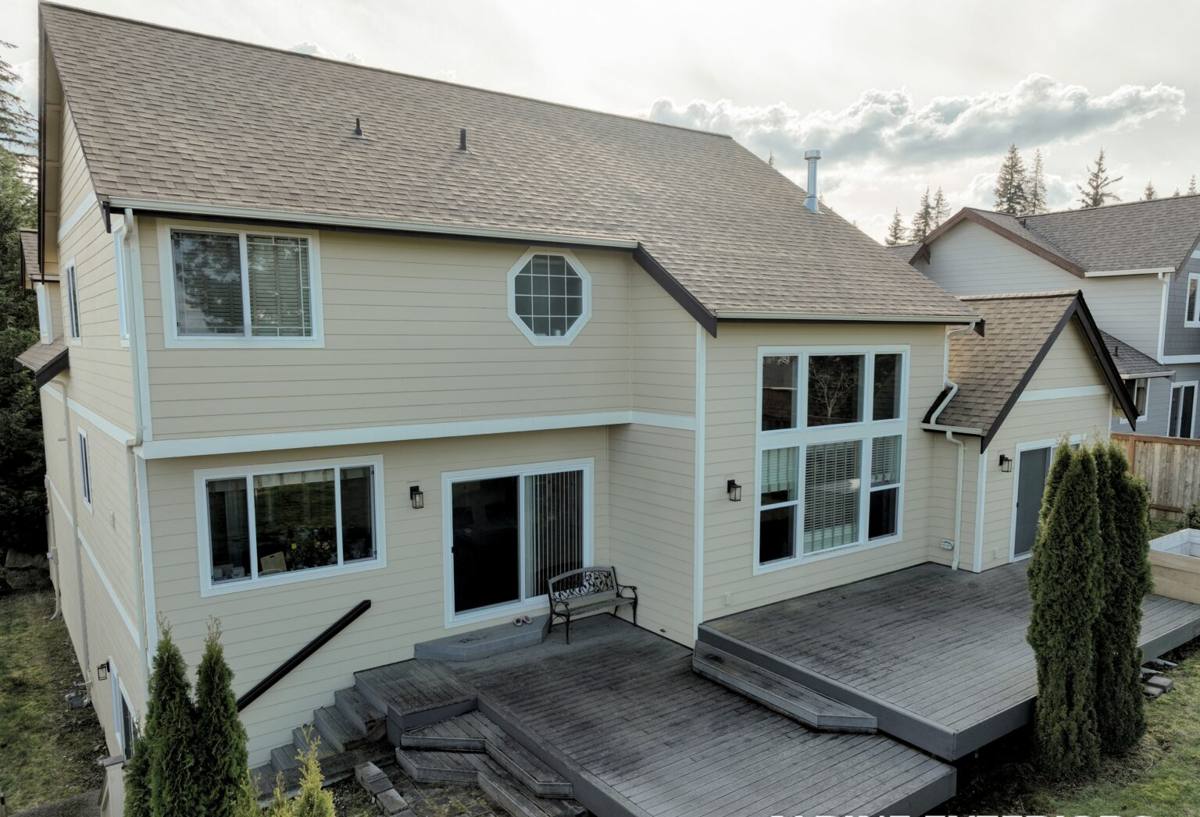
What Salt Air and Moss Season Actually Do to a Deck
It helps to understand the failure pattern before talking about the fix. Three things do most of the damage locally:
Salt Air and Corrosion
Airborne salt accelerates corrosion on any exposed metal — fasteners, brackets, hinges, railing hardware. Standard hardware that would last decades inland can start rusting and staining the wood around it in a few seasons this close to the water. Once a fastener corrodes, it loses holding strength long before it looks obviously bad, which is part of why deck hardware failures often catch homeowners by surprise.
Driving Rain and Trapped Moisture
It's rarely just rain — it's rain pushed sideways by wind, which finds its way into joints, ledger connections, and end grain that a calmer climate wouldn't stress nearly as hard. Wood that can't shed or dry out between storms starts to rot from the inside, often in framing members that are hidden under the decking boards where nobody looks until there's a soft spot underfoot.
Moss, Algae, and Surface Slickness
Whatcom County's moss season runs long. On decks with poor airflow underneath or boards installed too tight, moss and algae take hold on the walking surface and in the gaps between boards, turning the deck into a slip hazard and slowly breaking down whatever finish or coating was on the wood.
Choosing the Right Decking Material for a Custer Property
There's no single "best" decking material — the right call depends on how much upkeep a homeowner actually wants to do, budget, and how exposed the deck is to weather. Here's how the common options hold up under local conditions:
| Material | How It Handles Salt Air & Rain | Moss/Algae Resistance | Upkeep |
|---|---|---|---|
| Pressure-treated wood | Good if properly sealed and maintained; end grain and fastener points are the weak spots | Needs regular cleaning; textured grain holds moisture | Annual cleaning, re-sealing every 1-2 years |
| Cedar | Naturally moisture- and rot-resistant, but still needs sealing near salt air | Moderate; benefits from cleaning each spring | Sealing every 1-2 years, occasional board replacement |
| Composite decking | Very good — doesn't absorb moisture or rot | Better than wood but still needs periodic washing | Low; occasional washing, no sealing/staining |
| PVC/capped polymer decking | Excellent — fully sealed surface, no moisture absorption | Good; smooth cap sheds algae more easily than wood grain | Lowest; wash as needed |
We install all of these depending on what a homeowner wants. Composite and capped polymer boards tend to make the most sense for decks that see direct salt spray or heavy shade, since they take moisture and biological growth out of the equation almost entirely. Wood and cedar still have a place — they're often the right call for a homeowner who wants a natural look and is willing to keep up a maintenance routine — but we're honest that they ask more of the owner in this climate than they would somewhere drier.
Framing and Substructure — Where Decks Actually Fail First
The decking boards are what you see, but the framing underneath is what determines whether the deck is still safe in ten years. This is the part of the job that gets skipped or shortcut most often, and it's the part that matters most in a wet, salty climate.
- Ledger boards flashed and sealed correctly where the deck attaches to the house — the single most common source of hidden rot
- Joists and beams rated for exterior/ground contact where relevant, not just standard pressure-treated lumber used in the wrong application
- Proper spacing and airflow underneath the deck so moisture and moss don't build up in a dead zone with no ventilation
- Post bases set to keep wood off standing water, with drainage that actually directs rain away rather than pooling against footings
- Blocking and bracing sized for the deck's actual height and use, not the bare minimum to pass a quick look
A deck can look finished and still have a framing problem that only shows up years later as a soft spot, a wobble in the railing, or a board that won't stay flat. We build the substructure to the same standard as the visible surface, because that's the part that's expensive and disruptive to fix later.
Railings, Fasteners, and Hardware That Actually Hold Up
Hardware is where salt air does its quiet damage. Railings, joist hangers, and structural screws are all exposed to the same corrosive air as the rest of the deck, and cheap or mismatched hardware is often the first thing to fail — sometimes visibly, as rust streaks down the wood, and sometimes invisibly, as holding strength drops.
Our standard is to match fastener and hardware coatings to the fastener manufacturer's own rating for coastal or high-moisture exposure, and to avoid mixing metals that can react against each other and accelerate corrosion. Railings get through-bolted at the posts rather than relying only on screws, since post connections carry real load and take the brunt of wind and lean-on-the-railing pressure over time. It costs a little more up front than using whatever hardware is on the shelf, but it's the difference between a railing that's still solid in ten years and one that starts loosening in three.
How Our Deck-Building Process Works
1. On-Site Assessment
We walk the property, look at drainage, sun and shade exposure, wind direction, and how close the deck will be to salt air or standing moisture, and talk through what the homeowner actually wants to use the space for.
2. Material and Design Selection
We go over decking material options honestly — including the maintenance trade-offs above — along with railing style, layout, and any code requirements tied to height or guardrails.
3. Permitting
Deck permitting requirements depend on size, height, and attachment to the house. We handle figuring out what's required for the specific project rather than leaving the homeowner to sort that out.
4. Framing and Structural Work
This is where we spend the extra care described above — ledger flashing, joist sizing, airflow, and post/footing drainage — since it's the part that determines the deck's real lifespan.
5. Decking, Railings, and Finish
Boards, railings, and any stairs go on last, with fastener choices and spacing set to shed water and resist moss buildup rather than trap it.
6. Walkthrough
We go over the finished deck with the homeowner, including what maintenance (if any) the chosen material will need going forward.
Maintenance Realities, by Material
What a deck needs after it's built depends heavily on what it's built from. Being upfront about this before installation avoids surprises later:
- Pressure-treated wood or cedar: annual wash-down to clear moss and pollen, re-sealing every 1-2 years, and periodic inspection of fastener points for corrosion staining
- Composite decking: occasional washing to prevent surface algae, no sealing or staining required, but keep an eye on hidden framing since composite hides moisture problems underneath better than it prevents them
- PVC/capped polymer: lowest-maintenance option; wash as needed, check railing hardware periodically since hardware corrodes independently of the decking material
- All materials: keep gutters and downspouts near the deck clear so runoff isn't dumping extra water onto or under the structure
Permits and Custer-Area Considerations
Most decks attached to a house, or built above a certain height, require a permit in Whatcom County, and requirements can shift based on setback, lot coverage, and whether the property is in a shoreline or environmentally sensitive area — which is worth checking given how many Custer-area properties sit near water. We handle pulling the right permits as part of the job rather than treating it as the homeowner's problem to solve separately.
Why a Crew That Already Works Custer Matters
A lot of deck problems we get called to look at aren't from bad workmanship in the abstract — they're from a crew building to specs that make sense somewhere drier, without accounting for salt air, driving rain, and a moss season that doesn't really end. That shows up as fastener corrosion, hidden framing rot, and slick surfaces that a homeowner assumes is just normal wear.
Working regularly in this part of Whatcom County means we're not guessing at what holds up here — we've seen which fastener coatings actually last, which decking materials handle salt spray without a fight, and where drainage tends to go wrong on local lots. That local knowledge doesn't show up as a line item on an estimate, but it's the difference between a deck that needs real repair work in five years and one that's still solid in twenty.
If you're planning a new deck or replacing one that's showing its age, we're happy to come take a look and talk through what makes sense for your property — no pressure, no obligation. Reach out using the form below for a free estimate.