 Semiahmoo Exterior
 Why Blaine Decks Take More Punishment Than Most
Blaine sits close enough to Semiahmoo Bay and the Strait of Georgia that salt-laden air is a daily fact of life, not an occasional storm event. Add Whatcom County's long, wet winters and the shoulder-season drizzle that can linger into May, and you've got a climate that's genuinely tough on outdoor structures. Wood decks in this part of the county show gray, splinter, and rot faster than the same materials would fifty miles inland. Fasteners corrode sooner. Moss and algae find a foothold on any shaded or north-facing surface and don't let go.
Composite decking exists partly to solve exactly this problem, but "composite" isn't one product — it's a category with real differences in how boards handle moisture, salt exposure, and the moss and mildew that thrive in our shade and shoulder seasons. A deck built here needs to be specified and installed differently than one going in on the dry side of the state, and that's the gap a lot of homeowners don't find out about until the deck is already down.
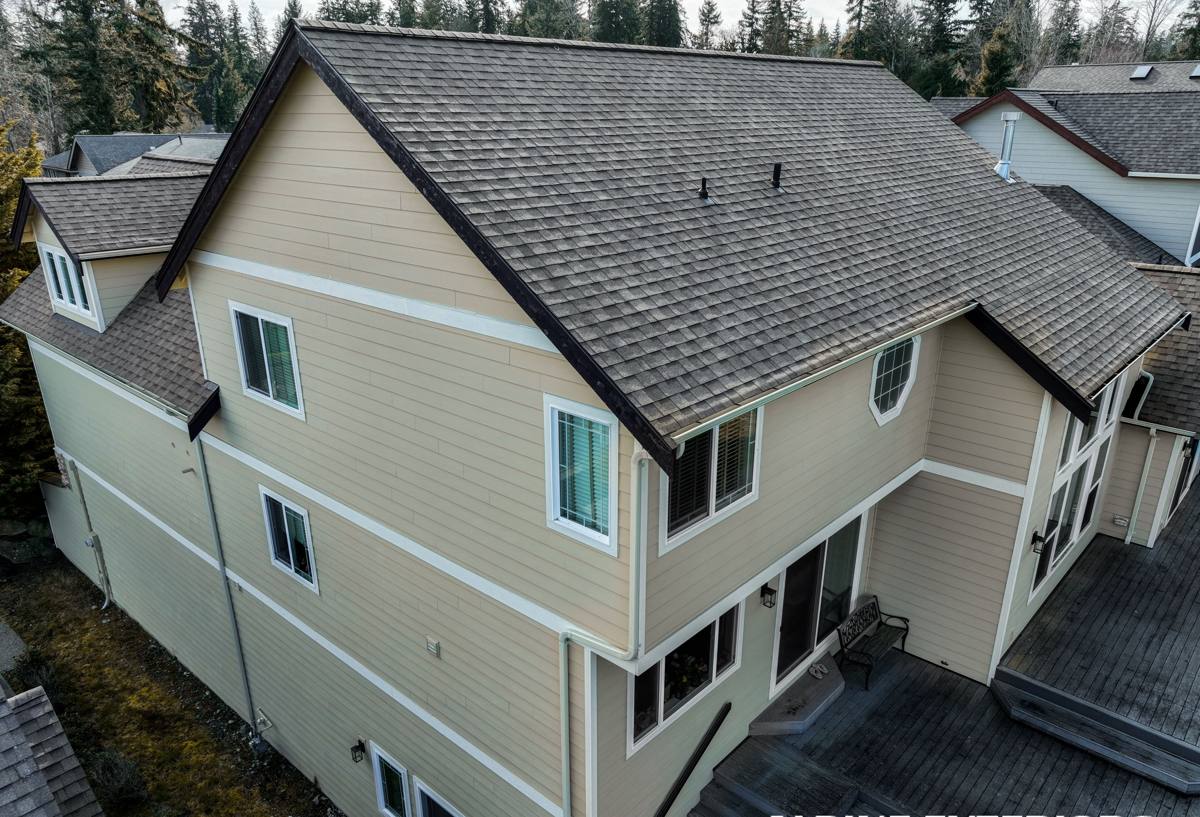
What a Blaine Climate Actually Demands From a Deck
Salt Air and Metal Fasteners
Salt in the air accelerates corrosion on anything ferrous — screws, joist hangers, brackets. On a coastal property, using standard hot-dip galvanized hardware instead of stainless or a marine-grade coated fastener is one of the most common shortcuts that shows up as rust streaks and loosening boards within a few years. This matters more for the hidden hardware than the decking itself, since a failed hanger or fastener is a structural problem, not a cosmetic one.
Driving Rain and Drainage
Whatcom County rain doesn't always fall straight down — wind off the water pushes it sideways into ledger boards, stair stringers, and the gap between decking and house siding. A deck that isn't flashed and sloped correctly at the ledger will feed water behind the siding, which is a slower and more expensive problem than anything happening on the deck surface itself. Proper drainage planning under and around the deck also keeps the substructure from sitting in standing water through the winter months.
Moss, Algae, and Shade
Decks under tree cover or on the north side of a house stay damp longer after every rain, which is exactly the environment moss and algae need. Composite surfaces vary quite a bit in how well they resist that growth and how easy they are to clean when it shows up anyway — this is one of the biggest practical differences between board lines, and it's worth more attention than color or grain pattern when you're picking a product for a shaded Blaine lot.
Composite Board Types — What's Actually Different
"Composite decking" covers a range of constructions, and the differences aren't cosmetic — they affect how the board performs in exactly the conditions Blaine deals with.
| Board Type | Moisture Behavior | Best Fit For | Trade-Offs |
|---|---|---|---|
| Capped composite (wood-plastic core, polymer shell) | Shell resists moisture and staining well; cut ends need proper sealing/capping | Most Blaine homes — good balance of cost and weather resistance | Mid-range cost; cut edges are the weak point if not detailed correctly |
| Mineral-based composite | Very low moisture absorption, dimensionally stable in wet-dry cycles | Shaded, damp, or heavy-rain-exposure areas | Higher material cost; fewer color/finish options in some lines |
| Uncapped composite | More prone to moisture absorption and surface fading over time | Budget-conscious projects with realistic maintenance expectations | We're upfront that this is not our first recommendation for a coastal lot — the moisture and mildew resistance simply isn't as strong |
| PVC/cellular decking | Effectively moisture-proof, no wood content to absorb water | Docks, waterfront-adjacent decks, high-splash zones | Different foot-feel and expansion behavior than wood-composite blends; needs its own fastening approach |
We don't push one brand or board type as a blanket answer. What matters is matching the board's real-world moisture and algae performance to where on your property the deck sits — full sun, shaded, close to the water, or tucked under eaves.
The Substructure Is Where Most Deck Failures Actually Start
A composite deck is only as good as what's underneath it, and this is the part homeowners rarely see once the job is done. In a wet coastal climate, the framing decisions matter as much as the decking choice:
- Pressure-treated or naturally durable framing lumber, rated for ground contact where joists sit close to grade
- Joist tape or a moisture barrier on top of every joist to keep water from wicking into the wood through fastener holes
- Stainless or coated fasteners and connectors throughout — not just at the ledger
- Proper joist spacing for the specific composite board being installed (composite typically needs tighter spacing than wood, and it varies by manufacturer)
- Ledger flashing that directs water away from the house, with a gap or flashing detail between deck and siding
- Airflow underneath the deck — blocked or low-clearance understructure traps moisture and speeds up rot in the framing
Skipping any one of these doesn't show up right away. It shows up in year three or four as soft framing, rusted hardware, or a deck that starts to feel spongy near the house — problems that cost far more to fix than they would have to prevent.
How We Approach a Blaine Composite Deck Build
1. Site Walk and Exposure Assessment
We look at sun exposure, wind direction, proximity to the water, drainage patterns, and existing moisture problems (peeling paint, moss on the house, soft ground) before recommending a board. A deck facing the Strait needs different detailing than one tucked on a sheltered side of the house.
2. Framing and Drainage Plan
We build or evaluate the substructure to handle standing water and salt exposure, including ledger flashing and joist protection, before a single composite board goes down.
3. Board Selection Based on Where the Deck Sits
We walk through the trade-offs above with you — moisture resistance, algae resistance, cost, and warranty structure — rather than defaulting to whatever's cheapest or most popular.
4. Fastening and Edge Detailing
Hidden fastener systems, proper board spacing for expansion, and correctly capped or finished cut ends (a common weak point where moisture gets into the board core) are done to the manufacturer's actual installation spec, not shortcuts.
5. Final Walkthrough
We go over basic care specific to your deck's exposure — what to expect from moss in the shaded corner, how the board handles the first wet winter, and what warranty coverage actually applies to your installation.
Living With a Composite Deck in Whatcom County
Composite decking is lower-maintenance than wood, not maintenance-free — that distinction matters most in a climate like ours.
- Sweep debris and standing leaves off the surface regularly through fall; trapped organic matter under leaves is what feeds moss and staining
- Rinse or wash the deck a couple times a year, more often in shaded areas, using a soft brush and a cleaner rated for composite — pressure washers can damage the surface shell if used incorrectly
- Check under-deck airflow paths seasonally to make sure they haven't been blocked by storage, plantings, or debris buildup
- Inspect visible fasteners and railing hardware yearly for rust or loosening, especially after the wet winter months
- Address moss on shaded boards early with an appropriate cleaner rather than letting it establish — it's far easier to remove when it's new
What Drives the Cost of a Composite Deck Here
| Factor | Why It Moves the Price |
|---|---|
| Board tier (capped, mineral-based, PVC) | Material cost and moisture performance scale together |
| Substructure condition | Replacing rotted or undersized framing adds cost but isn't optional on an older deck |
| Deck height and stairs | Elevated decks and multi-level stairs add framing, railing, and code requirements |
| Fastener and flashing spec | Marine-grade hardware and proper ledger flashing cost more than standard-grade materials but protect the investment |
| Site access | Waterfront or hillside lots with limited equipment access can add labor time |
We give straightforward, itemized estimates so you can see where the money is going — not a single lump number with no explanation.
Permits and Code Notes
Most deck projects in Whatcom County require a building permit, particularly for elevated structures, railings, and anything attached to the house. Requirements can vary depending on your specific jurisdiction and the size or height of the deck. We handle the permitting conversation as part of the process rather than leaving it for you to sort out separately, and we build to current code for railings, stair geometry, and structural attachment.
Why a Crew That Already Works Blaine Makes a Difference
A deck built to a generic spec sheet, without accounting for salt exposure, driving rain direction, and moss-prone shade, tends to show its age faster here than the same deck would somewhere drier and calmer. A crew that works Semiahmoo and Blaine regularly already knows which sides of a lot catch the worst weather, which board lines actually hold up under real coastal exposure over time, and which fastener and flashing details are worth the extra cost up front. That local pattern recognition is hard to get from a contractor who only occasionally works this stretch of coastline.
If you're weighing a composite deck for a Blaine property, we're happy to walk the site, talk through board options honestly — including the trade-offs, not just the upsides — and give you a clear, no-pressure estimate. Use the form below to get started.