 Semiahmoo Exterior
 Blaine's Climate Is Hard on Siding — Here's Why
Blaine sits right where Puget Sound wind, salt spray off Semiahmoo Bay, and heavy Pacific storm systems all converge on the same houses. That combination is tougher on exterior siding than most homeowners realize until they're dealing with the results: peeling paint, soft spots near the ground, streaking under gutters, and moss creeping up from the north side of the house by late fall.
Three things drive most of the siding failures we see on Blaine homes. First, salt air corrodes fasteners and finishes faster than it does even a few miles inland — homes closer to the water take the worst of it. Second, driving rain off the Strait pushes moisture sideways into seams, laps, and trim joints that were never designed to shed water at that angle. Third, Whatcom County's long wet season — often eight or nine months of the year with real moisture in the air — gives moss, algae, and mildew a long runway to establish themselves on anything that stays damp.
None of this means siding is doomed here. It means the material and the installation both have to be matched to what the site actually experiences, not to a generic spec sheet.
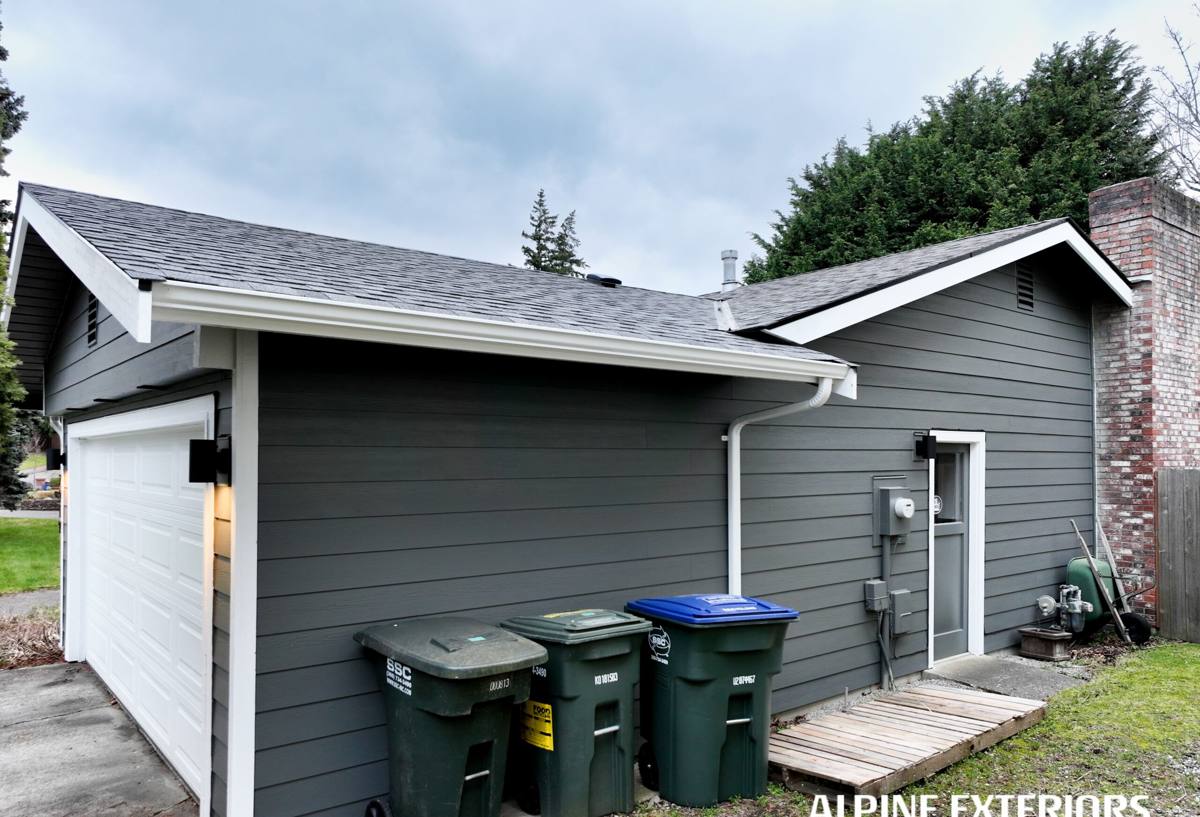
Signs a Blaine Home Needs Siding Replacement, Not Another Patch
Caulk and paint can buy time, but they don't fix a siding system that's failing underneath. Watch for these signs:
- Boards that feel soft, spongy, or give slightly when pressed near the bottom edge
- Paint that's bubbling, peeling, or won't hold no matter how often it's redone
- Visible warping, cupping, or gaps opening up at the seams
- Persistent moss or black streaking that comes back within a season of cleaning
- Musty smell or soft drywall on interior walls that share a wall line with worn siding
- Fastener heads rusting through the paint, or streaks of rust running down from nail lines
One or two of these can sometimes be addressed locally. Several at once, especially combined with visible rot at a corner or under a window, usually means the underlying material has reached the end of its useful life and a full or sectional replacement is the honest recommendation.
What a Correct Siding Replacement Actually Involves
Siding replacement isn't just pulling old boards off and nailing new ones on. In a climate like Blaine's, the work that happens between the studs and the finished siding matters as much as the siding itself.
Tear-Off and Inspection
Once the old siding comes off, the sheathing underneath gets a real look. This is where hidden rot, past water intrusion, or failed flashing usually shows up — problems that were invisible from outside. Any damaged sheathing gets replaced before anything new goes back on; covering over compromised wood just hides the problem for the next owner to find.
Weather-Resistive Barrier and Flashing
A weather-resistive barrier goes over the sheathing to manage the moisture that gets past the siding — and in a location that takes driving rain off the water, it will get past the siding eventually. Window and door flashing, kick-out flashing at roof-to-wall intersections, and proper head flashing above openings are what actually keep that moisture moving out and down instead of into the wall cavity.
Fastening and Lap Detail
Fastener spacing, lap exposure, and butt-joint treatment all affect how well the assembly sheds wind-driven rain. This is one of the most common places corners get cut — it doesn't show on day one, but it's usually the first thing to fail in year three or four.
Trim, Caulking, and Paint Line
Finish details — corner trim, caulk joints, and the factory or field-applied finish — are what stand between the assembly and the salt air day after day. Sloppy caulking or thin trim coverage is a fast track back to the same peeling and staining problems the old siding had.
Why We Install Only James Hardie Fiber Cement
We get asked regularly why we don't offer vinyl, LP SmartSide, cedar, or primed spruce alongside Hardie. It comes down to what actually holds up against salt air and sustained damp weather without turning into a maintenance job for the homeowner.
Vinyl is affordable and low-maintenance in mild climates, but it expands and contracts more than fiber cement, can crack in wind-driven debris, and its seams and J-channels give wind-blown rain more places to work its way behind the panel over time. Wood-based products like cedar or primed spruce look great initially but are organic materials in a climate that stays wet for most of the year — they need consistent, disciplined maintenance to keep moisture and rot at bay, and Blaine's moss season doesn't make that easier. Engineered wood siding closes some of those gaps but is still wood-based at its core, meaning edge and cut-end sealing has to be perfect and stay perfect for the product to perform as intended.
James Hardie fiber cement is non-combustible, dimensionally stable, and doesn't rot, feed insects, or support moss growth the way organic materials can. The ColorPlus factory finish is baked on and warrantied against fading and peeling — which matters directly here, since it's the finish taking the brunt of the salt spray, not something we're relying on field-applied paint to hold up against. Hardie's HZ5 product line is engineered for cold, wet climates like ours, and the company backs it with a strong, transferable limited warranty. It's the system we're comfortable putting our name on for houses that have to take this kind of weather year after year.
| Factor | Vinyl | Cedar / Primed Spruce | James Hardie Fiber Cement |
|---|---|---|---|
| Salt air / corrosion resistance | Fair — seams vulnerable | Poor without upkeep | Strong |
| Moisture / rot resistance | Good (non-organic) | Requires ongoing maintenance | Excellent |
| Moss / algae resistance | Moderate | Low | High |
| Finish durability | Can fade, chalk | Repaint every few years | Factory ColorPlus, long warranty |
| Fire resistance | Combustible | Combustible | Non-combustible |
Our Process, Start to Finish
- On-site assessment — we walk the exterior, check for hidden moisture damage, and talk through what's driving the need for replacement.
- Written estimate — a clear scope covering tear-off, sheathing repair (if needed), weather barrier, flashing, Hardie product line and color, and finish trim.
- Tear-off and sheathing repair — old siding removed, substrate inspected and repaired before anything new is installed.
- Weather barrier and flashing detail — the part of the job that determines how the house handles rain for the next several decades.
- Hardie installation — installed to manufacturer spec for fastening, gapping, and lap exposure suited to our wind and rain exposure.
- Final walkthrough — we go over the finished work with the homeowner before calling the job done.
What Siding Replacement Costs Depend On
We don't post fixed pricing because every Blaine home is different, but the same handful of factors drive the range on nearly every estimate:
| Factor | Why It Matters |
|---|---|
| Home size and wall complexity | More corners, gables, and dormers mean more cutting, trim, and labor |
| Condition of existing sheathing | Hidden rot found at tear-off adds repair scope |
| Siding profile and Hardie product line | Lap width, panel vs. plank, and HZ5 selection affect material cost |
| Trim and detail work | Corner boards, window casings, and fascia detail add labor |
| Access and site conditions | Steep lots, tight setbacks, or landscaping near the house affect staging |
What to Ask Before Hiring a Siding Contractor in Blaine
- Are they a certified or trained James Hardie installer, not just someone who occasionally orders the material?
- Do they inspect and repair sheathing before installing new siding, or install over whatever's underneath?
- Can they explain their flashing and weather-barrier approach in plain terms, not just "we do it right"?
- Do they carry proper licensing and insurance for exterior work in Washington?
- Will the estimate specify the Hardie product line, profile, and color — not just "siding replacement" as a line item?
- Do they have experience with homes in this specific area, dealing with this specific weather exposure?
Why It Matters That We Already Work in Semiahmoo and Blaine
A crew that installs siding across a wide range of inland climates isn't necessarily thinking about salt exposure or wind-driven rain angles specific to a shoreline community. Working Blaine and the broader Semiahmoo area regularly means we're used to detailing flashing and laps for this exposure, not treating it as an afterthought on a spec built for a drier part of the state.
It also means fewer surprises during the job itself — knowing what condition sheathing tends to be in on homes of a certain age in this area, what moss and moisture patterns to expect on north- and west-facing walls, and how to sequence work around Whatcom County's wet stretches so the house isn't left exposed longer than necessary.
Get a Free, No-Pressure Estimate
If your Blaine home is showing signs of worn-out siding — or you just want a straight answer about whether repair or full replacement makes more sense — we're happy to take a look and walk you through it. There's no obligation, and we'll give you an honest read on the condition of what's there now.