 Semiahmoo Exterior
 Why Birch Bay Siding Wears Differently Than Inland Homes
Birch Bay sits right where the wind comes off the water, and that changes what a home's exterior has to deal with year after year. Salt-laden air corrodes fasteners and finishes faster than it would a few miles inland. Driving rain off Georgia Strait and Semiahmoo Bay pushes moisture sideways into seams, laps, and trim joints that a calmer climate would never test. And the long, damp Whatcom County winters set up a moss and algae season that can run for months, keeping siding surfaces wet and organic growth active well past what homeowners further south ever see.
None of that is unusual for this part of Washington. But it does mean that a siding replacement done to a generic standard — rather than one built for this specific exposure — tends to show problems early: caulking that fails at year three instead of year ten, paint that chalks and fades on the weather-facing walls first, and moisture staining at the bottom courses where splash-back and standing dampness do the most damage.
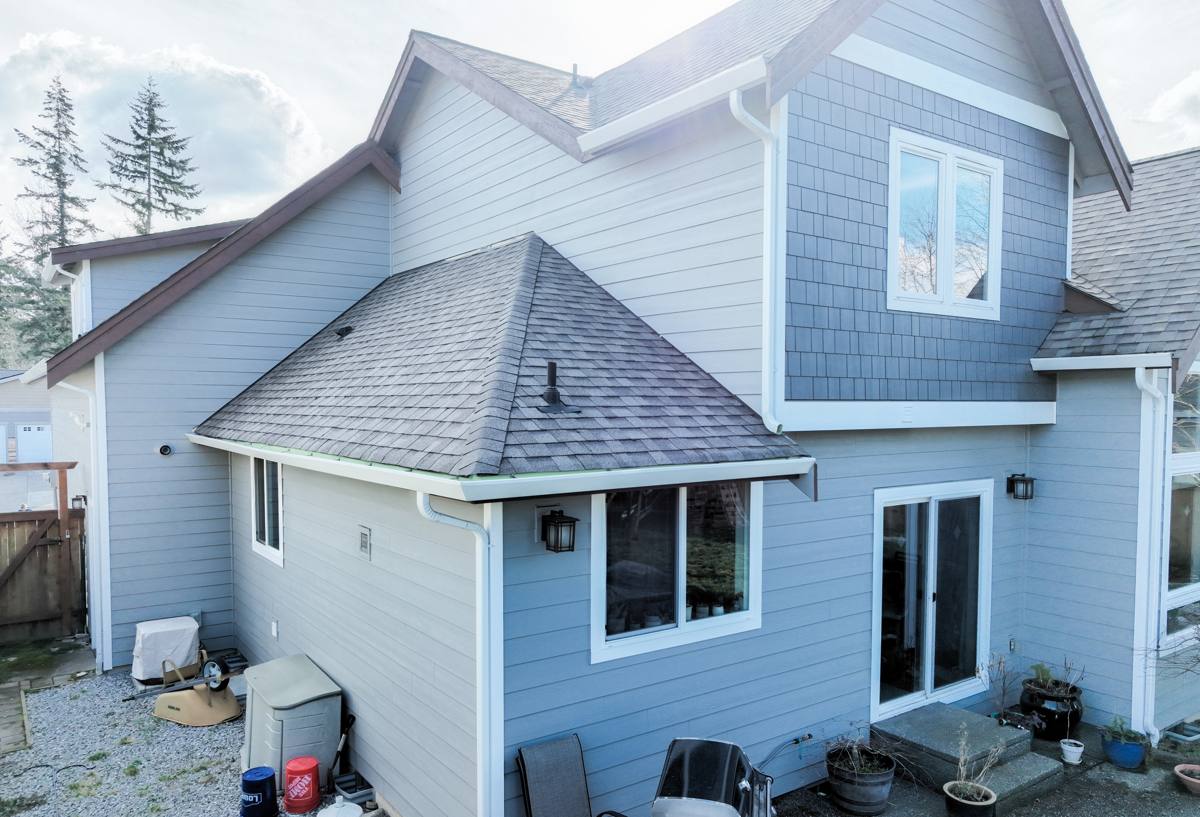
Signs a Birch Bay Home Needs Siding Replacement, Not Just Repair
Repair makes sense when the damage is isolated and the material underneath is sound. Replacement becomes the right call when the siding itself has stopped doing its job as a weather barrier. Common signs we see on Birch Bay homes include:
- Soft or spongy spots when you press on the siding, especially near the bottom courses and around window trim
- Paint that keeps failing within a year or two of repainting, no matter how well it was prepped
- Persistent moss or algae staining that comes back within a season of cleaning
- Visible cupping, warping, or delamination in wood-based or composite panels
- Gaps opening up at butt joints and corner trim where caulk has pulled away
- Interior signs — musty smell, peeling interior paint, or soft drywall near exterior walls — that point to moisture getting through
If you're only seeing one or two of these in a limited area, a targeted repair may buy you time. When several show up together, or the siding is original and past its expected service life, replacement is usually the more honest recommendation — patching a system that's failing across the board just delays the same decision at higher cost later.
What Coastal Wind Exposure Does Over Time
Birch Bay's open water exposure means wind-driven rain doesn't just hit the wall face — it gets forced up under laps and around fastener heads. Over years, that repeated wetting cycle is what breaks down caulking, corrodes uncoated fasteners, and eventually finds its way behind the siding to the sheathing. A correct replacement addresses this directly rather than hoping the next coat of paint will hold it back.
What a Correct Siding Replacement Actually Involves
Siding is only as good as what's underneath it. A proper replacement isn't just pulling old panels off and nailing new ones on — it's rebuilding the water-management system of the wall. For a Birch Bay home, that means:
- Full tear-off and sheathing inspection — checking for rot, soft spots, or prior moisture damage before anything new goes up
- A continuous weather-resistant barrier installed with proper shingle-lap overlap so water is directed out, not trapped in
- Correct flashing at every window, door, and roof-to-wall intersection — this is where most real-world leaks originate, not in the field of the siding itself
- Rain-screen or proper clearance where the siding meets grade, decks, and roof lines, so splash-back and standing moisture can't wick into the material
- Manufacturer-specified fastening — correct nail type, spacing, and penetration depth, which matters even more in a salt-air environment where the wrong fastener corrodes early
- Proper caulking and sealant only where the manufacturer calls for it — over-caulking traps moisture just as often as under-caulking lets it in
Skipping any one of these steps is usually invisible on install day and expensive five years later. This is the part of the job that separates a siding replacement that lasts twenty-plus years from one that needs attention again within a decade.
Why We Install Only James Hardie Fiber Cement Siding
We install James Hardie exclusively — not vinyl, not LP SmartSide, not primed wood, not other fiber cement brands. That's a deliberate standard, not a limitation, and it matters even more in an environment like Birch Bay's.
Fiber cement is non-combustible, which matters for wildfire-aware building codes and simple peace of mind. It doesn't absorb water the way wood-based products can, so it resists the swelling, cupping, and rot that a long moss season and constant coastal dampness tend to cause in less moisture-stable materials. James Hardie's ColorPlus factory finish is baked on under controlled conditions, which holds color and resists the chalking and fading that field-applied paint struggles with under sustained UV and salt exposure.
James Hardie also builds climate-specific HZ product lines engineered for different regional demands — including moisture and moderate freeze-thaw conditions typical of the Pacific Northwest. Combined with a strong transferable warranty, that gives Birch Bay homeowners a siding system actually engineered for the conditions their home sits in, not a general-purpose product asked to perform in a demanding coastal climate it wasn't built for.
We're upfront that other products have real advantages in certain situations — vinyl is inexpensive, LP SmartSide is lighter to handle, cedar has a look some homeowners want no other material fully replicates. Our position isn't that those products are bad. It's that after years of installation experience in this climate, we standardized on the one system that consistently holds up best against salt air, driving rain, and heavy moisture cycling — and we'd rather install one product well than several products adequately.
How Siding Options Compare for Birch Bay Conditions
| Factor | James Hardie Fiber Cement | Vinyl | Wood-Based Composite / Primed Wood |
|---|---|---|---|
| Moisture resistance | High — does not swell or rot | High, but can warp/buckle in heat cycling | Moderate — vulnerable to sustained damp exposure |
| Salt air / coastal durability | Strong, factory finish resists chalking | Can fade and become brittle over time | Finish maintenance needed more often |
| Fire resistance | Non-combustible | Combustible, can melt/deform | Combustible |
| Maintenance | Low — factory-finished color | Low, but limited repair options | Higher — repainting/sealing on a cycle |
| Typical lifespan when correctly installed | 30+ years | 20-30 years | Varies, often shorter in wet climates |
Our Siding Replacement Process
Homeowners generally want to know two things: what's actually going to happen to their house, and how disruptive it will be. Our process is built around answering both clearly upfront.
- On-site assessment — we look at the existing siding, sheathing condition where accessible, and the specific exposure of each wall (a Birch Bay home's water-facing side typically needs more attention than its sheltered side)
- Written estimate — scope, materials, and timeline laid out clearly, with no pressure to decide on the spot
- Tear-off and sheathing check — removing old siding and addressing any rot or damage found before covering it back up
- Weather barrier and flashing installation — the water-management layer that does the real long-term work
- James Hardie installation to manufacturer spec — correct fastening, clearances, and joint treatment
- Final walkthrough — reviewing the finished work with the homeowner before we consider the job done
Cost Factors for a Birch Bay Siding Replacement
Every home is different, so we don't quote broad numbers without seeing the house, but the main variables that drive cost are consistent:
| Factor | Why It Matters |
|---|---|
| Home size and wall complexity | More corners, gables, and trim details mean more labor and material cuts |
| Condition of existing sheathing | Hidden rot found during tear-off adds repair scope before new siding goes on |
| Siding profile chosen | Lap width, shake-style panels, and trim details vary in material and install cost |
| Accessibility | Multi-story walls, tight lot lines, or steep grading affect staging and labor time |
| Existing flashing and moisture damage | Correcting prior water intrusion issues is part of doing the job right, not optional add-on work |
Why a Crew That Already Works Birch Bay Matters
Siding installation isn't one-size-fits-all across Washington. A crew that mainly works drier, inland areas can install a technically fine job that still underperforms here, simply because they're not used to detailing for this level of wind-driven rain and sustained coastal moisture. A crew that regularly works Birch Bay and the surrounding Whatcom County coastline already knows which walls need extra flashing attention, how much clearance to leave at grade and hardscape, and where moss tends to establish itself first — and builds the install around those realities instead of a generic checklist.
That local familiarity also shows up in smaller, practical ways: knowing how local permitting and inspection typically runs, understanding how nearby homes of similar age and construction have held up, and being available for follow-up if a question comes up after the job is finished.
After Replacement: What Birch Bay Homeowners Should Expect
Correctly installed James Hardie siding is low-maintenance, but "low-maintenance" doesn't mean "no maintenance" in this climate. A periodic rinse to keep salt residue and moss spores from building up, prompt attention to any caulking that looks like it's separating, and keeping gutters and downspouts clear so water isn't sheeting down the wall face will all extend the life of the job well beyond its already strong baseline durability.
If your Birch Bay home's siding is showing its age, or you just want an honest opinion on whether repair or replacement makes more sense, we're happy to take a look. Fill out the form below for a free, no-pressure estimate.