 Semiahmoo Exterior
 Why Bellingham Siding Wears Differently Than Siding Inland
Bellingham sits close enough to the water that homes take a different kind of beating than a house thirty miles inland in Whatcom County. Salt-laden air off the bay works into seams, fastener heads, and any gap in the paint film. Driving rain off Puget Sound doesn't just wet the surface of a wall — wind-driven rain pushes moisture sideways and upward, finding its way behind loose boards and worn caulk. And the long, gray moss season here means anything shaded or north-facing stays damp for months at a stretch, giving mold, algae, and moss a real head start on materials that can't shed water quickly.
None of that means siding is doomed here. It means the material and the installation both have to be chosen with this specific climate in mind, not a generic "siding is siding" approach. That's the whole point of a page like this one: siding replacement in Bellingham is a different job than siding replacement in a dry climate, and it should be treated that way from the first inspection to the final caulk line.
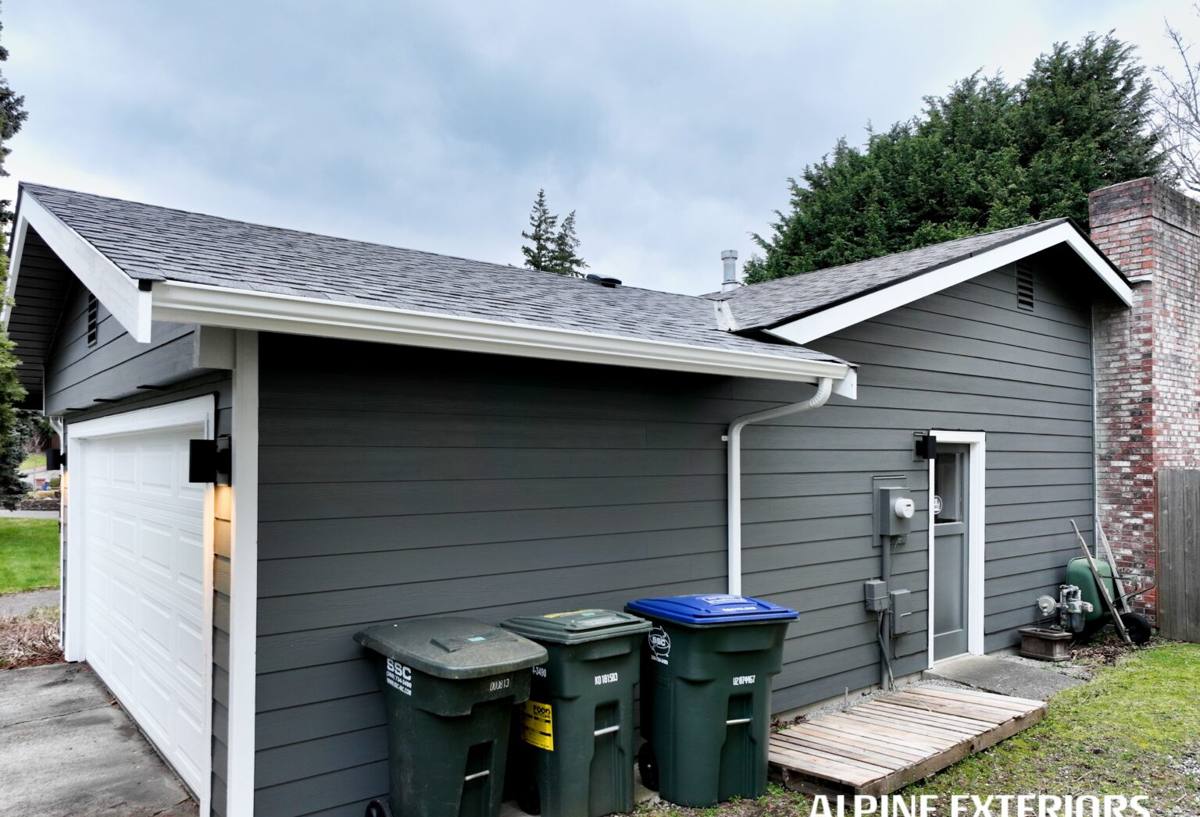
Signs a Bellingham Home Actually Needs Replacement, Not a Patch
Not every siding problem calls for a full tear-off. But in this climate, small issues compound fast, and knowing the difference between a repair and a replacement saves homeowners money and headaches.
- Soft or spongy spots when you press on the siding, especially near the bottom courses or under windows
- Persistent moss or dark algae streaking that comes back within weeks of being cleaned
- Paint that's bubbling, peeling, or failing faster than it should on a home its age
- Visible warping, cupping, or separation at the seams and butt joints
- A musty smell in an adjacent room, or interior drywall staining near exterior walls
- Siding that's original to a home built more than 20-25 years ago and has never been replaced
- Rot found during a repair that turns out to run further than one board
If you're only seeing one or two of these on a wall or two, a repair may genuinely be the right call. If you're seeing several of these across multiple elevations, or the moisture has clearly gotten behind the siding into the sheathing, that's a replacement conversation — patching over a compromised water-management system just delays the real cost.
What a Correct Siding Replacement Actually Involves
Siding replacement isn't just pulling off old boards and nailing up new ones. In a climate that sees this much rain and salt exposure, what happens underneath the visible siding matters as much as the siding itself.
Tear-Off and Inspection
Once the old siding comes off, the sheathing underneath gets inspected for rot, soft spots, and existing moisture damage. This is the point where problems that were invisible from the outside — a leak that's been running behind the wall for years — finally get found and dealt with, instead of getting sealed back up under new siding.
Weather-Resistive Barrier
A properly lapped weather-resistive barrier (housewrap) goes over the sheathing before anything else. In a wind-driven-rain climate like Bellingham's, the lap direction and overlap amount matter — water has to be directed down and out, not given a path inward at every seam.
Flashing at Every Penetration
Windows, doors, hose bibs, light fixtures, vents — every single penetration through the wall plane is a potential entry point for water. Correct flashing, properly integrated with the weather barrier using the shingle-lap principle (each layer overlaps the one below it), is what actually keeps driving rain out. This is also the step that gets rushed or skipped on lower-quality jobs, and it's usually the reason a "new" siding job starts leaking within a few years.
Fastening and Fit
Fiber cement siding has specific fastening requirements — nail placement, spacing, and depth all affect how the material performs over time. Fasteners driven too deep can crack the material or compromise its water resistance; fasteners that are too shallow or misplaced can work loose as the house settles and the material moves with temperature and humidity swings.
Caulking and Trim Details
Butt joints, trim boards, and corners all need the right sealant, applied correctly, to prevent the exact kind of water intrusion that's most common in this climate. This is detail work, not an afterthought.
Why We Install Only James Hardie Fiber Cement Siding
We made a deliberate decision to install one siding system — James Hardie fiber cement — rather than offering a menu of vinyl, engineered wood, or other fiber cement brands. That decision was shaped directly by climates like this one.
Fiber cement is non-combustible and dimensionally stable, meaning it doesn't expand and contract with moisture and temperature the way wood-based products do. That matters in a climate where humidity swings are constant and the material spends a good portion of the year damp. James Hardie's HZ5 product line is specifically engineered for climates with freeze-thaw cycles and high moisture exposure, which describes the Pacific Northwest well. The ColorPlus factory finish is baked on under controlled conditions and backed by its own finish warranty, which reduces the repainting cycle that a lot of homeowners here are used to fighting against with wood or older vinyl.
We're not going to tell you every other product is bad — plenty of products have real strengths. But we are going to tell you honestly why we don't install them, because we think homeowners deserve that honesty before they sign a contract, not after.
Vinyl Siding: A Fair Look
Vinyl is inexpensive and low-maintenance in mild climates. In a coastal, high-wind, wet climate, though, it tends to show its limits: it can warp or buckle with temperature swings, seams are a known path for water intrusion behind the panel, and it's rarely the best match for a house that's exposed to driving rain and salt air on a regular basis. It also isn't paintable in the way fiber cement is, so a color change down the road usually means a full replacement.
LP SmartSide and Wood-Based Products: A Fair Look
Engineered wood and traditional cedar both have real appeal — natural look, workability, and in cedar's case, a classic Pacific Northwest aesthetic. The trade-off is moisture sensitivity. Wood-based products rely heavily on an intact factory or field-applied coating to keep water out; once that coating is compromised — by a scratch, a poorly caulked joint, or normal weathering — moisture can get into the substrate and cause swelling, delamination, or rot. In a climate with this much sustained dampness and moss growth, that coating has to work harder and longer than it does almost anywhere else in the country.
Material Comparison for a Bellingham-Area Climate
| Factor | James Hardie Fiber Cement | Vinyl | Wood / Engineered Wood |
|---|---|---|---|
| Moisture resistance | High — cement-based, won't swell or rot | Moderate — seams can let water behind panel | Depends entirely on coating integrity |
| Salt air performance | Strong — non-organic material | Fair — can chalk and degrade faster near coast | Weaker — organic material, coating-dependent |
| Moss / algae resistance | Good with normal cleaning | Fair — surface can stay damp in shaded areas | Weakest — organic surface, needs more upkeep |
| Fire resistance | Non-combustible | Melts/deforms under heat | Combustible |
| Repainting cycle | Long — factory ColorPlus finish, 15-year+ finish warranty | Not paintable in the traditional sense | Shorter — coating needs regular renewal |
This table reflects general material behavior, not a claim about any specific product failing — every material can perform well when installed and maintained correctly. It's simply why our own standard, for this climate, is fiber cement.
Our Siding Replacement Process for Bellingham Homes
The process itself doesn't change dramatically from house to house, but the details we pay closest attention to are shaped by working in this specific area.
- Inspection and estimate: we walk every elevation, check for existing moisture damage, and talk through what we're seeing before any number gets put on paper.
- Product and color selection: we help homeowners choose the right James Hardie plank profile, texture, and color for their home, factoring in how the color and finish will hold up to this climate's UV and moisture exposure.
- Tear-off and sheathing inspection: old siding comes off and any rot or damage underneath gets identified and addressed before anything new goes up.
- Weather barrier and flashing: housewrap and flashing get installed to manage wind-driven rain, with special attention to window and door penetrations.
- Siding installation: James Hardie planks are installed to manufacturer fastening specs, with correct spacing for expansion.
- Trim, caulking, and final detailing: corners, butt joints, and trim get sealed correctly — the step most responsible for long-term water performance.
- Final walkthrough: we go over the finished work with the homeowner before calling the job done.
Cost Factors for Bellingham Siding Replacement
We're not going to quote a number here — every home is different, and giving a fake range wouldn't be honest. But these are the factors that actually move the price up or down on a real job.
| Factor | Why It Matters |
|---|---|
| Extent of existing rot or moisture damage | Sheathing repair adds labor and material beyond siding itself |
| Home size and elevation complexity | More corners, gables, and dormers mean more cutting, flashing, and labor |
| Siding profile and texture chosen | Lap width, texture, and trim details affect material cost |
| Access and site conditions | Tight lots, slopes, or landscaping near the house can affect setup and staging |
| Number of stories | Multi-story homes require more scaffolding and safety setup |
| Trim and accessory work | Fascia, soffit, and trim replacement alongside siding adds scope |
Why Hiring a Crew That Already Works in This Area Matters
A contractor who works regularly in Whatcom County and the Semiahmoo area knows things a crew from out of the region has to learn on your dime. They know which elevations on a coastal-facing home tend to take the worst of the driving rain. They know how long moss season actually runs here and what that means for scheduling cleaning and maintenance. They're familiar with local permitting expectations and inspection standards, and they've likely already worked through the access and staging challenges common to homes in this area — narrow lots, mature landscaping, sloped sites near the water.
That local familiarity doesn't replace the fundamentals of a correct installation — good flashing and correct fastening matter everywhere — but it does mean fewer surprises and a crew that already understands why the details matter here specifically.
Maintaining James Hardie Siding in a Salt Air, Moss-Prone Climate
Fiber cement is genuinely low-maintenance compared to wood, but "low-maintenance" doesn't mean "no maintenance," especially in this climate.
- Rinse siding with a garden hose a couple of times a year to clear salt residue and airborne debris, especially on sides facing open water or prevailing wind
- Keep gutters clean and downspouts directed away from the wall to prevent localized soaking
- Trim back vegetation and tree cover that keeps any one section of wall shaded and damp longer than the rest of the house
- Address any moss or algae growth early with a gentle wash rather than letting it establish and spread
- Recaulk trim and joints if you notice cracking or separation — small caulk failures are easy to fix and expensive to ignore
- Have siding and trim visually inspected every few years, particularly after a stretch of severe winter weather
Ready to Talk About Your Bellingham Home's Siding?
If your siding is showing its age, or you just want an honest opinion on whether you're looking at a repair or a full replacement, we're happy to take a look. The form below gets you a free, no-pressure estimate — no obligation, just a straight answer about what your home actually needs.