 Semiahmoo Exterior
 Why Semiahmoo Resort Siding Wears Differently
Semiahmoo sits out on the water, and that changes the math on siding maintenance. Homes here aren't just dealing with normal Pacific Northwest rain — they're dealing with that rain arriving sideways off Semiahmoo Bay, carrying salt off the water, and then sitting on north- and west-facing walls that rarely get a full day of sun to dry out. Add in Whatcom County's long, mild, damp shoulder seasons and you get months at a time where siding simply doesn't get a chance to dry between weather events. That combination is why we treat siding repair calls in Semiahmoo Resort as a different job than the same repair twenty minutes inland — the exposure is worse, and the fix has to account for it.
Most of the repair calls we get out here aren't dramatic. They're small failures that started years earlier and finally reached the point where a homeowner noticed a soft spot, a stain, or a section that just doesn't look right anymore. Catching those early is the whole game.
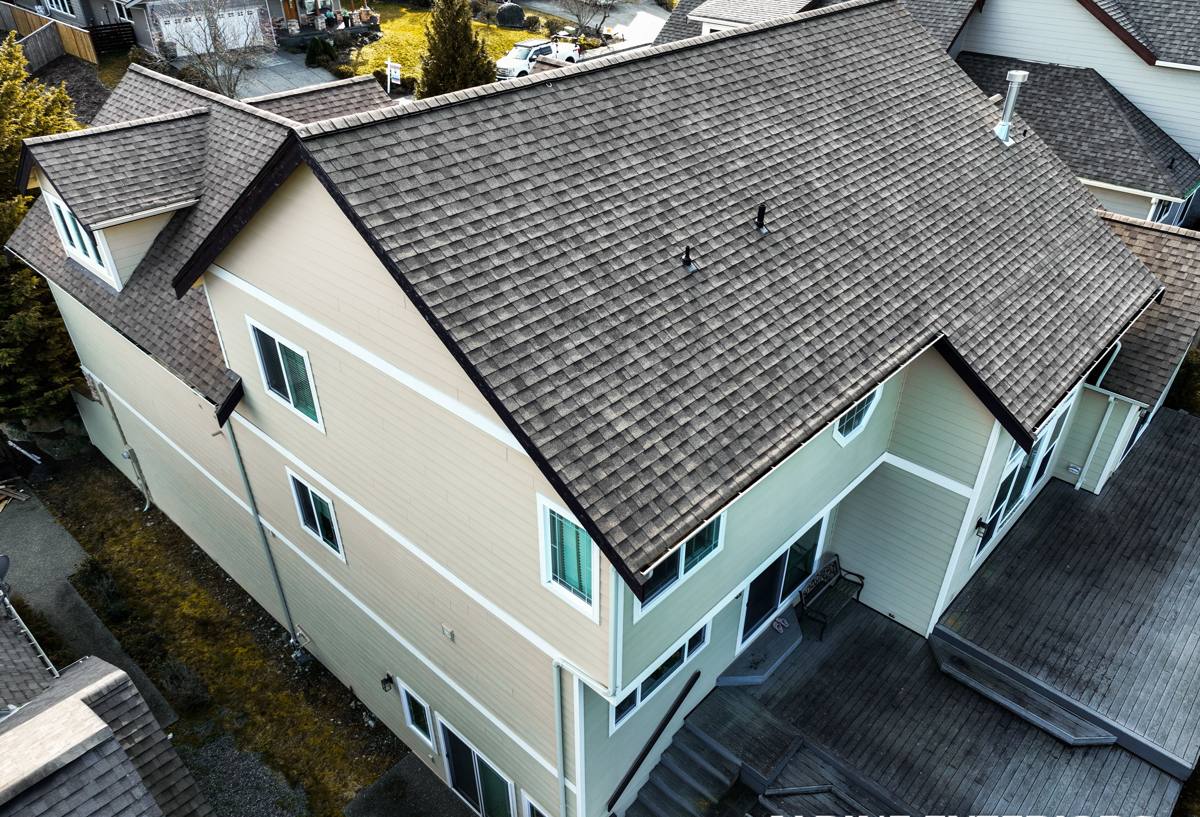
What Salt Air, Driving Rain, and Moss Actually Do
Salt-Laden Wind
Airborne salt is corrosive to metal fasteners, flashing, and trim components, and it's abrasive to painted and coated surfaces over time. On a waterfront or near-waterfront property, siding, fasteners, and caulking all age faster than the same materials would a few miles inland. This is why generic siding advice — written for a typical suburban lot — often undersells what Semiahmoo homes actually need.
Driving Rain
Wind-driven rain doesn't just wet a wall, it pushes water sideways and upward, testing every seam, joint, and piece of flashing on a home. Any gap in the water-resistive barrier behind the siding, any caulk joint that's failed, or any panel that's lost its seal becomes an entry point. Once water gets behind siding in a marine climate, it doesn't dry out quickly — it sits, and that's where rot and mold start.
Moss and Algae
Whatcom County's damp season runs long, and shaded, north-facing walls near mature landscaping or close to the water can stay damp for weeks. Moss and algae growth on siding isn't just cosmetic — it holds moisture against the surface, and on the wrong material that constant dampness accelerates deterioration underneath.
Signs a Semiahmoo Resort Home Needs Siding Repair
Most siding failures give warning signs well before they become expensive. Homeowners in this area should walk their exterior a couple of times a year and look for:
- Soft, spongy, or bubbling spots when you press on the siding, especially near the bottom courses or below windows
- Visible gaps, cracks, or separated seams, particularly around trim, corners, and window and door casings
- Dark streaking, persistent staining, or a musty smell near an exterior wall (often a sign of moisture intrusion, not just surface dirt)
- Heavy moss or algae buildup that keeps returning after cleaning
- Peeling, chalking, or fading paint/finish in patches rather than evenly across the whole elevation
- Rust streaks below fasteners or trim, a sign the metal is corroding from salt exposure
- Warped, bowed, or visibly separating panels or boards
Any one of these on its own might be minor. Several together, or any sign near a window, door, or roofline where water concentrates, is worth a closer look before it spreads.
What a Correct Siding Repair Actually Involves
A good siding repair is not just pulling off a damaged piece and nailing up a new one. Done right, it's a small construction project with the same fundamentals as a full install:
Find the Real Cause, Not Just the Symptom
If a section of siding is soft or stained, something let water in. Before any new material goes up, we find out whether it was a failed caulk joint, missing or damaged flashing, a gap at a penetration (a vent, light fixture, or hose bib), or a seam that was never properly lapped. Replacing the siding without fixing the cause just buys a few more years before the same spot fails again.
Check What's Behind the Siding
Once the damaged section is off, we inspect the water-resistive barrier and the sheathing underneath. In a marine environment, it's common to find some degree of moisture staining or soft sheathing even when the siding itself looked okay from the outside. Any compromised sheathing or barrier gets repaired before new siding goes back on — covering up a wet wall assembly with new siding just hides the problem.
Match the Material and the Installation Detailing
Repairs need to match the existing siding's profile, reveal, and finish as closely as possible, and they need to be installed with the same attention to flashing, fastener placement, and caulk joints as a new install. A patch that's installed loosely, without proper flashing at the top, or with the wrong fastener will fail again — often faster than the original did.
Reseal and Finish Properly
Correct sealant at joints and terminations, proper fastener type and spacing, and a finish that matches the surrounding wall so the repair doesn't stand out. On a resort-community home, appearance matters as much as function.
Repair or Replace: What Actually Drives the Decision
| Factor | Leans Toward Repair | Leans Toward Replacement |
|---|---|---|
| Extent of damage | Isolated to one wall, corner, or a handful of boards/panels | Recurring failures across multiple elevations |
| Underlying cause | One identifiable source (flashing, caulk, a penetration) | Widespread barrier failure or systemic moisture issues |
| Material condition | Rest of the siding is sound and holding its finish | Siding is aging out, chalking, or delaminating broadly |
| Material type | Original material is still available and matches well | Discontinued profile/color, or the original product itself is the ongoing problem |
| Age of the siding | Well within expected service life | At or past the point where more repairs just delay the inevitable |
We'll always tell a homeowner honestly which side of that table their house falls on. A targeted repair is often the right call. Sometimes it isn't, and pretending otherwise just costs the homeowner money twice.
Why We Repair With James Hardie Fiber Cement
We install James Hardie fiber cement siding exclusively, and that carries into how we handle repairs. Fiber cement doesn't absorb and swell with moisture the way wood-based products can, it doesn't feed rot, and it holds paint and factory ColorPlus finishes far longer than most alternatives in a salt-air environment. When we're patching into existing Hardie siding, we can match profile and reveal closely and tie the repair into the existing product line cleanly. When we're asked to repair a different material — wood, vinyl, or another fiber cement brand — we'll still assess it honestly, but for homeowners planning ahead, we'll tell you straight that a marine-exposure property like Semiahmoo Resort is exactly the environment where the difference between siding products shows up fastest, and it's why Hardie is what we put on homes ourselves.
Our Process for Semiahmoo Resort Repairs
Siding repair on a resort-community property comes with a few practical considerations beyond the technical work — HOA or community aesthetic standards, tighter lot access in some sections, and neighbors close enough that a sloppy job site is noticed. Our process is straightforward:
- On-site inspection to identify every affected area, not just the spot the homeowner called about — we check the whole elevation and adjacent walls for related issues
- A clear explanation of what's causing the damage and an honest repair-versus-replace recommendation
- A written estimate before any work starts, with no surprise add-ons once we open the wall
- Careful removal, inspection of the barrier and sheathing, and repair of the root cause before new siding goes up
- Clean job site practices — this is someone's home in a community where appearances matter, and we treat it that way
Why a Crew That Already Works Semiahmoo Resort Matters
A siding repair crew that hasn't worked marine-exposure properties before will often treat a Semiahmoo Resort repair like any other repair — patch it, caulk it, move on. That approach doesn't hold up here. A crew that already knows this stretch of Whatcom County knows to check for salt-driven fastener corrosion even when the siding face looks fine, knows which elevations take the worst of the driving rain off the bay, and knows moss regrowth on a north wall is a moisture problem worth investigating, not just a cleaning job. That local pattern-recognition is what keeps a repair from becoming a repeat call two years later.
If you're seeing soft spots, staining, gaps, or persistent moss on your Semiahmoo Resort home's siding, it's worth having it looked at before the next storm season adds to the damage. We offer free, no-pressure estimates — we'll walk the exterior, tell you honestly what we find, and lay out your options with no obligation.