 Semiahmoo Exterior
 Decking Built for Semiahmoo Resort's Coastal Conditions
Homes at Semiahmoo Resort sit about as close to the water as a Whatcom County property can get, and that location shapes almost every decision that goes into a deck. Salt-laden air off the bay accelerates corrosion on anything metal, wind-driven rain finds its way into joints and end grain that would stay dry a few miles inland, and the long gray stretch of fall through spring keeps moss and algae growing on any surface that doesn't shed water and get airflow. A deck built to a generic spec sheet will show its age here faster than the same deck built five miles inland. Composite decking, installed correctly for this specific site, holds up to that environment far better than wood — but "correctly" is doing a lot of work in that sentence, and it's worth understanding what that actually means before you sign a contract.
Why Composite Makes Sense Here
Wood decking in a marine environment fights a losing battle: it absorbs moisture, swells and shrinks with the weather, and needs regular sealing to keep salt air and rain from working into the grain. Skip a season of maintenance and you're looking at cupping, splintering, and rot at the fastener points. Composite boards don't absorb water the way wood does, so they don't swell, crack, or splinter from repeated wetting and drying. That doesn't mean composite is maintenance-free — algae and moss will still grow on any decking surface that stays damp and shaded, composite included — but it means the material itself isn't degrading underneath that surface growth the way wood fibers do.
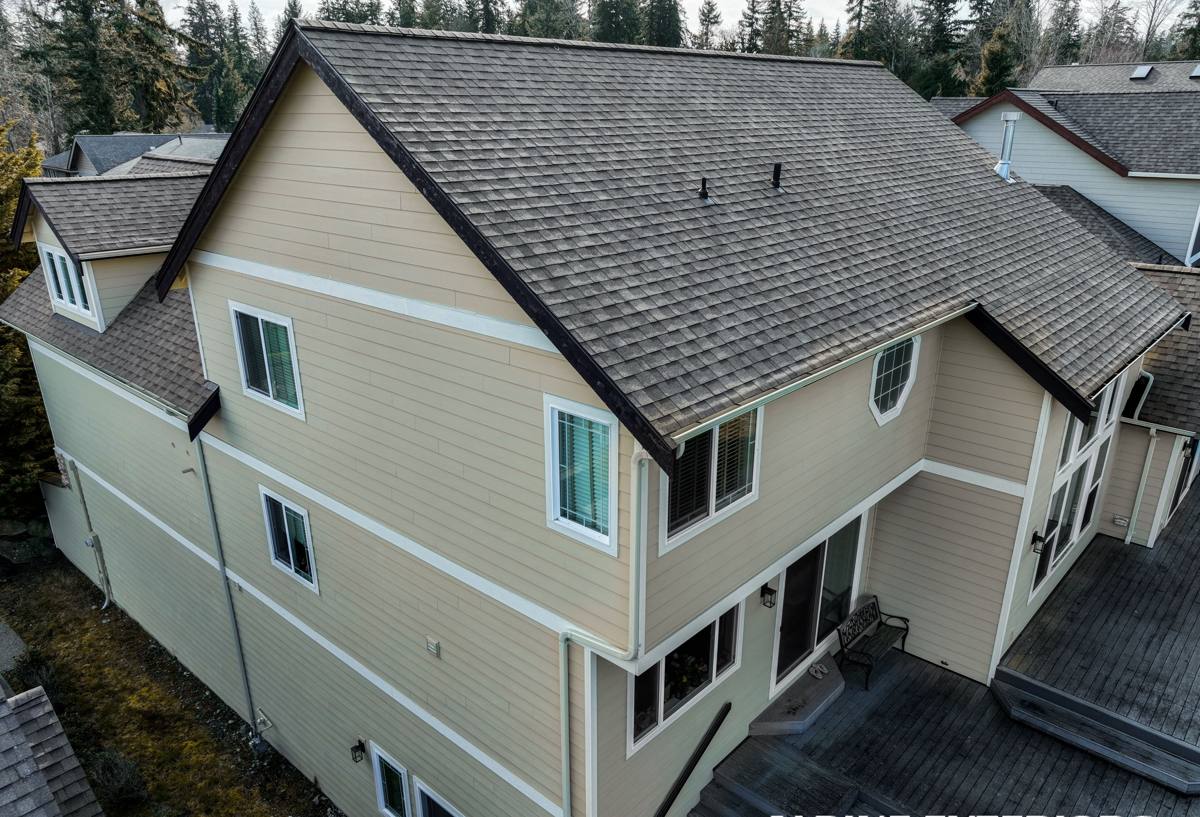
What Salt Air Does to a Deck That Isn't Built for It
The biggest failure point we see on decks near the water isn't the decking boards themselves — it's the hardware holding everything together. Standard hot-dip galvanized fasteners and joist hangers are rated for general exterior use, but they weren't designed for sustained salt air exposure. Over a few years that environment can compromise the coating on standard-grade hardware, and once corrosion starts on a joist hanger or ledger bolt, it's happening somewhere you can't see it — under the decking, at the house connection, in the substructure.
For a deck at Semiahmoo Resort, we spec fasteners and connectors rated for coastal or marine-grade exposure throughout the substructure, not just at the visible surface. That's a small cost difference at the time of construction and a significant difference in what the deck looks like structurally in ten years.
Driving Rain and the Ledger Connection
The other place we pay close attention is where the deck meets the house. Wind-driven rain off the water doesn't fall straight down — it gets pushed sideways into wall assemblies, and a ledger board that isn't flashed correctly will let water track behind the siding and into the framing over time. That's not a decking problem, it's a water-management problem, but it's the single most common source of hidden damage behind deck installations in this region. Proper ledger flashing, correct fastener spacing, and a drainage gap between the ledger and the house wall are non-negotiable details on every deck we build here, whether the resort's aesthetic guidelines call for a specific board color or not.
Moss, Algae, and Long-Term Surface Care
Whatcom County's moss season is long, and a deck that doesn't get much direct sun — common on lots with mature trees or homes shaded by neighboring structures — will grow surface algae on any decking material eventually. Composite manufacturers build some resistance into their cap layers, but resistance isn't immunity. The things that actually control moss and algae growth are airflow underneath the deck, proper board spacing for drainage, and a maintenance routine that doesn't let organic debris sit and hold moisture against the surface.
- Adequate ground clearance and ventilation beneath the deck structure, not just at the perimeter
- Correct board-to-board gapping so water sheds through rather than pooling on the surface
- Gutters or drip-edge details that keep roof runoff from sheeting directly onto the deck
- Periodic surface cleaning with a soft-bristle brush and a composite-safe cleaner, not a pressure washer on high pressure held close to the boards
- Keeping planters, mats, and furniture legs from creating permanently damp, shaded spots on the surface
What a Correct Composite Deck Installation Involves
A composite deck is only as good as what's underneath it. The boards themselves get most of the attention in a sales pitch, but the substructure is what determines whether the deck is still solid — and still under warranty — a decade from now.
Substructure and Framing
Joists should be spaced to the composite manufacturer's specification, which is often tighter than standard wood-decking spacing, especially at angles or on picture-frame borders. In a coastal environment, we also look closely at whether joist tape or another moisture barrier is used on top of the framing — it's a cheap step that keeps water from sitting directly on top of the joist and driving corrosion or rot from the top down, where it's hardest to spot.
Fastening System
Hidden fastener systems are standard on most composite decking now, and they give a cleaner look with no visible screw heads to collect grime or corrode over time. But hidden-fastener clips vary in quality and in how well they hold up to repeated wet-dry cycling. We use fastening hardware that's rated for the coastal exposure this location sees, not just whatever ships in the base kit.
Expansion and Drainage Detailing
Composite material expands and contracts with temperature, and boards need gap allowances at butt joints, around posts, and at the house connection to accommodate that movement without buckling. Getting this wrong doesn't show up on day one — it shows up as boards that start to bow or push against fixed points after a year or two of seasonal cycling.
Comparing Decking Approaches for a Semiahmoo Resort Property
| Factor | Wood Decking | Composite Decking |
|---|---|---|
| Salt air / corrosion resistance | Depends entirely on fastener grade and finish upkeep | Board material is inert; hardware still needs marine-grade spec |
| Maintenance routine | Regular sealing/staining, more frequent in coastal climates | Periodic surface cleaning, no sealing or staining required |
| Moss/algae exposure | Grows on surface; wood also absorbs moisture beneath growth | Grows on surface but material doesn't absorb moisture the same way |
| Upfront cost | Generally lower material cost | Higher material cost, offset over time by lower upkeep |
| Long-term surface behavior | Can cup, splinter, or gray unevenly without upkeep | Holds color and surface consistency longer with less input |
Working Within Semiahmoo Resort's Setting
Properties in a resort community like this often have shared aesthetic expectations for the neighborhood, and homeowners here are usually mindful of how a deck reads from the street and from neighboring lots, in addition to how it performs. We work with whatever board colors, rail styles, and layout constraints matter to a given homeowner, but we don't compromise on the substructure and hardware decisions described above to hit a lower price point. Those are the choices that determine whether the deck is still performing well in the marine environment a decade out, long after the initial look has settled in.
Our Process for a Semiahmoo Resort Deck Project
- On-site assessment — we look at sun exposure, drainage patterns, proximity to the water, and the existing structure (if replacing a deck) before recommending a spec.
- Material and hardware selection — composite board line, fastening system, and substructure hardware chosen for the coastal exposure at this specific lot, not a one-size spec.
- Permitting — we handle the permit process with Whatcom County where required, including any structural review for elevated decks or ledger connections.
- Framing and substructure — joists, ledger flashing, joist tape, and marine-grade fasteners installed to spec before a single board goes down.
- Decking installation — boards installed with correct spacing and expansion gaps, hidden fasteners set to the manufacturer's pattern.
- Final walkthrough — we go over drainage, maintenance expectations, and warranty documentation with the homeowner before calling the job done.
What to Check Before Hiring a Deck Contractor Here
- Do they spec marine or coastal-grade fasteners for jobs near the water, or use standard hardware everywhere?
- Do they flash the ledger board connection properly, or treat it as a simple bolt-through attachment?
- Can they explain their joist spacing and expansion-gap approach for the specific composite product being installed?
- Are they familiar with Whatcom County permitting requirements for deck structures?
- Do they offer a clear, written maintenance guide for the finished deck, including realistic expectations about surface algae and cleaning?
If you're planning a new composite deck or replacing an aging one at Semiahmoo Resort, we're happy to walk the site, look at your sun and drainage situation, and put together a straightforward, no-pressure estimate — just fill out the form below to get started.