 Semiahmoo Exterior
 Roof Repair Built for Laurel's Weather, Not a Generic Climate
Laurel sits in the part of Whatcom County that takes weather seriously. Storms roll in off the water with wind behind them, rain doesn't just fall here — it drives sideways under eaves and flashing — and the tree cover that makes this area attractive also means shade, damp, and moss for most of the year. A roof repair that works fine in a drier inland climate can fail fast here if it doesn't account for those conditions. We repair roofs in and around Semiahmoo regularly, and the fixes that hold up long-term in Laurel are not always the fixes you'd use somewhere with a milder, drier pattern.
This page covers what roof repair actually means for a Laurel home: what the climate does to a roof over time, how to tell a repair job from a replacement job, what a correct repair involves step by step, and why local experience changes the outcome. We're not going to give you generic roofing advice — this is specific to what we see on Whatcom County roofs.
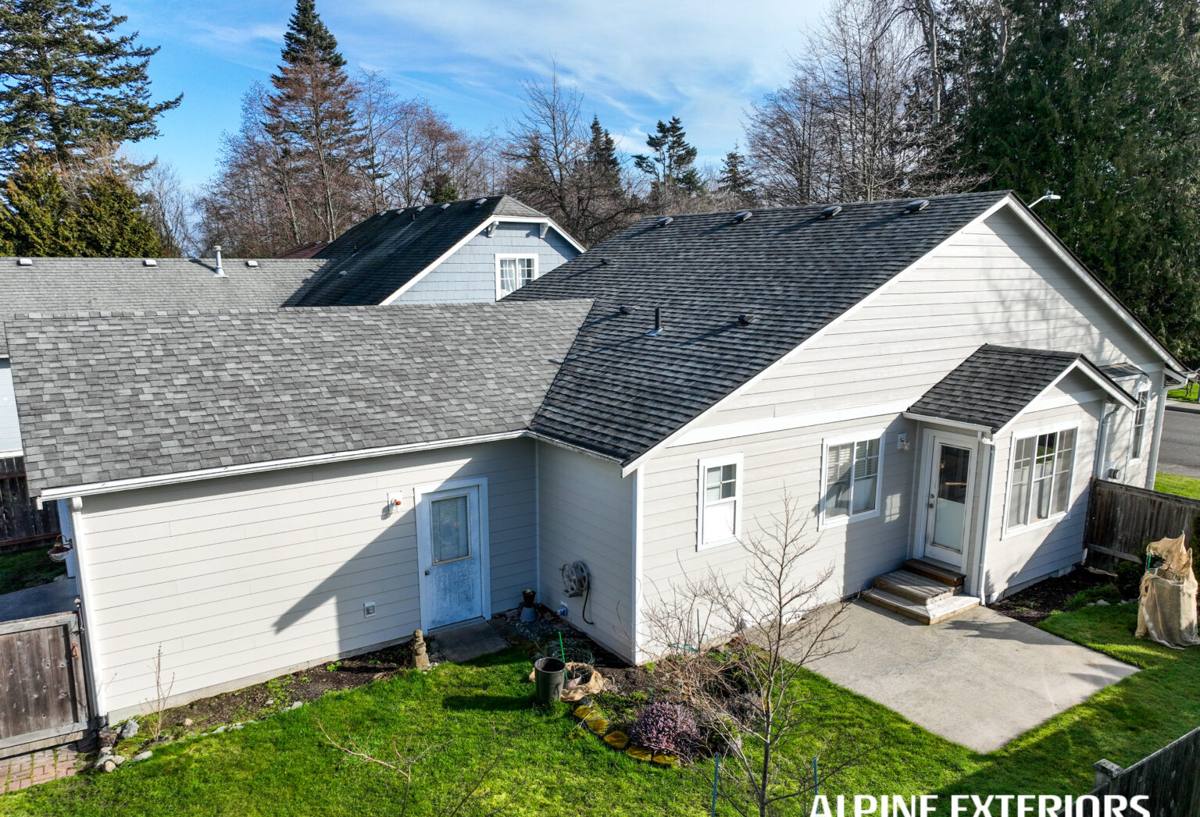
What Salt Air, Driving Rain, and Moss Actually Do to a Roof
Salt Air and Metal Components
Proximity to Semiahmoo Bay and the broader Puget Sound means airborne salt is a real factor here, even a few miles inland. Salt-laden air accelerates corrosion on exposed metal — flashing, fasteners, gutter hardware, and any exposed nail heads. A roof that's fine visually can still have flashing that's thinning from the underside or fasteners that have lost their grip because the metal has degraded faster than the shingles around it. This is one of the most common causes of a "mystery leak" that seems to come from nowhere: the water isn't getting past the shingles, it's getting past corroded flashing at a valley, chimney, or wall intersection.
Wind-Driven Rain
Rain that comes straight down is relatively easy for any roof to shed. Rain that comes in at an angle, pushed by wind off the water, behaves differently — it can work up under shingle edges, past poorly lapped flashing, and into gaps that would never see water in calmer conditions. This is why repairs done to a "dry climate" standard sometimes fail here within a season or two. The underlayment, flashing laps, and sealant choices all need to assume rain will hit the roof from more than one direction.
Moss Season
Whatcom County's combination of moisture and shaded, tree-lined lots means moss isn't a cosmetic issue — it's a structural one if left unaddressed. Moss holds moisture against the roofing material long after the rest of the roof has dried, which accelerates granule loss on asphalt shingles and rot on wood-adjacent components. It also grows under shingle tabs and along ridge lines, gradually lifting them and creating entry points for water. A repair that doesn't address the moss causing the damage in the first place is a temporary fix at best.
Signs a Laurel Roof Needs Repair Right Now
Most roof problems don't announce themselves as a dramatic leak on day one. They show up as smaller signs first, and catching them early is almost always cheaper than waiting.
- Moss growth along ridges, valleys, or the shaded side of the roof (usually the north-facing slope)
- Granules collecting in gutters or at downspout outlets — a sign of shingle wear
- Shingles that look cupped, curled, or lifted at the edges, especially after a windstorm
- Rust streaks below metal flashing or exposed fasteners
- Water stains on interior ceilings, particularly near chimneys, skylights, or where two roof planes meet
- Sagging or soft spots when walked on, which can indicate underlying deck damage
- Daylight visible through the roof deck from inside an attic space
- Consistently damp or musty smell in an attic, even without a visible leak
If you're seeing more than one or two of these, it's worth having someone look before the next storm cycle rather than after.
Repair or Replace? How We Actually Decide
Not every roof problem in Laurel means a full replacement, and we don't push toward one unless the numbers genuinely favor it. Here's how we weigh the decision:
| Factor | Leans Toward Repair | Leans Toward Replacement |
|---|---|---|
| Age of roofing material | Under roughly 12-15 years, materials still have life | Nearing or past the manufacturer's expected lifespan |
| Extent of damage | Localized — one valley, one section, one flashing point | Widespread granule loss, multiple leak points across the roof |
| Roof deck condition | Deck is solid, damage hasn't reached the sheathing | Soft, rotted, or delaminated decking found during inspection |
| Moss/moisture history | First significant moss issue, caught early | Repeated moss cycles with no prior treatment or maintenance |
| Underlayment condition | Underlayment intact where accessible | Underlayment failing broadly, not just at the repair site |
An honest inspection is the only way to answer this correctly. We'll tell you plainly if a section can be repaired versus if you're better off addressing the whole roof at once rather than paying for repairs that only buy a year or two.
What a Correct Roof Repair Involves
Diagnosis Before Anything Gets Touched
The most common mistake in roof repair isn't bad workmanship — it's fixing the wrong spot. Water travels along the underlayment and roof deck before it shows up as a stain inside the house, so the visible damage and the actual entry point are often several feet apart. A correct repair starts with tracing the leak to its actual source, not just patching where the ceiling stain is.
Removing Damaged Material Properly
Damaged shingles, rotted decking, or compromised underlayment need to come out — not get covered over. Covering a soft spot or degraded flashing with new material on top is a shortcut that fails, usually within a year, and often makes the eventual real fix more expensive.
Matching Flashing and Underlayment to the Conditions
Given the wind-driven rain typical here, flashing laps and underlayment need to be installed with enough overlap and the right sealant to handle rain hitting from multiple angles, not just straight down. This is one of the areas where climate-appropriate technique actually matters, not just climate-appropriate materials.
Addressing the Cause, Not Just the Symptom
If moss caused the damage, the repair should include moss removal and a plan to slow regrowth — otherwise you're back in the same spot in a couple of seasons. If corrosion caused a flashing failure, replacing that flashing with a corrosion-resistant option matters more here than in a drier, inland climate.
Our Roof Repair Process
- Inspection: We get on or above the roof (not just a ground-level look) to check shingles, flashing, valleys, penetrations, and — where visible — the underside of the deck from the attic.
- Diagnosis and honest options: We explain what we found, what's causing it, and whether repair or replacement makes sense, including what happens if you do nothing.
- Written estimate: Clear scope of work and pricing before anything starts — no surprise add-ons mid-job.
- The repair itself: Removal of damaged material, deck check and repair if needed, correct flashing and underlayment work, and matching shingles or roofing material as closely as possible.
- Cleanup and walkthrough: Debris and old material hauled off, and we walk you through what was done and what to watch for going forward.
Materials and Methods We Use for Local Conditions
| Component | What We Prioritize | Why It Matters Here |
|---|---|---|
| Flashing | Corrosion-resistant metals and full, correctly lapped installation | Salt air accelerates corrosion on lower-grade or poorly lapped flashing |
| Underlayment | Full coverage with attention to wind-driven rain paths | Angled rain finds gaps that straight-down rain never would |
| Fasteners | Corrosion-resistant fasteners, properly seated | Standard fasteners can weaken faster near salt-influenced air |
| Sealants | Products rated for sustained moisture exposure, not just occasional rain | Whatcom County's rain frequency means sealants stay wet longer between dry spells |
| Shingle matching | Closest available match in profile and color | A visibly mismatched patch is a common complaint with lower-effort repairs |
Why a Crew That Already Works Laurel Makes a Difference
Roofing technique that works in a dry inland region doesn't automatically transfer to a coastal-influenced climate like Semiahmoo's. A crew that hasn't worked this specific stretch of Whatcom County may not think about salt-air corrosion on flashing, may under-detail wind-driven rain protection, or may not recognize moss damage patterns until they're advanced. Local experience means fewer callbacks — not because the work is fundamentally different everywhere, but because the details that matter here are known upfront instead of learned through a failed repair.
There's also a practical side: familiarity with local permitting expectations, typical roof styles in the area, and realistic scheduling around this region's weather windows. Roof repair here often has a narrower dry-weather window than people expect, and a crew that works Laurel regularly plans around that instead of getting caught mid-job by a weather shift.
After the Repair: Keeping It From Happening Again
A good repair holds up longer with a little ongoing attention, especially given how long moss season runs in this region.
- Keep gutters and downspouts clear so water isn't backing up under roof edges
- Trim back overhanging branches to reduce shade and debris buildup, which slows moss regrowth
- Have moss growth addressed early rather than letting it establish through a full wet season
- Schedule a roof check after any major windstorm, even if nothing looks obviously wrong from the ground
- Keep an eye on attic conditions for musty smells or damp spots between visible leak events
If you're seeing moss, granule loss, or a stain that showed up after the last storm, it's worth having it looked at before the next one. We offer free, no-pressure estimates for roof repair in Laurel and throughout the Semiahmoo area — use the form below to get one scheduled.