 Semiahmoo Exterior
 Roofing Laurel Homes for What This Climate Actually Does
Laurel sits in a stretch of Whatcom County where a roof earns its keep. You're close enough to salt water for airborne salt to matter, far enough north that the rain season runs long, and shaded enough by conifers and cloud cover that moss isn't an occasional nuisance — it's a permanent tenant if you let it be. A roof that's "fine" on paper in a drier, sunnier market can fail early here simply because it wasn't built with this specific combination of conditions in mind. That's the gap we work in: new roof installation done for Laurel's actual weather, not a generic spec sheet.
This page covers one job — putting a new roof on a Laurel home — and what that job needs to include to hold up for decades instead of just years.
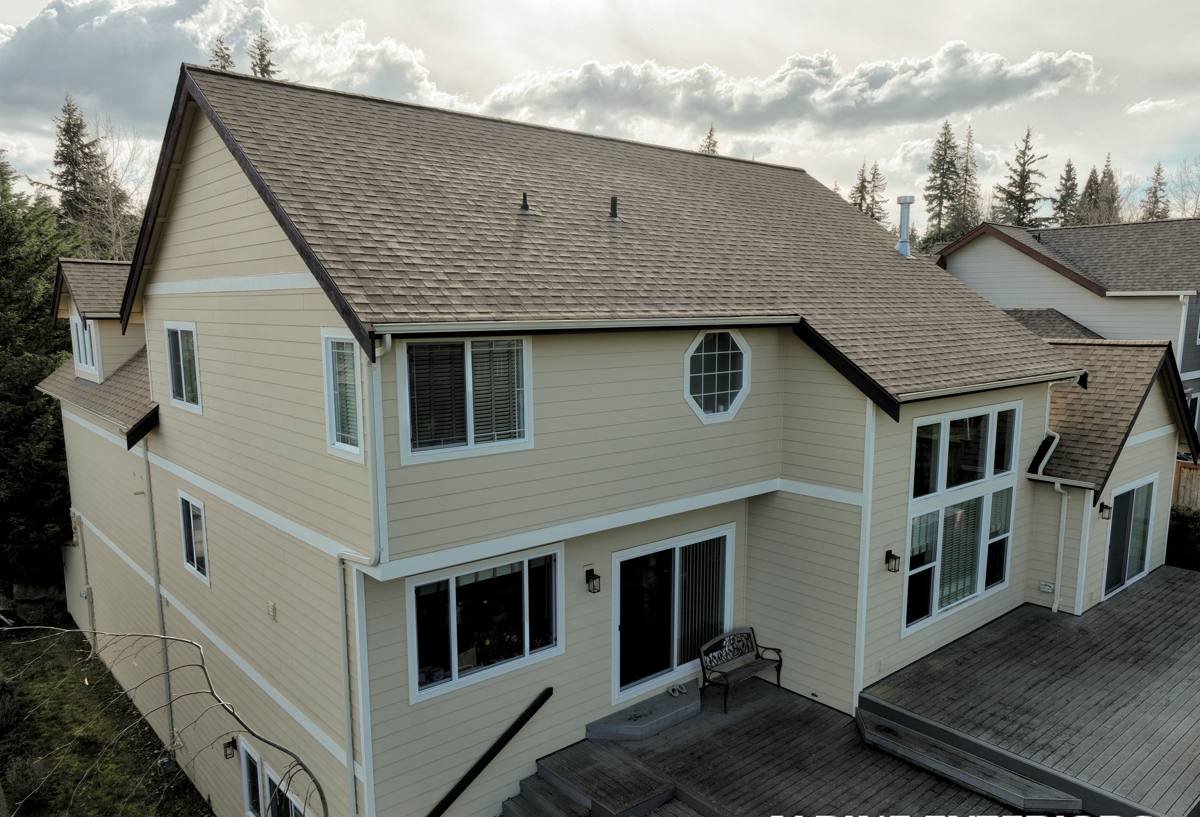
What Salt Air, Driving Rain, and Moss Season Do to a Roof
Salt Air
Proximity to Semiahmoo Bay and the broader Puget Sound/Strait of Georgia airshed means fine salt particulate rides the wind and settles on every exterior surface, roofs included. Salt accelerates corrosion on exposed metal — nails, flashing, vent caps, gutter hardware — faster than it would inland. Fasteners and flashing rated for a dry, inland climate corrode faster here, and once a fastener starts going, the shingle or panel it's holding is no longer secure.
Driving Rain
Whatcom County rain doesn't just fall straight down — winter storms push it sideways, which means water gets tested against every seam, lap, and penetration on a roof, not just the open field of the shingles. A roof that only sheds water well when it falls vertically will leak here. Underlayment, flashing details, and how laps are oriented against the prevailing wind direction all matter more in a driving-rain climate than they would somewhere calmer.
Moss Season
Cool, damp, and shaded conditions for a good part of the year give moss and algae exactly what they need to colonize a roof. Moss isn't just cosmetic — it holds moisture against the roofing material, lifts shingle edges as it grows under them, and works its way into fastener holes and laps, opening paths for water where none existed before. A roof installed without moss-resistant details is signing up for a shorter service life almost regardless of the material used.
Signs a Laurel Home Needs a New Roof — Not Another Repair
Not every roof problem in this climate calls for full replacement. But there's a point where patching stops being cost-effective and starts being money spent to delay the inevitable. Signs worth a real inspection:
- Granule loss showing up in gutters or at downspout outlets, especially on a roof past 15–20 years old
- Moss growth that returns within a season or two of cleaning, particularly on north-facing or shaded slopes
- Curling, cupping, or cracked shingles across large areas rather than one isolated spot
- Soft spots or visible sagging in the roof deck when viewed from the attic or from the ground
- Repeated leaks in different locations after past repairs, suggesting the underlayment or deck itself has failed
- Rusted, pitted, or loosening metal flashing around chimneys, valleys, and vents
- Daylight visible through the roof deck from inside the attic
- An age past the manufacturer's realistic service life for this climate, regardless of surface appearance
If a roof is showing two or more of these at once, replacement usually costs less over the next decade than a string of repairs on a roof that's already past its practical service life.
Choosing a Roofing System That Fits Laurel's Conditions
Every roofing material sold in the Pacific Northwest can technically be installed here — the question is which one performs well under salt exposure, driving rain, and heavy moss pressure without demanding constant upkeep. Here's how the common options compare for a Laurel home specifically.
| Material | Salt Air Behavior | Moss Resistance | Typical Service Life Here |
|---|---|---|---|
| Algae-resistant asphalt composition shingle | Good with corrosion-resistant fasteners and flashing | Good — copper-infused granules slow regrowth | 20–30 years |
| Standard (non-AR) asphalt shingle | Fair — depends on hardware quality | Poor without regular cleaning | 15–20 years, often less in shaded areas |
| Standing seam metal | Excellent with marine-grade or coated fasteners | Very good — smooth surface sheds debris | 40–60 years |
| Cedar shake | Fair — needs regular maintenance in damp shade | Poor — organic material feeds moss growth | 15–25 years with active upkeep |
| Composite/synthetic shake or slate | Good | Good — non-organic surface | 30–50 years |
We're honest about the trade-offs on each. Cedar shake looks the part for a Northwest home, but in a shaded, damp, moss-heavy setting it's genuinely high-maintenance — the same organic surface that gives it its look is what moss and algae attach to easiest, and skipping upkeep shortens its life fast. That's not a knock on the product; it's a maintenance-burden conversation we'd rather have upfront than after installation. Algae-resistant asphalt and metal both give Laurel homeowners a better balance of appearance, cost, and low-maintenance performance for this specific climate.
What a Correct Roof Installation Actually Involves
Tear-Off and Deck Inspection
A new roof starts by removing the old one down to the deck — never installing over existing layers. This lets us actually see the plywood or OSB underneath, check for soft spots, rot, or delamination from years of moisture exposure, and replace any damaged sections before anything new goes down. Skipping this step is how a new roof ends up failing over a compromised deck within a few years.
Underlayment and Ice-and-Water Protection
Given how much water this roof will see sideways as well as straight down, underlayment selection and placement matter. Self-adhered ice-and-water membrane goes at eaves, valleys, and around penetrations — the spots most exposed to wind-driven rain and the most common leak points on an underspecified roof. Synthetic underlayment across the rest of the field gives a second line of defense if anything ever gets past the surface layer.
Flashing at Every Penetration
Chimneys, skylights, plumbing vents, and roof-to-wall transitions are where roofs actually leak, far more often than the open field of shingles. Correctly lapped, corrosion-resistant flashing at each of these — installed in the right sequence with the underlayment and roofing material — is non-negotiable in a driving-rain climate.
Ventilation
A roof that traps heat and moisture in the attic ages faster from the inside out, and can encourage condensation that mimics or worsens moss and moisture problems on the outside. Balanced intake and exhaust ventilation keeps the deck dry and helps the roofing material reach its full rated life.
Moss-Resistant Details
On shaded slopes and valleys where moss pressure is highest, we look at options like copper or zinc strips near ridges, algae-resistant shingle products, and roof design choices that reduce standing debris and shade wherever the homeowner's layout allows it. None of this eliminates the need for occasional cleaning, but it meaningfully slows how fast moss comes back.
Corrosion-Resistant Fasteners and Hardware
Every nail, screw, and piece of flashing hardware on a Laurel roof should be rated for coastal/salt-air exposure. This is a small line-item cost difference and a large difference in how the roof ages over 20-plus years.
Our Installation Process
The work itself follows a consistent sequence, whether the home is a straightforward single-story or has multiple valleys and penetrations to manage:
- On-site assessment — we inspect the existing roof, deck, ventilation, and any problem areas (moss buildup, past leak history, flashing condition) before quoting anything
- Material and system recommendation — based on the home's exposure, roof pitch, shading, and the homeowner's budget and appearance preferences
- Written estimate — clear on materials, scope, and price, with no surprise add-ons introduced after work starts
- Tear-off and deck repair — old roofing removed, deck inspected and repaired as needed
- Underlayment, flashing, and ventilation installed — the layers that actually determine whether the roof stays dry
- Roofing material installed — per manufacturer specification, which is also what keeps material warranties valid
- Final walkthrough — cleanup, debris check (including magnetic nail sweep of the yard), and a review of the finished work with the homeowner
Maintenance That Protects the Investment
A correctly installed roof still benefits from basic upkeep in this climate — this isn't optional in a moss-heavy, high-rainfall area the way it might be elsewhere.
- Keep gutters and downspouts clear so water doesn't back up under roof edges
- Have moss and debris cleaned off before it establishes thick growth, not after
- Trim back overhanging branches that keep roof sections shaded and damp
- Schedule a walk-through inspection every couple of years, especially after major windstorms
- Address minor flashing or fastener issues promptly rather than waiting for a leak
None of this requires a homeowner to get on the roof themselves — it's the kind of light, periodic check that catches small issues before they become deck damage or interior leaks.
Why a Crew That Already Works Laurel Matters
Roofing crews who mostly work drier, milder markets can still install a technically competent roof — but "technically competent" and "correct for this climate" aren't always the same thing. A crew that already works Laurel and the rest of Whatcom County knows which slopes in this area collect moss fastest, how far wind-driven rain actually travels up under an eave in a real winter storm here, and which fastener and flashing specs hold up against sustained salt exposure rather than just passing a one-time inspection. That local pattern recognition shows up in the details — where ice-and-water membrane gets extended, how ventilation is balanced for a shaded lot, which moss-resistant options are worth the small added cost and which aren't necessary on a given roof.
It also matters for straightforward reasons: a local crew is easier to reach for a warranty question five years down the road, understands regional permitting, and isn't guessing at how a product performs here versus how it performs in a catalog spec sheet written for a different climate.
Get a Straight Answer on Your Laurel Roof
If your roof is showing its age or you're just trying to plan ahead, we're glad to take a look and give you an honest read on what it actually needs — no pressure, no inflated urgency. Use the form below to request a free estimate, and we'll walk the roof, talk through the options that make sense for your home's exposure and budget, and put it in writing.