 Semiahmoo Exterior
 Point Roberts' Siding Climate: Salt, Rain, and a Long Moss Season
Point Roberts sits out on its own peninsula with water on three sides, which means homes there take a different kind of weathering than houses a few miles inland. Salt-laden marine air is a near-constant presence, working on painted surfaces, trim, and fasteners year-round rather than just during storm season. Add driving rain that comes in sideways off the water during winter fronts, and siding has to actively shed water at every seam, corner, and penetration — not just resist it in calm weather. Shade from tree cover combined with that moisture load also produces a long moss and algae season, especially on north-facing walls, that most siding products in this region have to contend with for much of the year.
None of this is unique to one street or one part of the community — it's the general exposure profile for homes anywhere on this stretch of Whatcom County coastline, including the Semiahmoo area we're based in. What changes house to house is how much direct wind and salt exposure a given wall gets, and how well the existing siding has been holding up against it.
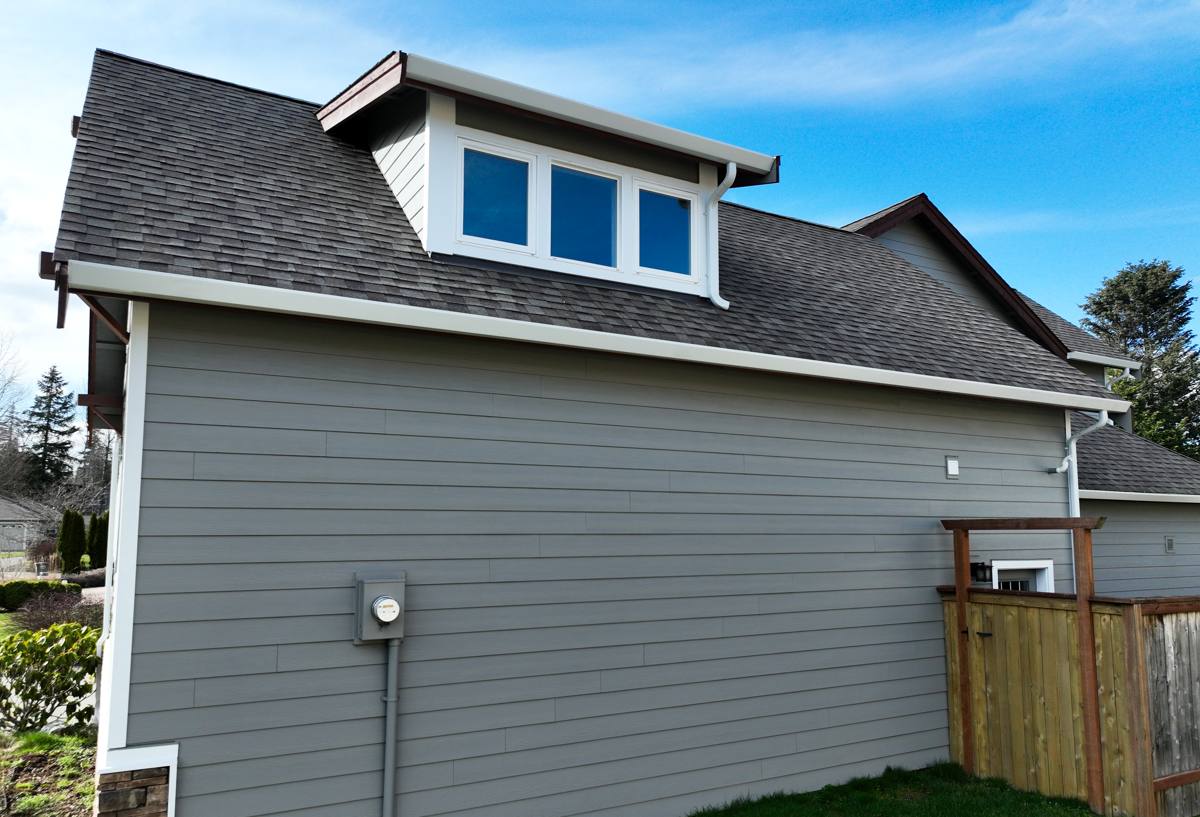
What Siding Actually Needs to Do Here
In a climate like this, the material matters less than the system behind it. A cladding product needs to be dimensionally stable so it doesn't cup, crack, or pull away from fasteners as it cycles through wet and dry conditions. It needs a factory-applied finish that resists salt-driven fading and chalking better than field-applied paint, since repainting a home exposed to constant marine air is a recurring cost most owners would rather avoid. And it needs to be installed with the gaps, flashing, and drainage details that let incidental moisture get out from behind the cladding instead of sitting there.
This is why we install James Hardie's HZ5 product line on homes in this area rather than the standard HZ10 line sold in drier, less exposed regions. HZ5 is engineered specifically for wetter, harsher climates — it's the same fiber cement formulation family, but the version Hardie builds for places that get more rain and more moisture cycling. Pairing the right product line with correct installation is what actually determines how a wall performs here, not the brand name on the piece.
Why Fiber Cement, Not Vinyl or Wood-Based Products
Vinyl siding can warp and gap at the seams under sustained wind-driven rain, and salt air accelerates the fading of its color over time since there's no factory finish protecting it the way ColorPlus does on Hardie board. Wood-based and primed products — cedar, primed spruce, LP SmartSide — depend on an unbroken paint or coating layer to keep moisture out of the substrate; once that layer is compromised by driving rain or prolonged dampness, the material underneath is vulnerable in a way non-combustible fiber cement isn't. That's the core reason we standardized on James Hardie rather than offering multiple product lines.
The Point Roberts Access Factor
Point Roberts is a U.S. exclave — the only way to reach it by road is to drive north into Canada and back south across the border, since it's physically cut off from the rest of Washington by water. That geography sounds like a minor detail until it's your siding material sitting at a crossing, or your crew losing half a work day because deliveries weren't timed around it. A crew based in the Semiahmoo area that already works this peninsula regularly plans material staging and crossing logistics before the job starts, not after they discover the problem on day one.
This is also why we don't treat Point Roberts jobs as an afterthought squeezed between other work. Material orders, dumpster or debris logistics, and daily crew scheduling all get planned around the crossing up front, so the project timeline you're quoted is one we can actually hold to.
What a Correct James Hardie Installation Involves
Flashing and Water Management
Every window, door, and penetration needs proper flashing integrated with a weather-resistant barrier behind the siding — this is where most siding failures actually start, regardless of brand. In a driving-rain climate, flashing details that would be marginal elsewhere simply aren't acceptable here.
Fastening and Gaps
Hardie board has to be fastened per manufacturer spec — correct nail type, placement, and depth — and installed with the specified gaps at butt joints, corners, and trim to allow for expansion and drainage. Fastening it like a generic panel product is one of the most common ways an otherwise good material underperforms.
Caulking and Finish Work
Joints and seams need the right sealant applied correctly, and factory-primed cut edges need to be sealed in the field so the ColorPlus finish's protection isn't compromised at every cut.
- Weather-resistant barrier installed and lapped correctly before any siding goes up
- Flashing integrated at every window, door, and penetration — not just caulked over
- Manufacturer-specified fastener type, spacing, and penetration depth
- Correct gaps maintained at butt joints, corners, and trim for drainage and movement
- All field-cut edges primed and sealed to protect the factory finish
- Starter strip and clearance from grade, decks, and roof lines set to manufacturer minimums
Correct Installation vs. Common Shortcuts
| Detail | Done Correctly | Common Shortcut We See |
|---|---|---|
| Butt joint gaps | Set per Hardie spec for drainage and movement | Boards butted tight, trapping moisture |
| Window/door flashing | Integrated with the water-resistive barrier | Caulk used as a substitute for flashing |
| Cut edges | Primed and sealed in the field | Left raw, inviting moisture into the substrate |
| Clearance from grade/decks | Meets manufacturer minimum clearance | Siding runs too close to grade or hardscape |
| Fasteners | Correct type and depth per product line | Standard fasteners driven too deep or shallow |
Our Process for a Point Roberts Project
- On-site assessment — we look at existing siding condition, wall exposure to wind and salt spray, and any moisture damage before quoting anything.
- Material and logistics planning — HZ5 product, trim, and color are ordered and staged with the border crossing built into the timeline, not treated as a surprise.
- Removal and inspection — old siding comes off and the sheathing and framing underneath get checked for hidden moisture damage before new material goes up.
- Installation to spec — flashing, barrier, fastening, and gaps done to manufacturer detail, not shortcuts that happen to look fine on install day.
- Final walkthrough — we go over the finished work with you before we consider the job done.
Why We Only Install James Hardie on Homes Out Here
On an exclave, a callback isn't a quick trip across town — it's a crossing each way, for us and often for you if a warranty claim needs to be handled by the manufacturer. That reality makes us more conservative about what we're willing to put on a wall, not less. James Hardie's factory ColorPlus finish and transferable warranty mean fewer repaint cycles and a manufacturer standing behind the product for the long haul, which matters more when "just having someone stop by" isn't as simple as it is elsewhere. We'd rather install one product correctly, to spec, than offer a menu of cheaper options and hope the climate is forgiving. Out here, it usually isn't.
Living With Salt Air and Moss: What Homeowners Can Do
Good installation gets you most of the way there, but a little seasonal attention keeps a Hardie exterior looking and performing the way it should for the long term.
- Rinse salt residue off exterior walls a few times a year, especially after winter storm cycles
- Keep gutters and downspouts clear so water isn't sheeting down wall sections unnecessarily
- Trim back vegetation and tree cover that keeps north-facing walls shaded and slow to dry
- Gently wash visible moss or algae growth before it has a chance to establish and spread
- Have caulking at trim and joints checked every few years and refreshed if it's failing
What Drives Project Cost
| Factor | Why It Matters Here |
|---|---|
| Home size and wall complexity | More corners, gables, and trim mean more flashing and cut-edge detail work |
| Existing siding removal | Tear-off and disposal logistics take longer to plan around the crossing |
| Hidden moisture damage | Sheathing or framing repair adds cost but is essential to address, not cover over |
| Trim and color selection | Custom trim packages and specialty ColorPlus colors affect material lead time |
| Material staging and delivery | Cross-border logistics are planned in, not billed as a surprise mid-project |
If you're weighing your siding options for a home in Point Roberts, we're happy to walk the exterior with you, point out what the salt air and rain have already done, and give you a straightforward, no-pressure estimate — no invented urgency, just an honest look at what your walls actually need.