 Semiahmoo Exterior
 Fiber Cement Siding for Blaine and the Semiahmoo Coastline
We're based right along the Semiahmoo waterfront, at the edge of Blaine, so we don't have to guess what this coastline does to a house — we watch it happen year-round. Salt air off Semiahmoo Bay and Drayton Harbor, driving rain that comes in sideways off the water, and a moss season that barely takes a break between fall and spring all put steady pressure on exterior materials here. This page is specifically about fiber cement siding: what it is, why it's the only siding material we put on Blaine homes, and what a correctly installed fiber cement job actually involves in this climate.
This isn't a general siding overview. If you already know you want fiber cement and want to understand it in more depth before committing to a project, or you're comparing it against whatever is currently on your house, this is written for that conversation.
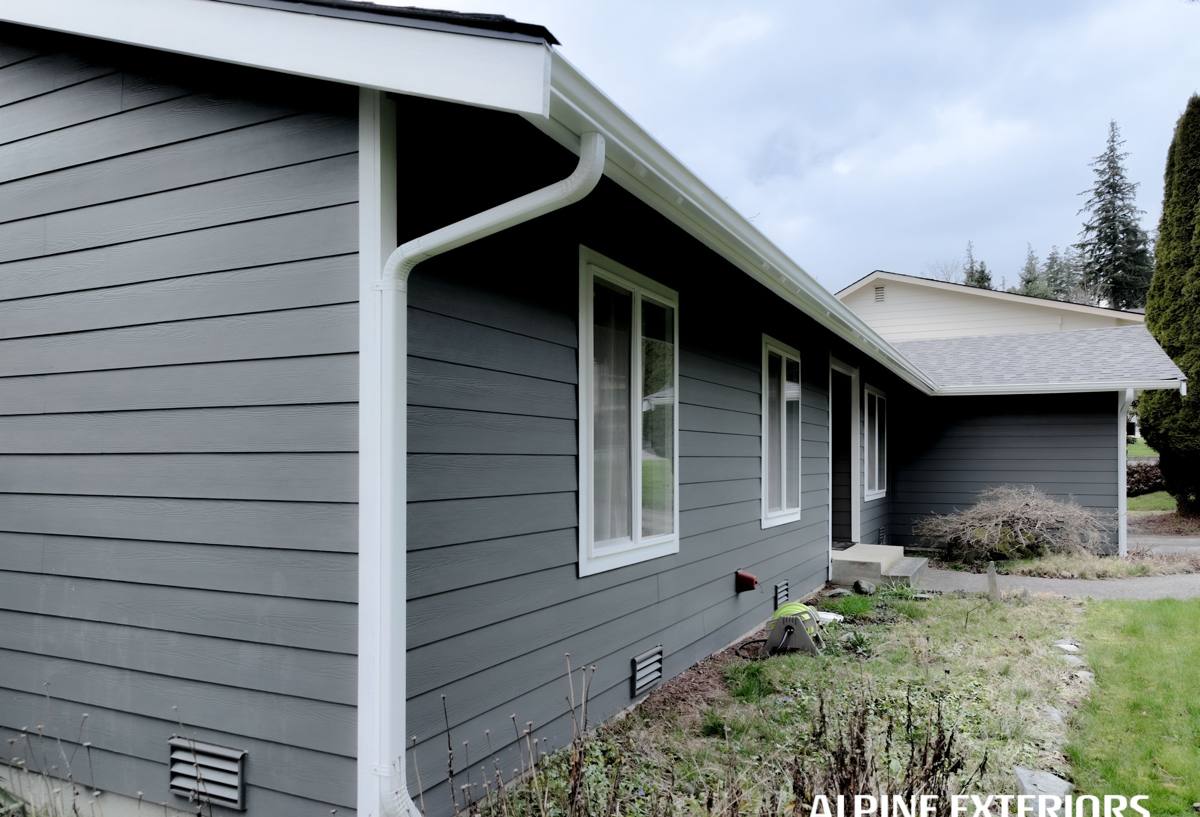
What Fiber Cement Siding Actually Is
The Material Itself
Fiber cement siding is made from a mixture of portland cement, sand, and cellulose fiber, formed into planks or panels and cured under controlled conditions. That composition is what separates it from vinyl (a petroleum-based plastic) and from wood-based products like cedar or engineered wood siding, which rely on a wood or wood-strand core. The cement-based structure gives fiber cement a rigidity and density that wood and vinyl products don't have, and it's largely responsible for how the material behaves once it's on a wall exposed to real weather.
How It Holds Up in a Wet, Salty Climate
Fiber cement doesn't rot, and it isn't a food source for insects the way untreated wood siding can be. It's also dimensionally stable — it doesn't swell, cup, or warp the way engineered wood siding can after repeated wetting and drying cycles, which matters in a place like Blaine where siding rarely gets a long stretch of fully dry weather to recover between storms. It's not immune to moisture; poor installation can still let water behind the material and cause problems at the sheathing. But the material itself doesn't absorb and hold water the way porous or wood-based products do, which is a meaningful advantage this close to the water.
Why This Is the Only Siding Material We Install in Blaine
We standardized on James Hardie fiber cement after seeing, on tear-offs and service calls up and down this stretch of coastline, which siding materials actually held up to years of salt air and wind-driven rain and which ones quietly failed behind a fine-looking surface. A few specifics behind that decision:
- Non-combustible core: Fiber cement doesn't feed a fire the way wood-based siding can, which matters for both homeowner safety and how insurers view the home.
- HZ5 formulation for this climate: Hardie engineers its HZ product line for specific climate zones, and the HZ5 formulation is built for regions with sustained moisture exposure and freeze-thaw cycling — a reasonable description of Blaine's winters.
- Factory-applied ColorPlus finish: The color is baked on in a controlled factory process rather than brushed on after installation, which holds up longer against fading and chalking under sustained salt air and UV than field-applied paint.
- A warranty that follows the installation spec: Hardie's transferable warranty is one of the stronger ones in the siding industry, but it's tied directly to installation following their published requirements — which is part of why we treat that spec as non-negotiable, not optional.
We don't install LP SmartSide, vinyl siding, Cemplank, Allura, primed spruce, or cedar. That's a professional standard specific to this coastline, not a judgment on every homeowner who's happy with one of those products elsewhere. In a town where salt exposure and wind-driven rain are near-constant, we'd rather install one system we fully stand behind than offer a cheaper option that quietly shifts maintenance risk back onto the homeowner a few winters later.
Where Fiber Cement Product Lines Fit on a Blaine Home
| James Hardie Product | What It Is | Where It Fits |
|---|---|---|
| HardiePlank | Traditional horizontal lap siding | The most common full-house choice; the standard workhorse siding profile |
| HardiePanel | Vertical sheet siding | Board-and-batten look, often used on gables, accent walls, or a full modern facade |
| HardieShingle | Staggered or straight-edge shingle panels | Accent detailing on gable ends or transitions, a common Pacific Northwest look |
| HardieTrim | Fiber cement trim boards | Corners, window and door surrounds, fascia — paired with any of the above |
What a Correct Fiber Cement Install Involves on This Coastline
Before the New Siding Goes Up
Once old siding comes off, we check the sheathing underneath for rot, soft spots, or existing moisture damage before anything new gets installed. Fiber cement is a durable material, but it can't fix a compromised substrate underneath it — covering a damaged wall just hides the problem behind a better-looking surface. Given how much of Blaine's weather comes with wind behind it, we also give the house wrap and flashing at every window, door, and penetration close attention at this stage, since that's the layer doing the real work if water gets past the siding surface.
Fastening and Clearance Details That Matter Here
Hardie's warranty depends on correct fastener type, spacing, and embedment, and in a salt-air environment the fastener choice matters even more than the spec sheet alone suggests — corrosion-resistant fasteners are not optional here. Clearance above grade, roofline, and deck or patio surfaces also needs to hold to spec, because a home sitting close to open water can see more splash-back and standing moisture at the base of a wall than a similar house set further inland.
Finishing Details
Field-cut edges get sealed rather than left exposed, and butt joints and trim transitions get treated per Hardie's own joint-treatment guidance rather than just caulked shut. Those are the details that are easy to rush and almost impossible to inspect once the siding is up — which is exactly why they're worth getting right the first time.
- Rainscreen gap behind the siding so any moisture that gets past the surface can drain and evaporate instead of sitting against the sheathing
- Corrosion-resistant fasteners at Hardie's specified spacing and embedment depth
- Flashing integrated at every window, door, and wall penetration, lapped to shed water downward
- Correct clearance above grade, roofline, decks, and patios
- Sealed field-cut edges and properly treated butt joints and trim transitions
- Installation matched to the HZ5 climate specification for this region
How We Approach a Fiber Cement Siding Project in Blaine
- Walkthrough and assessment: We look at the current siding, sheathing condition where visible, and how sun, wind, and water exposure vary across the different walls of the house.
- Written estimate: The estimate reflects what we actually see on the house, including product line and profile options that make sense for the home.
- Tear-off and substrate check: Old siding comes off, and the sheathing gets inspected and repaired as needed before anything new goes up.
- Weather barrier and flashing: House wrap and flashing get installed and lapped correctly at every seam and penetration.
- Fiber cement installation to spec: Fastening, clearance, joint treatment, and rainscreen detail all follow Hardie's published requirements as the baseline.
- Final walkthrough: We go over the finished job together, cover maintenance expectations for a coastal property, and confirm the work matches the estimate.
What Drives the Cost of a Fiber Cement Siding Job Here
| Factor | Why It Matters in Blaine |
|---|---|
| Home size and number of stories | More surface area and more difficult access both add labor time |
| Trim and detail complexity | Window surrounds, corners, and multiple product lines (plank plus panel or shingle accents) add cutting and finish work |
| Sheathing condition once old siding is off | Homes closer to the water more often show moisture-related sheathing repair needs |
| Product line and profile chosen | HardiePlank, HardiePanel, and HardieShingle involve different material and labor requirements |
| Wall exposure to wind and water | Water-facing walls may need more attention to flashing and clearance detail than sheltered ones |
These are general drivers rather than a quote — every home along this stretch of coastline sits at a slightly different distance from the water and under different tree cover, so we walk the property before putting a real number to the work.
When It's Time to Consider Replacing What's on Your Walls Now
- Existing siding is wood-based or vinyl and shows warping, cupping, or brittleness after repeated wet seasons
- Paint or finish is failing faster than a repaint schedule can reasonably keep up with
- Moss or dark staining returns quickly after cleaning, especially on shaded or water-facing walls
- Soft or spongy sections turn up low on the wall or around window and door trim
- Panels are cracked, buckled, or missing after a windstorm off the water
- The current material is more than 20-25 years old with no documented replacement history
None of these automatically means a full tear-off is the right call, but each is worth a professional look, and each is a reasonable reason to ask what fiber cement would do differently on that same wall.
Why Hiring a Crew That Already Installs Fiber Cement in Blaine Matters
Fiber cement is a forgiving material when it's installed correctly and an unforgiving one when it isn't — a missed rainscreen gap or under-spec fastener doesn't show up as a problem on install day, it shows up two or three wet seasons later as moisture damage behind a wall that otherwise looks fine. Working this coastline regularly means we've seen what those shortcuts look like once a wall comes back open, and we build every Blaine job to avoid repeating them. It also means that if a warranty question or a maintenance question comes up years down the road, it's a call to a crew still working in this same area, not one that's moved on to a different region entirely.
If you're considering fiber cement siding for a home in Blaine or along the Semiahmoo waterfront, we're glad to come take a look and walk you through what it would actually involve on your house. Reach out using the form below for a free, no-pressure estimate.