 Semiahmoo Exterior
 Why Point Roberts Weather Is Tough on Windows
Point Roberts sits out on the water, and that location cuts both ways. The views are part of why people live there, but the exposure is also why windows in this community fail faster than they do a few miles inland. Salt-laden air off the Salish Sea works on hardware, seals, and finishes year-round, not just during storms. Add driving rain that hits window walls almost sideways during winter systems, and a moss season that can stretch from fall through spring, and you have a climate that punishes any window with a weak seal, poor drainage, or the wrong frame material.
None of this means windows here need to be exotic or overbuilt. It means the details that get skipped on an easy inland install — flashing, drainage paths, fastener choice, glass package — actually matter and actually show up in your energy bill and your maintenance list within a few years, not decades.
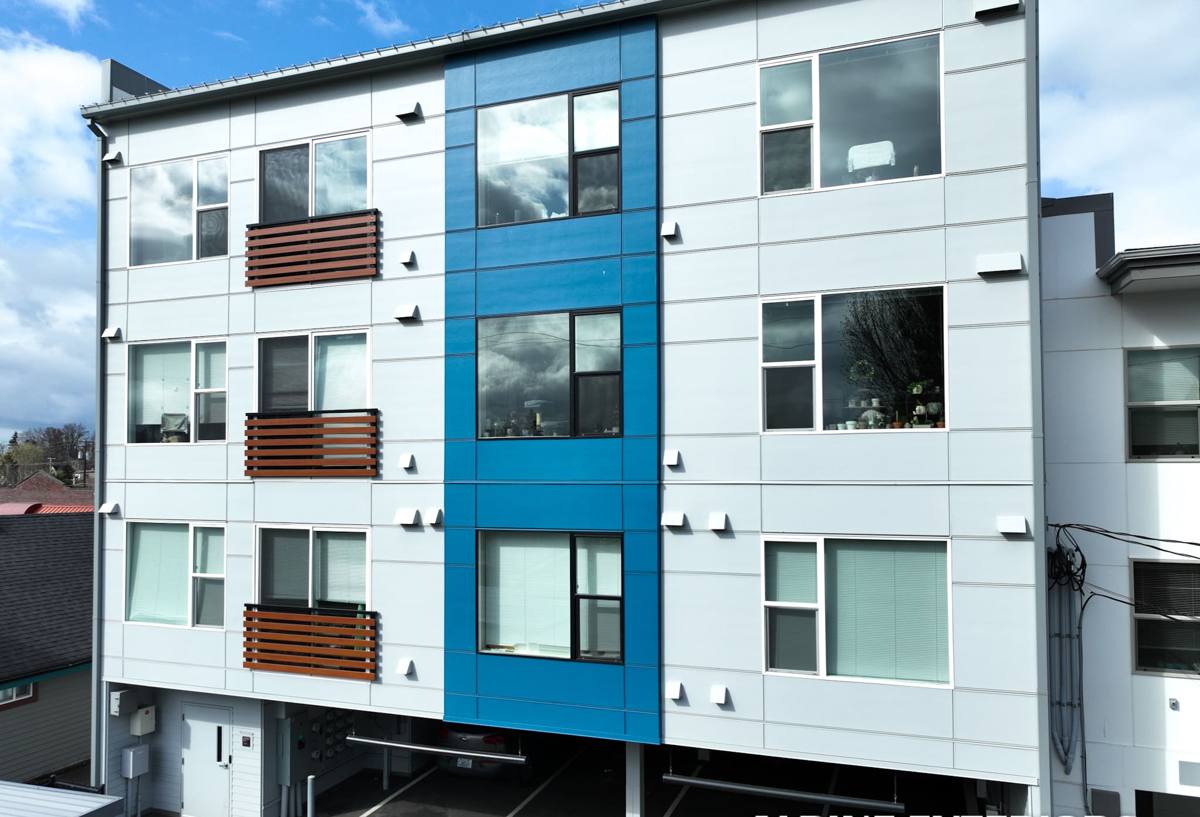
What "Energy-Efficient" Actually Means for This Location
Every window sold today gets labeled efficient. The label alone doesn't tell you much. What matters is how a window performs against the specific stresses of a marine, wet, moderate-temperature climate like Whatcom County's — which is different from what a window needs to do in a dry, hot climate or a deep-freeze one.
U-Factor and Solar Heat Gain in a Marine Climate
U-factor measures how much heat a window lets escape; lower is better for our heating-dominated climate. Solar Heat Gain Coefficient (SHGC) measures how much solar heat comes through the glass. In Whatcom County, keeping U-factor low matters more than chasing a very low SHGC, since we're not fighting intense summer sun the way a southern climate would. A window tuned for the desert Southwest is tuned for the wrong problem here.
Glass Packages Worth Considering
Double-pane with a low-E coating and argon or krypton gas fill is the baseline we recommend for most Point Roberts homes. Triple-pane adds real value on north- and west-facing walls that take the brunt of winter storms, or on homes where road or wind noise is a factor. It's a meaningful upgrade in cost and weight, so we walk through where it earns its keep rather than spec'ing it everywhere by default.
Signs Your Current Windows Are Costing You Money
Homeowners often wait until a window is visibly failing before calling anyone, but in this climate the interior symptoms usually show up well before the glass itself gives out. Watch for:
- Condensation or fogging between the panes — the seal has failed and the gas fill is gone
- Soft or discolored wood at the sill or bottom corners, even under paint
- A noticeable draft you can feel with a hand near the frame on a windy day
- Difficulty opening, closing, or locking a window that used to operate smoothly
- Green or black growth building up in the tracks or on the exterior sill faster than you can keep up with it
- Rooms near large window walls that feel noticeably colder than the rest of the house
- Visible gaps or cracked caulk where the frame meets the siding or trim
Any one of these on its own isn't an emergency. Several together, especially on the weather-facing side of the house, usually means the window is past the point where caulk and weatherstripping will fix it.
What a Correct Installation Involves
Energy efficiency lives or dies at the installation, not just the product spec sheet. A well-rated window installed with gaps in the flashing will underperform a mid-grade window installed correctly. This is the part of the job that's hardest to see once it's done, and the part most worth asking a contractor about before they start.
Flashing and Water Management
Every opening needs a drainage path so any water that gets past the exterior seal — and in driving rain, some always will — has somewhere to go besides your wall cavity. That means correctly lapped flashing tape, a sloped sill pan, and weep paths that aren't accidentally caulked shut. This is the single most common shortcut we see in older installs around here, and it's the reason some "leaky window" complaints are actually wall problems wearing a window's name.
Sealing Without Trapping Moisture
The instinct is to caulk everything solid, but a window wall also needs to be able to dry out if moisture does get in. We seal the exterior weather barrier tight while making sure the assembly can still shed water outward — sealing a window shut on both sides is how you end up with hidden rot instead of a visible leak you'd actually notice.
Choosing a Frame Material for Salt Air
Frame material matters more here than in a dry inland town, because salt air accelerates corrosion on metal components and UV plus moisture accelerates wear on anything with an exposed finish. Here's how the common options hold up in this specific environment:
| Frame Material | Salt-Air / Moisture Behavior | Maintenance |
|---|---|---|
| Vinyl | Doesn't corrode; performs consistently near salt water | Low — occasional cleaning, no repainting |
| Fiberglass | Very stable dimensionally, holds finish well against sun and salt | Low to moderate — durable finish, higher upfront cost |
| Wood (unclad) | Attractive but vulnerable to the sill rot and moisture cycling common here | High — regular repainting and sealing required |
| Wood with aluminum or fiberglass cladding | Good moisture protection on the exterior face; interior wood still needs some care | Moderate — exterior is low-care, interior isn't |
| Aluminum (uncoated or poorly coated) | Prone to pitting and corrosion in direct salt exposure over time | Higher — finish maintenance to prevent corrosion |
We're not going to tell you a homeowner's choice is wrong if they love the look of real wood — it's a legitimate choice, just one that comes with a maintenance commitment we want you to walk in with eyes open about, especially this close to the water.
Our Process, Start to Finish
- On-site assessment: we look at each opening individually — sun exposure, wind exposure, current condition — rather than quoting a whole house off one template
- Product selection: we go over frame material, glass package, and grille or hardware options based on that specific home's exposure
- Measurement and ordering: precise measurements matter more here since a loose-fitting window is a future leak path
- Removal and prep: we check the opening for existing rot or water damage before the new window goes in — putting a new window into a compromised opening just hides the problem
- Installation: proper flashing, shimming, insulating, and sealing per the details above
- Final check and cleanup: operation, seal, and site cleanup before we call the job done
Why a Crew That Already Works Point Roberts Matters
Point Roberts is geographically part of Whatcom County but physically separated from it — the only land route in and out passes through Canada. That's not a small detail for a construction project. It affects how far in advance materials need to be ordered, how a crew plans a work day so they're not making an extra round trip mid-project, and how realistic a timeline actually is. A contractor who hasn't worked out there before will learn these logistics on your job, on your timeline.
Beyond logistics, a crew that has actually installed windows in Point Roberts homes has seen firsthand how the salt air and storm exposure specific to that peninsula treat different products and installation methods over time. That's the kind of judgment that doesn't come from a spec sheet — it comes from having done the work here before.
Cost Factors to Expect
We don't post fixed prices because window replacement cost depends on real, project-specific variables. What we can tell you is what drives the number up or down:
| Factor | Effect on Cost |
|---|---|
| Frame material (vinyl vs. fiberglass vs. clad wood) | Vinyl is typically the most affordable; fiberglass and clad wood cost more upfront but often less to maintain |
| Glass package (double-pane vs. triple-pane) | Triple-pane adds cost and is best targeted at the most exposed elevations rather than every window |
| Window size and configuration | Large picture windows, bays, and custom shapes cost more than standard operable units |
| Condition of the existing opening | Hidden rot or water damage found during removal adds repair cost before the new window goes in |
| Number of windows in the project | Whole-house projects typically bring a better per-window rate than one-off replacements |
Living With New Windows: Moss and Salt Maintenance
New, efficient windows still need a small amount of upkeep to stay that way in this climate. Rinsing salt residue off exterior frames periodically, keeping tracks and weep holes clear of debris and moss so water can actually drain, and checking exterior caulk lines once a year for cracking will add years to the life of the installation. None of this is heavy work — it's the kind of five-minute check that's easy to build into whatever else you're already doing around the exterior each season.
If you're weighing whether it's time to replace windows on a Point Roberts home, we're happy to take a look and give you a straight answer — including telling you if a window doesn't need replacing yet. Reach out for a free, no-pressure estimate using the form below.