 Semiahmoo Exterior
 Why Blaine Harbor Windows Wear Out Faster Than Inland Homes
Blaine Harbor sits right where Semiahmoo Bay meets the weather coming off the Strait of Georgia, and that location is tough on a house. Salt-laden air corrodes hardware and pits aluminum components years before an equivalent window would fail inland. Driving rain, pushed sideways by wind off the water, finds every gap in flashing and trim that a calmer climate would never expose. And the long, wet Whatcom County winters keep north-facing walls and shaded window bays damp enough, long enough, for moss and algae to take hold on sills, cladding, and anything with a horizontal surface to collect moisture. None of this is unique to one house — it's the baseline condition for anything facing the harbor or open water in this part of Semiahmoo.
Windows are usually the first place this shows up, because they're a manufactured assembly with seals, weatherstripping, and hardware that age on a different timeline than the siding around them. A window that would give a homeowner twenty trouble-free years in a drier, inland part of the state can start fogging, sticking, or leaking at the corners in half that time here if it wasn't built or installed with this exposure in mind.
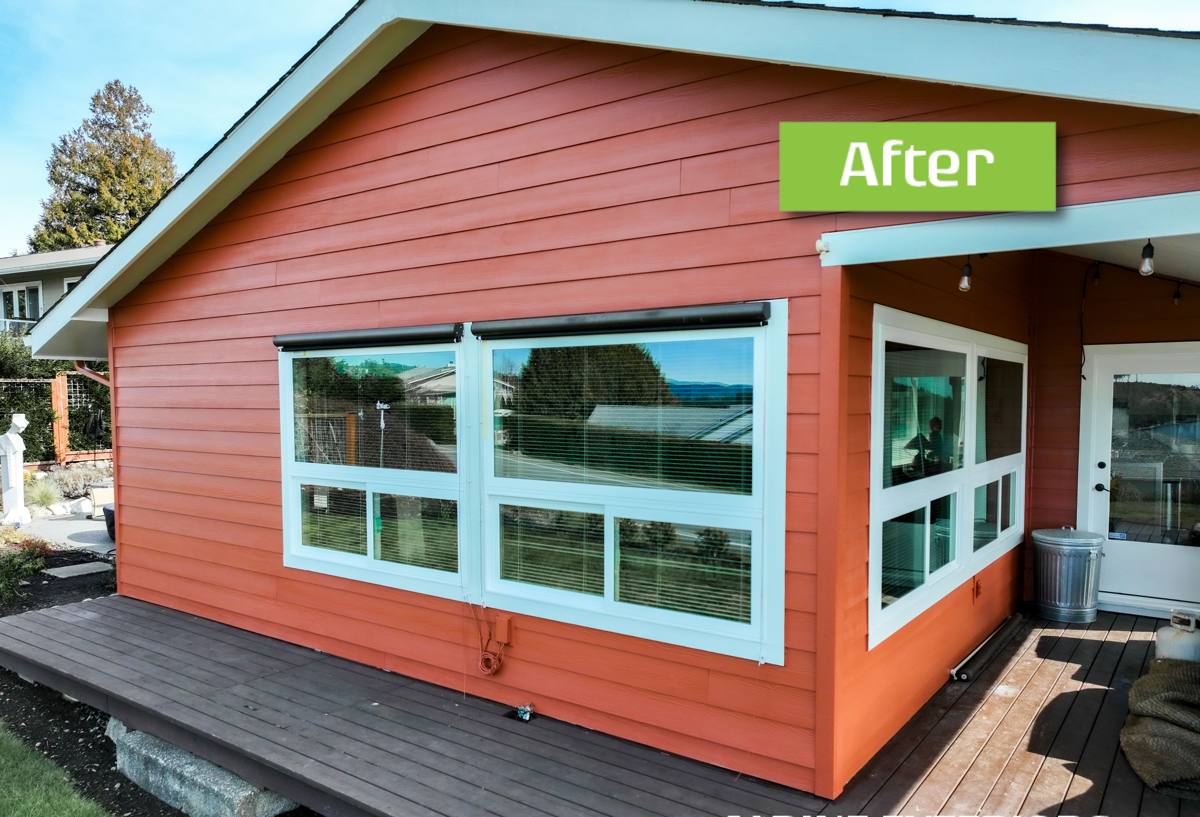
What "Energy-Efficient" Actually Means in This Climate
Energy efficiency for a window comes down to a few measurable properties, and which ones matter most changes with climate. In Blaine Harbor, we're a heating-dominated climate almost year-round — the goal is keeping warmth in, not keeping solar heat out.
- U-factor — measures how much heat escapes through the window. Lower is better, and it's the single most important number for our climate.
- SHGC (Solar Heat Gain Coefficient) — measures how much solar heat passes through. In a mostly-overcast, heating-dominated climate like ours, a moderate SHGC is usually fine; we're not fighting summer heat gain the way a desert climate would.
- Air infiltration rating — how much air leaks around a closed sash. This matters more here than in calmer climates, because sustained wind off the water puts real pressure on a window's seals, not just an occasional gust.
- Condensation resistance — how well the frame and glass edge resist interior condensation during cold, damp stretches. Poorly rated windows fog and sweat on the inside during our wettest months, which feeds mold and rot in the surrounding trim.
A window with a great U-factor rating on paper can still underperform if it's not sealed and installed to handle wind-driven rain and salt air specifically — the rating tells you what the product can do in a lab, not what it will do on a harbor-facing wall.
Frame Material: What Holds Up on the Water
Frame material choice matters more in Blaine Harbor than in most parts of Whatcom County, because salt air accelerates corrosion and UV/moisture cycling accelerates material fatigue. Here's how the common options generally compare for this specific exposure:
| Frame Material | Salt Air Exposure | Maintenance | Notes for Blaine Harbor |
|---|---|---|---|
| Vinyl | Good — won't corrode | Low | Solid all-around choice; verify UV-stable formulation and reinforced corners for wind exposure |
| Fiberglass | Very good — dimensionally stable, resists pitting | Low | Handles temperature swings and moisture cycling well; often a strong fit for harbor-facing walls |
| Wood-clad | Fair — cladding protects wood, but any breach lets moisture in | Moderate to high | Attractive option but demands disciplined sealant maintenance in this climate |
| Aluminum | Poor to fair without marine-grade coatings | Moderate | Prone to pitting and corrosion near open water unless specifically rated for coastal use |
We don't rule out any of these categories outright — wood-clad windows have real appeal for certain homes, and some aluminum products are built for coastal exposure. Our job is matching the material to how exposed a given wall actually is, not defaulting to one product line for every house.
Hardware and Weatherstripping
Locks, hinges, and cranks matter as much as the frame. Standard-grade hardware corrodes and seizes faster on a harbor-facing elevation than it will three blocks inland. We look for stainless steel or corrosion-resistant hardware and durable, compressible weatherstripping rated for repeated wetting — cheap foam gaskets compress permanently after a wet winter or two and stop sealing.
What a Correct Installation Actually Involves
A high-efficiency window installed poorly will underperform a modest window installed correctly — and in this climate, installation quality is often the bigger factor. The window itself only does its job if the wall around it is managing water correctly.
- Sill pan flashing — a sloped, sealed pan under the window rough opening that directs any water that gets past the window back outside, rather than into the wall framing.
- Proper flashing sequencing — flashing tape and building paper layered so water sheds downward and outward, shingle-style, at every seam.
- Compatible sealants — sealants and flashing tapes chosen for compatibility with the specific frame material and cladding, not a one-size-fits-all caulk.
- Correct shimming and fastening — the window squared and supported without bowing the frame, which can compromise the seal even on a well-made window.
- Insulation at the gap — the space between the window frame and rough opening filled with the right low-expansion insulation, not left open or overpacked.
- Interior and exterior trim sealed back up — every penetration and joint closed against wind-driven rain before we consider the job finished.
Skipping or rushing any one of these steps is how a good window ends up with a rot problem behind the wall five years later — a failure that has nothing to do with the window itself and everything to do with the install.
Our Process for Blaine Harbor Homes
1. On-Site Assessment
We start by walking the exterior and looking at each window's actual exposure — which walls take direct wind and rain off the water, which are more sheltered, and where we see early signs of moisture damage, moss growth, or failed seals.
2. Product Recommendation, Not a Default Sale
Based on that walk-through, we recommend frame material and glass packages by wall, not a single product for the whole house. A sheltered side yard window doesn't need the same spec as a wall facing the harbor directly.
3. Careful Removal
Old windows come out with attention to what's behind them — we check the sheathing and framing for hidden rot or moisture damage before anything new goes in, since covering up an existing problem defeats the purpose of the upgrade.
4. Installation with Full Water Management
Sill pans, flashing, compatible sealants, correct insulation, and finished trim — done in that order, every time, regardless of how mild the weather looks on install day.
5. Final Check
We test operation, check seals, and walk the job with the homeowner before we consider it done.
Signs Your Current Windows Are Losing the Fight
- Fogging or a milky haze between the panes — the seal has failed and the insulating gas has escaped
- Persistent condensation on the inside of the glass during cold, damp weeks
- Visible corrosion, pitting, or a chalky white residue on metal hardware or frames
- Moss or dark staining building up on sills or the trim just below the window
- Drafts you can feel near the frame on a windy day
- Soft or discolored trim or drywall around the window opening
- Windows that are hard to open, close, or lock — a sign the frame has swelled or shifted
One or two of these on an older window is normal wear. Several at once, especially on a harbor-facing wall, usually means the moisture management behind the window has already broken down.
Why Local Experience in Blaine Harbor Matters
A crew that mostly works drier, inland parts of Whatcom County will size up a window job differently than one that regularly works homes exposed to Semiahmoo Bay. Knowing which walls in this area take the worst of the wind-driven rain, which product lines actually hold up to sustained salt air rather than just resisting it in a showroom, and how the moss season here affects sill design and drainage — that's knowledge you build by working this specific stretch of coastline, not by reading a spec sheet. It also means a faster, more informed response if something needs a look after a bad storm, since we already know the conditions your home is dealing with.
Living With Salt Air After Installation
Even a well-installed, corrosion-resistant window benefits from basic upkeep in this environment. Rinsing salt residue off frames and glass periodically, keeping weep holes and drainage tracks clear of debris and moss buildup, and doing a quick visual check of exterior sealant after major storms will extend the life of the installation significantly. None of this is heavy maintenance — it's the kind of five-minute check that prevents small issues from becoming wall damage.
If you're dealing with drafty, foggy, or corroding windows on your Blaine Harbor home, we're happy to take a look and give you a straightforward, no-pressure estimate — just fill out the form below.