 Semiahmoo Exterior
 Building Decks for Lynden's Wet, Mossy Climate
A deck in Lynden lives a different life than a deck in Spokane or Phoenix. Whatcom County sits under the same marine weather system that pushes salt-laden air and driving rain into the Semiahmoo shoreline, and that same system dumps months of steady moisture on Lynden every fall through spring. Add the tree cover and irrigation common on Lynden properties, and you get long stretches where wood surfaces stay damp and shaded — exactly the conditions moss, algae, and rot organisms need to take hold.
None of that means you can't have a great deck here. It means the deck has to be built and finished with this climate in mind from the start, not treated like a generic add-on. The framing, the fasteners, the decking material, and the drainage details all have to account for months of standing moisture, not just an occasional rainstorm.
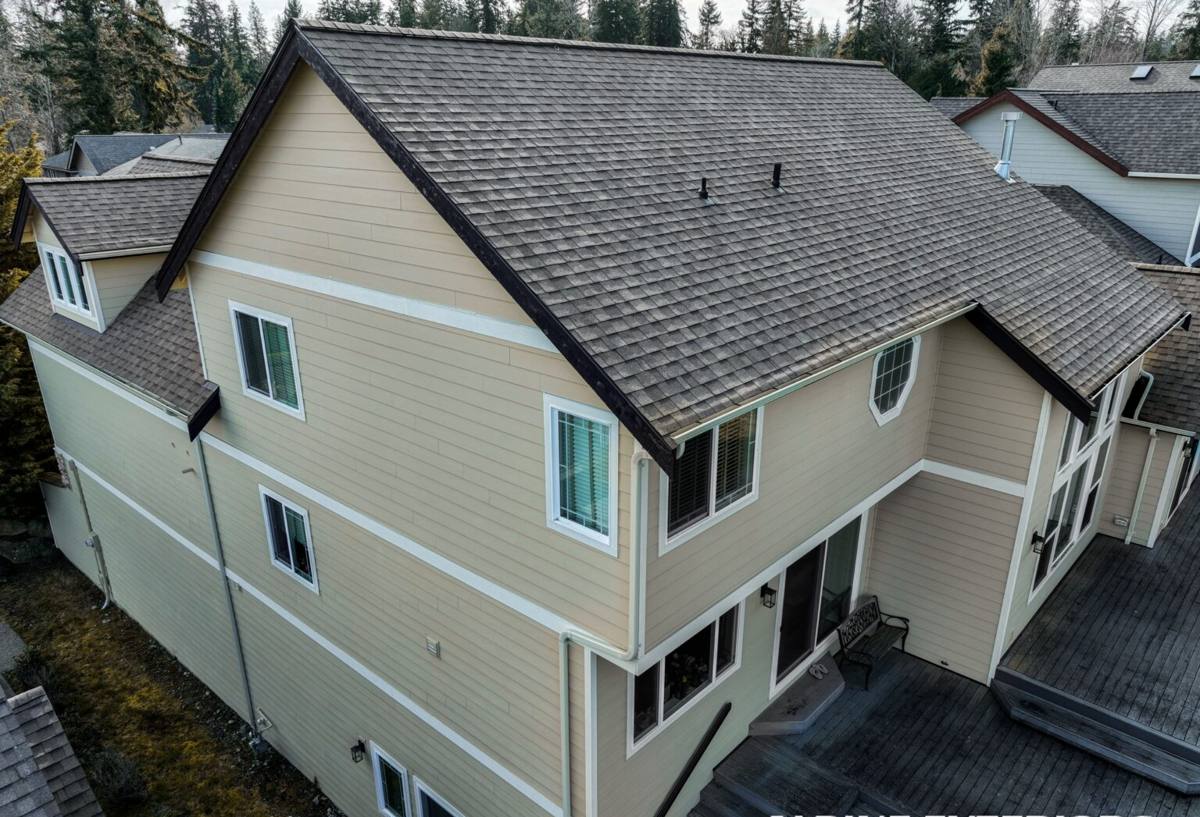
What Local Homes Actually Need From a Deck
Most deck problems we get called out to fix in this area trace back to a handful of root causes: undersized or poorly flashed ledger boards, joists that never get a chance to dry out, decking installed with no gap for airflow, and fasteners that weren't rated for pressure-treated lumber's chemical makeup. In a drier climate, sloppy work like this can go a decade before it shows. Here, it shows in two or three wet seasons.
Framing and Structure
Joists, beams, and posts need to be sized for the actual span and load, not just "what's always been done." Ledger boards attached to the house require proper flashing so water is directed away from the rim joist rather than trapped behind the siding. Post bases should hold wood off concrete or soil contact, since ground-level moisture is a year-round condition here, not a seasonal one.
Airflow Underneath
A deck built low to the ground with no ventilation underneath will hold humidity against the framing long after a storm passes. Where grading and height allow, we build in enough clearance and gaps between boards to let air move, which is one of the simplest ways to slow rot and mildew without adding cost.
Drainage Away From the House
Water needs somewhere to go. That means correct slope on any solid surface, gutters or drip edges that don't dump straight onto the deck, and grading below the deck that carries runoff away from the foundation instead of pooling under it.
Choosing a Decking Material for This Climate
There's no single "best" decking material — there's a best fit for your budget, your maintenance appetite, and how much shade and moisture your specific lot deals with. Here's how the common options actually perform under Whatcom County conditions.
| Material | Moisture Behavior Here | Maintenance | Typical Lifespan |
|---|---|---|---|
| Pressure-treated wood | Resists rot with proper sealing, but absorbs water and can cup or check if finish is neglected | Annual cleaning, re-sealing every 1-3 years | 15-20 years with upkeep |
| Cedar | Naturally rot-resistant, ages to gray if unsealed; still needs finish to prevent moss growth | Cleaning and finish every 1-2 years | 15-25 years with upkeep |
| Composite | Doesn't absorb water or rot, but can stay damp on the surface longer, which feeds surface algae/moss without regular cleaning | Periodic washing, no staining or sealing | 25-30+ years |
| PVC / capped polymer | Fully water-resistant, most consistent performance in shaded, damp spots | Occasional washing | 25-30+ years |
We install all of these. The honest trade-off is that wood costs less up front but asks for more of your time every year, while composite and PVC cost more up front and ask for almost nothing but a hose and a brush. Neither is "better" in the abstract — it depends on whether you'd rather spend money now or maintenance hours later.
Railings, Stairs, and Code Basics
Any deck built above a certain height off grade needs a permit, guardrails, and stairs that meet Washington's adopted building code. Guardrails generally need to reach a minimum height with baluster spacing tight enough that a small child can't pass through, and stair rise and run have to stay consistent from step to step — inconsistent stairs are one of the most common trip hazards on older decks we get asked to repair. We pull permits and build to code as standard practice, not as an upsell, because it's what protects you if you ever sell the house or file an insurance claim after an accident.
Our Process for a Custom Deck in Lynden
1. On-Site Walkthrough
We look at your lot's grading, shade pattern, drainage, and how the house's roofline and gutters interact with where you want the deck. This tells us as much about the build as your Pinterest board does.
2. Design and Material Selection
We talk through layout, size, and material honestly — including what each option will actually cost you in upkeep over the years you'll own the house, not just the sticker price today.
3. Permitting
We handle the permit application and inspections required for the scope of work, so you're not the one chasing paperwork or scheduling inspectors.
4. Build
Footings, framing, decking, railings, and stairs, built in that order with each stage checked before the next begins. We don't cover framing with decking until flashing and fastening are right, because that's the part you can't inspect again once it's closed up.
5. Walkthrough and Care Guidance
Before we call it done, we walk the finished deck with you and explain what maintenance it actually needs given the material you chose and where the deck sits on your property.
Keeping a Deck Ahead of Moss and Mildew
Every deck material benefits from a basic seasonal routine here — the difference between materials is how much routine they need, not whether they need any at all. A little consistency goes a lot further than an occasional deep clean after moss has already taken hold.
- Sweep leaves and debris off the surface regularly, especially in fall — trapped organic matter holds moisture and feeds moss
- Rinse or wash the deck surface a few times a year, more often in heavily shaded spots
- Check and clear gaps between boards so water and debris don't pack in and hold moisture against the wood
- Inspect ledger flashing and fastener heads annually for rust, staining, or gaps
- Re-seal or re-stain wood decking on the schedule the product calls for — don't wait until it looks bad
- Keep gutters and downspouts clear so water isn't dumping directly onto or under the deck
Cost Factors for a Custom Deck
Every deck is priced around its own combination of size, material, height off grade, and site access, so we won't put a number here that doesn't apply to your project. What consistently moves the price up or down is:
- Size and shape: multi-level decks, curves, and odd angles take more labor than a simple rectangle
- Height off grade: taller decks need deeper footings, more structural framing, and stairs
- Material choice: composite and PVC decking cost more per square foot than pressure-treated wood, cedar sits in between
- Railing style: cable, glass, or custom metal railings cost more than standard baluster railings
- Site access: a backyard that's hard to reach with equipment or material adds labor time
- Permitting and inspection scope: larger or taller decks may require engineering review
We give straight numbers based on your actual site and choices, not a vague range pulled from a website.
Why It Matters That We Already Work in Lynden
Building decks in this part of Whatcom County means building for wet, shaded conditions as the default, not the exception. A crew that mostly works drier inland climates will size framing, choose fasteners, and detail flashing for a different set of assumptions than what actually holds up here. We work this region regularly, which means we've seen what a poorly flashed ledger board or an unventilated deck frame looks like after a few wet seasons — and we build to avoid it the first time, rather than fixing it later.
It also means we're not guessing at permitting requirements or local inspection expectations. Knowing the process ahead of time keeps your project moving instead of stalling on paperwork.
Let's Talk About Your Deck
If you're planning a new deck or replacing one that's showing its age, we're happy to take a look and give you a straight, no-pressure estimate — including an honest read on which materials make sense for your specific spot on the property. Fill out the form below to get started.