 Semiahmoo Exterior
 Building Decks for Custer's Marine Climate
Custer sits close enough to the water and far enough into Whatcom County's marine weather pattern that decks here take a different kind of beating than decks built inland or in a drier climate. Salt-laden air off the Strait works into fasteners and hardware. Driving rain off winter storms doesn't fall straight down — it comes in sideways and finds every gap in flashing, decking gaps, and post bases. And the long stretch of grey, wet months between fall and spring gives moss and algae months to take hold on any surface that doesn't shed water and dry out fast.
None of that means a deck can't last decades here. It means the deck has to be built with those specific conditions in mind from the footings up, not just finished with a nice-looking board on top. That's the difference between a deck that needs real repair work in eight years and one that's still solid in twenty-five.
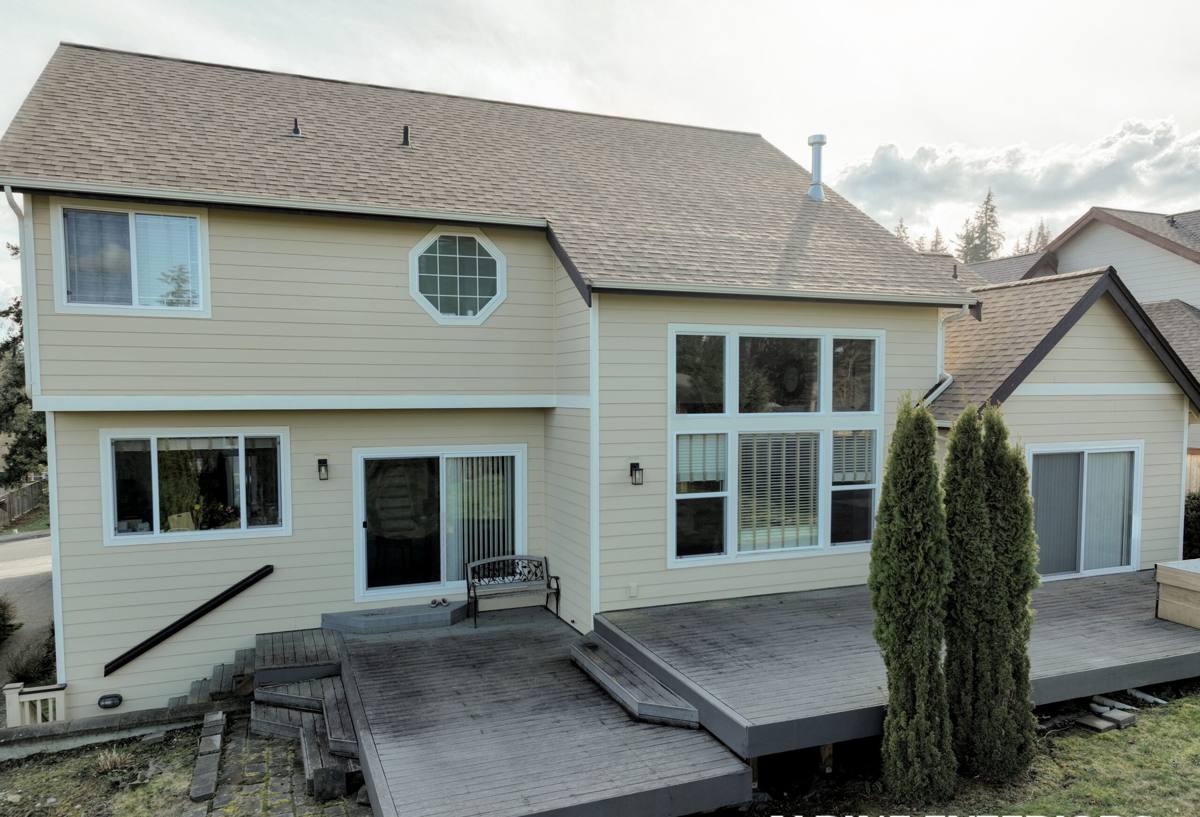
What a Custer Deck Actually Needs to Hold Up
A deck built for this area has to manage three things at once: moisture shedding, airflow underneath, and corrosion resistance in every fastener and connector. Skip any one of the three and the deck will show it early, usually in the form of soft spots near ledger boards, rust streaks bleeding down joists, or a slick green film on the walking surface by the second winter.
Moisture Management
Every horizontal surface on a deck is an opportunity for water to sit. Proper board spacing, correct slope away from the house, and flashing at the ledger connection where the deck meets the structure are not optional details — they're the parts of the job that determine whether the framing underneath stays dry or slowly rots from the inside.
Airflow Underneath
A deck built low to the ground or boxed in without ventilation traps damp air against the joists year-round. In a climate that gets this much sustained rain, that trapped moisture is exactly what invites rot and mold in framing lumber, even lumber that was rated for ground contact or pressure-treated.
Corrosion-Resistant Hardware
Salt air accelerates corrosion on standard fasteners faster than most homeowners expect. Hardware rated for coastal or high-moisture exposure — hot-dip galvanized or stainless structural connectors — costs more up front but avoids the failure point that shows up first on cheaper builds: rusted-out joist hangers and screws that shear off under load.
Decking Material Options for This Climate
There's no single "best" decking material for Custer — there's a best material for your budget, your maintenance appetite, and how much direct weather exposure your deck will actually get. Here's how the common options compare under local conditions.
| Material | How It Handles Rain & Moss | Maintenance | Typical Lifespan Here |
|---|---|---|---|
| Pressure-treated wood | Needs sealing to shed water well; moss will grow on shaded, damp boards without upkeep | Annual cleaning and periodic re-sealing | 15-20 years with upkeep |
| Cedar | Naturally moisture-resistant but still needs finish maintenance in this much rain | Regular cleaning, re-oiling or staining every 1-3 years | 15-25 years with upkeep |
| Composite decking | Sheds water well; capped composites resist moss better than wood but still need cleaning in shaded, damp spots | Periodic washing, no sealing or staining | 25-30+ years |
| PVC decking | Fully synthetic, minimal water absorption, low moss adhesion | Occasional washing | 30+ years |
We'll walk through which of these fits your yard's sun and shade pattern, your budget, and how much maintenance you actually want to do — a shaded, north-facing deck under trees behaves very differently than one that gets full afternoon sun.
Framing, Footings & Drainage — Where Cheap Decks Fail First
The decking boards are the part everyone sees. The framing, footings, and drainage are the part that determines whether the deck is still safe to stand on a decade from now. This is where corners get cut on budget builds, and it's also the part that's expensive and disruptive to fix after the fact.
- Footings set below frost depth and sized for the actual load of the deck, not a generic minimum
- Post bases that keep wood off standing water, with a gap for drainage and airflow
- Ledger board flashing that directs water away from the house rim joist, not into it
- Joist spacing and blocking that matches the decking material's actual span rating
- A consistent slope away from the house so water doesn't pool against the foundation
We treat these as the non-negotiable part of the job. The visible finish work only lasts if what's underneath it is done right the first time.
Our Deck Building Process
We run every Custer deck project through the same sequence, whether it's a small replacement deck or a larger new build:
- On-site assessment — we look at sun exposure, drainage patterns, existing structure (for replacements), and how the space will actually be used
- Material and layout discussion — honest trade-offs on wood versus composite versus PVC based on your budget and maintenance preference, not a sales pitch toward the highest-margin product
- Permitting — we handle the Whatcom County permit application and inspection scheduling where required
- Demolition and site prep — removing old decking and framing where applicable, checking the ledger connection and rim joist for hidden rot before building over it
- Footings and framing — built to code minimums or better, with corrosion-resistant hardware throughout
- Decking, railing, and finish work — installed with proper spacing and fastening for the material chosen
- Final walkthrough — we go over maintenance expectations specific to the material you picked before we consider the job done
Permits and Code in Whatcom County
Most new decks and many deck replacements in Whatcom County require a building permit, particularly once you're above a certain height off grade or attaching to the structure of the house. Requirements can vary depending on the specifics of the project and where the property sits relative to Custer's unincorporated area versus nearby city limits. We handle the permit application and inspection scheduling as part of the job so you're not tracking that down yourself — but if you're planning a smaller freestanding project and want to know upfront whether it needs a permit, ask us before you start and we'll give you a straight answer.
Maintenance to Expect After We Build
Every decking material needs some upkeep in this climate — the honest question is how much and how often. Here's a general checklist we give homeowners regardless of which material they choose:
- Sweep off leaves and debris regularly, especially in fall — trapped organic material holds moisture and feeds moss
- Rinse or scrub off algae and moss buildup at least once a year, more often in shaded spots
- Check and clear gaps between boards so water keeps draining through rather than pooling
- Inspect railing connections and stair fasteners annually for looseness or corrosion
- Re-seal or re-stain wood decking on the schedule appropriate to the product — don't wait until it's visibly grey and cracking
- Keep gutters and downspouts near the deck clear so runoff isn't dumping directly onto or under it
Cost Factors for a Custer Deck Project
Every deck is different, but the price is driven by a consistent set of factors. Rather than quote a number that won't mean much without seeing your project, here's what actually moves the cost up or down:
| Factor | Effect on Cost |
|---|---|
| Decking material chosen | Pressure-treated is the lowest upfront cost; PVC and premium composites cost more but reduce long-term maintenance |
| Deck height off grade | Taller decks need more substantial footings, framing, and often railing engineering |
| Size and shape | Multi-level decks or non-rectangular layouts add labor and material complexity |
| Site access | Tight side-yard access or sloped lots can increase labor time for material handling and equipment |
| Demolition needs | Replacing an old deck adds removal and disposal cost, plus potential hidden repair work at the ledger |
| Railing and stair complexity | Custom railing, multiple stair runs, or built-in features add both material and labor |
Why Hire a Crew That Already Works Custer
A deck building crew that already works in and around Custer knows what this area's rain and moss season actually does to a deck over time, because we've seen it firsthand on other local projects — not from a general regional guideline. That means we're not guessing at what hardware, flashing details, or material spacing hold up here; we're building to what's already proven out on decks we can point to nearby. It also means we understand Whatcom County's permitting process well enough to keep that part of the project moving instead of stalling it.
If you're weighing a new deck or a replacement in Custer, we're happy to come take a look, talk through material options honestly, and put together a straightforward estimate. There's no pressure and no obligation — just a clear look at what your project actually needs.