 Semiahmoo Exterior
 Why Custer Decks Take a Different Kind of Beating
Custer sits close enough to the water and open farmland that decks here deal with a combination most inland homes never see: salt-laden air drifting off Semiahmoo Bay and the Strait, driving rain that comes in sideways more often than straight down, and a moss and algae season that can run eight months out of the year in a shaded yard. None of that is dramatic on its own. Together, over a few winters, it's what turns a cheap or poorly installed deck into a slick, stained, cupping mess while a properly built one down the street still looks and performs the way it did the day it went in.
We're not describing a worst-case scenario — this is just what Whatcom County weather does to exterior wood and wood-alternative surfaces every year. A composite deck built for Custer needs to shed water fast, resist organic growth without constant scrubbing, and hold its fasteners and framing tight through repeated wet-dry cycles. That's the standard we build to.
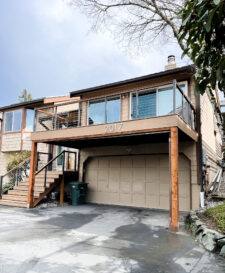
What "Correct" Composite Decking Looks Like Here
Framing and Substructure First
The deck board is the part homeowners see, but the framing underneath is what decides whether that board stays flat, quiet, and dry over time. In this climate we pay particular attention to:
- Joist spacing tightened to the composite manufacturer's wet-climate spec, not just the minimum code spacing meant for drier regions
- Joist tape or a comparable moisture barrier on every cut and top edge, since untreated cut ends are where rot starts fastest
- Proper slope away from the house — usually a slight pitch built into the framing, not left to the decking to correct
- Ledger board flashing that actually integrates with the home's water-resistive barrier, not just caulked and hoped for
- Post bases and hardware rated for coastal exposure, since standard zinc-coated fasteners corrode faster this close to salt air
Ventilation Underneath
A deck built low to the ground or over a patio slab with no airflow underneath will trap moisture no matter how good the board on top is. We check clearance and, where the design allows it, build in venting or gap spacing so air can move and moisture can actually leave instead of sitting under the boards all winter.
Composite vs. Other Decking Materials for This Climate
Homeowners in Custer usually compare composite against pressure-treated wood or cedar. Here's the honest breakdown based on how each performs in a wet, salt-air, moss-prone environment — not brand marketing.
| Material | Moisture Behavior | Moss/Algae Resistance | Ongoing Maintenance |
|---|---|---|---|
| Composite decking | Doesn't absorb water into the board core; surface can still get slick if not cleaned | Capped boards resist staining but still need periodic cleaning in shade | Occasional wash; no staining or sealing |
| Pressure-treated wood | Absorbs and releases moisture constantly; prone to cupping and checking | Grain holds moisture, feeding growth faster | Annual cleaning, sealing, and inspection for soft spots |
| Cedar | Naturally moisture-resistant but still a wood product exposed to the elements | Better than treated pine but still needs upkeep | Regular oiling/sealing to hold color and resist weathering |
Composite isn't maintenance-free — we tell every customer that upfront. It still needs periodic washing, especially in shaded or north-facing yards where moss gets a foothold. What it doesn't need is annual sealing, sanding, or staining, and that's the trade-off most Custer homeowners are actually looking for.
Fasteners, Boards, and Finish Details That Actually Matter
A lot of what separates a deck that lasts from one that doesn't isn't the board brand — it's the small stuff installers skip to save time. On every composite deck we build, that includes:
- Hidden fastener systems sized and spaced correctly for the board's expansion and contraction range
- Picture-frame or end-cap detailing on exposed board ends so raw cut edges aren't left absorbing water
- Stainless or coated fasteners throughout, given the corrosive effect of salt-laden coastal air
- Board gapping set for our actual humidity and temperature swings, not a generic factory chart
- Railing post attachment reinforced below deck level, since railing failure is almost always a structural connection problem, not a railing problem
Skipping any one of these doesn't usually show up in year one. It shows up in year three or four, as squeaking, staining around fasteners, or boards that have shifted out of alignment.
Dealing With Moss, Algae, and Standing Water
Custer's tree cover and damp winters make moss and algae a fact of life on any north-facing or shaded deck. Composite boards with a quality cap layer resist staining better than raw wood, but "resist" doesn't mean "immune." A few things make a real difference:
- Board profiles with grooved or textured surfaces that don't trap standing water in low spots
- Gaps between boards sized to actually drain, not just look uniform
- Keeping gutters and downspouts clear so runoff isn't dumping directly onto or under the deck
- A simple seasonal rinse — soap, water, and a soft brush — before moss gets established rather than after
We design and install with all of this in mind rather than treating moss control as something the homeowner has to fight after the fact.
Our Process for a Custer Composite Deck
1. On-Site Assessment
We walk the site, check drainage patterns, sun/shade exposure, and how close the deck sits to grade or existing structures. This tells us how aggressive the moisture and ventilation detailing needs to be for that specific yard.
2. Design and Material Selection
We talk through board profiles, color, and railing options based on your home and budget — and we're straightforward about which composite lines hold up best in coastal, high-moisture settings versus which are better suited to drier inland installs.
3. Permitting and Framing
Whatcom County permitting requirements apply based on deck height, attachment to the home, and footprint. We handle that process and build the substructure to hold up under our wet-dry cycle, not just pass a one-time inspection.
4. Installation
Framing, flashing, decking, and railing go in with the fastening and gapping details above. We don't rush board installation — expansion gaps and fastener torque done wrong are two of the most common causes of early composite deck failure.
5. Walkthrough and Care Guidance
Before we leave, we walk the finished deck with you and explain the actual maintenance it needs — which, for composite, is minimal but not zero.
What Drives the Cost of a Composite Deck
Every project is different, but the same factors move the price up or down on most jobs we quote in this area.
| Factor | Why It Matters |
|---|---|
| Deck size and shape | Complex shapes, multiple levels, or curves add labor and material waste |
| Height above grade | Taller decks need heavier framing, railing, and sometimes stairs |
| Board tier | Composite lines range from entry-level capped boards to premium multi-layer products |
| Site access | Tight side yards or sloped lots increase labor time for material and equipment |
| Railing and lighting | Cable rail, glass panels, and integrated lighting add cost beyond a basic rail |
| Substructure condition | Rebuilding or reinforcing existing framing adds scope on replacement projects |
We give straightforward, itemized estimates rather than a single vague number, so you can see exactly where the budget is going and what's optional versus structural.
Deck Health Checklist for Custer Homeowners
If you already have a deck — composite or otherwise — these are the warning signs worth checking each fall before the wet season sets in:
- Soft or spongy spots anywhere on the deck surface or around post bases
- Rust streaks or dark staining around fastener heads
- Standing water that doesn't drain within a few hours after rain
- Moss or algae buildup concentrated in one shaded area
- Railing posts that flex or feel loose when pushed
- Gaps between boards that have visibly widened or closed unevenly
- Any separation where the deck ledger meets the house
Catching these early is usually a repair. Catching them late is usually a rebuild.
Why a Crew That Already Works Custer Makes a Difference
Decking installers who don't work this specific area regularly tend to build to a generic spec — the same detailing they'd use for a dry inland climate. That's how you end up with a deck that looks fine at handoff and starts showing problems within a couple of wet seasons. A crew that's already handling exterior work throughout Semiahmoo and the surrounding Whatcom County communities knows what the salt air does to fasteners, how fast moss establishes on a shaded north wall, and how much slope and ventilation this specific weather pattern actually demands — not what a manufacturer's national install guide assumes.
That local familiarity also means faster, more accurate estimates, since we're not guessing at permitting timelines or typical site conditions in your neighborhood — we've already worked through them on nearby projects.
If you're planning a new composite deck or want an honest look at one that's already showing wear, we'll come out, walk the site, and give you a straightforward, no-pressure estimate — just fill out the form below.