 Semiahmoo Exterior
 Composite Decking in Marietta: Built for a Waterfront Climate
Marietta sits close to the water along Semiahmoo Bay and Drayton Harbor, which means homes here deal with a version of Whatcom County weather that's a step harsher than what you'll find further inland. Salt-laden air moves off the water, rain comes in sideways more often than not, and shaded, damp yards grow moss on almost anything that sits still long enough. A deck built for a dry inland lot doesn't hold up the same way here. Composite decking, installed correctly for this specific environment, is one of the few outdoor surfaces that can handle it without turning into a yearly maintenance project.
This page is about composite decking specifically for Marietta properties — what the climate actually does to a deck near the water, what a correct installation looks like, and how we approach the job differently than a crew that only builds decks a few miles inland where conditions are milder.
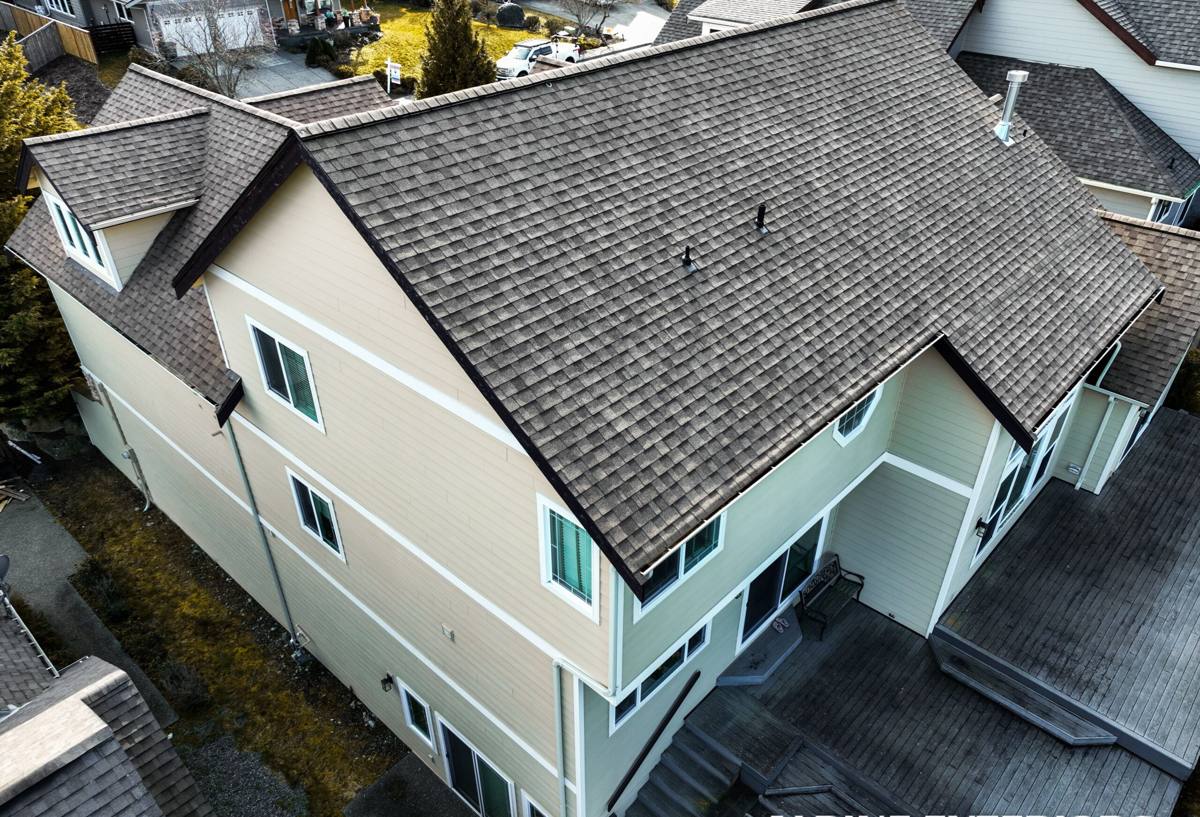
What Salt Air, Rain, and Moss Actually Do to a Deck
It helps to understand the specific stresses at play before talking about materials or installation, because each one attacks a deck differently.
Salt Air
Airborne salt from Semiahmoo Bay settles on every exterior surface, including decking, railings, and hardware. On wood, it accelerates weathering and graying. On metal fasteners and connectors, it speeds up corrosion — this is the part homeowners underestimate most, because the boards can look fine while the hidden hardware underneath is degrading.
Driving Rain
Whatcom County storms coming off the water don't fall straight down — wind pushes rain sideways, which means it gets into gaps, seams, and ledger connections that a calmer inland rain never would. Water that would normally run off a flat surface instead gets driven into joints, fastener holes, and the point where the deck meets the house.
Moss Season
Shaded, moisture-holding surfaces near the water grow moss for a large part of the year. Moss holds water against whatever it's growing on, and if it's growing in fastener heads or board grooves, it keeps that spot wet long after the rest of the deck has dried. Over time that constant dampness finds any weak point in the material or the install.
None of these on their own is dramatic. Together, over years, they're what separates a deck that still looks good after a decade from one that's warped, stained, or structurally soft underneath a fine-looking surface.
Why Composite Makes Sense for a Marietta Property
We install composite decking because it responds to this specific combination of conditions better than the alternatives, not because it's trendy. A few honest points of comparison:
| Material | Salt air behavior | Moss/moisture behavior | Ongoing maintenance |
|---|---|---|---|
| Pressure-treated wood | Fasteners corrode faster; wood grays and can split | Absorbs moisture, feeds moss and mildew growth | Annual sealing/staining recommended |
| Cedar or other natural wood | Weathers faster near salt air without regular sealing | Prone to moss, soft spots, splintering if untreated | Sealing every 1-2 years, board replacement over time |
| Capped composite | Cap layer resists salt residue and staining | Non-porous surface sheds moisture, resists moss adhesion | Periodic washing, no sealing or staining |
| PVC decking | Fully synthetic, very resistant to salt exposure | Non-porous, sheds water well | Low; can run warmer underfoot in direct sun |
Composite isn't maintenance-free — nothing outdoors near the water truly is — but it removes the two biggest recurring jobs wood demands: sealing/staining and chasing rot before it spreads. That matters more in Marietta than it would somewhere drier, simply because the wet season here is longer and the salt exposure is constant rather than occasional.
What a Correct Composite Deck Install Actually Involves
Composite boards themselves are fairly forgiving, which is exactly why a lot of installation mistakes get hidden rather than caught early. The board looks fine on day one regardless of what's underneath it. The parts that actually determine whether a deck lasts are the parts you don't see once it's finished.
Framing and Structure
The substructure carries the real weight, and it's usually still wood — pressure-treated joists and beams. In a damp, salt-air environment, that framing needs joist tape or a comparable moisture barrier on top of every joist, stringent attention to end-cuts (which lose their factory treatment and need to be sealed), and spacing that accounts for proper drainage and airflow underneath.
Fasteners and Hardware
This is the single most common corner cut we see. Standard or mismatched fasteners corrode faster near salt air, and once a fastener starts failing, it can stain the board around it or loosen the board itself. We use fastener and hardware systems rated for coastal/marine-adjacent exposure — it costs more up front and it's the difference between hardware that lasts and hardware that needs replacing in a few years.
Ledger Board Connection
Where the deck attaches to the house is the highest-risk point for water intrusion, especially with driving rain coming off the water. Proper flashing at the ledger — installed so water is directed out and away from the house framing, not just caulked and hoped for — is non-negotiable here.
Drainage and Airflow
Composite doesn't rot, but the framing underneath still can if water and moss are allowed to sit against it. Correct spacing between boards, clearance under the deck, and grading that moves water away from the structure all matter more in a climate that stays wet for a large part of the year.
Board Layout and Expansion Gaps
Composite expands and contracts with temperature swings. Gaps at butt joints, picture-frame borders, and against the house need to be sized correctly — too tight and boards can buckle; too loose and it looks sloppy and collects debris.
Our Process for a Marietta Composite Deck
- Site assessment — we look at sun/shade exposure, drainage patterns, proximity to the water, and existing structure condition before quoting anything.
- Structural check — existing footings, posts, and framing get evaluated; anything undersized or already showing moisture damage gets addressed before new decking goes on top of it.
- Material selection — we walk through composite options based on your budget, sun exposure, and how much upkeep you actually want to do, not just the highest-margin product.
- Moisture protection install — joist tape, sealed cuts, and corrosion-resistant hardware go in before a single board is laid.
- Board installation — proper fastening system, correct spacing, and attention to ledger flashing and drainage.
- Railing and finish work — hardware matched to the same corrosion-resistant standard as the deck itself.
- Final walkthrough — we go over what maintenance (if any) the specific product you chose actually needs.
Choosing the Right Board for Your Yard
Not every composite product is the right fit for every spot on a Marietta lot. A few factors that actually change the recommendation:
| Factor | Why it matters here |
|---|---|
| Shade level | Shaded areas near trees or the north side of a house hold moisture longer and grow moss faster — a board with a textured, moss-resistant cap performs better there |
| Distance from the water | Closer lots see more direct salt exposure on hardware and railings, which pushes us toward marine-grade fasteners regardless of board choice |
| Sun exposure | South- and west-facing decks see more UV fading over time; lighter or capped colors tend to hold up better than deep, dark tones |
| Foot traffic and use | High-use decks benefit from a denser board with better scratch and stain resistance around grills or furniture |
| Budget | Capped composite generally costs less upfront than full PVC; PVC costs more but handles constant moisture exposure slightly better |
Living With a Composite Deck in This Climate
Composite cuts down maintenance significantly, but "low maintenance" isn't "no maintenance," especially this close to the water. A short seasonal checklist we give clients:
- Rinse or sweep the deck surface regularly through moss season to keep spores from settling into board grooves
- Use a soft-bristle brush and a composite-safe cleaner for any visible moss or algae — avoid pressure washing directly into seams, which can force water where it doesn't belong
- Check railing hardware and fastener heads once or twice a year for early signs of corrosion or staining
- Keep gutters and downspouts near the deck clear so runoff isn't dumping extra water onto or under the structure
- Trim back vegetation that's shading the deck and keeping it damp longer than it needs to be
- Confirm drainage under the deck isn't blocked by debris, especially after fall and winter storms
Mistakes We Commonly Find on Existing Decks
When we're called out to look at a problem deck in this area, the same handful of issues show up repeatedly:
- Standard fasteners used instead of corrosion-resistant hardware, showing rust stains within a few years
- No joist tape or moisture barrier, leading to rot in the framing underneath boards that still look fine on top
- Ledger boards flashed poorly or not at all, with water intrusion into the house rim joist
- Boards installed with no expansion gap, causing buckling after a hot stretch
- Poor under-deck drainage, letting moss and standing water sit against the structure through the wet months
Every one of these is preventable at install time and expensive to fix after the fact. Catching them early — or better, never having them happen — is the whole point of hiring a crew that understands this specific environment.
Why It Matters to Hire a Crew That Already Works Marietta
A composite deck built to a generic inland spec will still look acceptable when it's finished. The difference shows up three, five, ten years later, when the hardware a general contractor didn't upgrade starts rusting, or the ledger flashing that was "good enough" elsewhere lets water into the house during a wind-driven rain. Building for Marietta means treating the salt air, the rain direction, and the moss season as design inputs from the start — not problems to deal with after they show up.
We work throughout the Semiahmoo area and understand what this specific stretch of Whatcom County coastline does to an outdoor structure over time. That's not a marketing line — it's the reason our material and hardware choices, and our approach to framing and flashing, are consistently a step up from a standard build.
If you're planning a new composite deck or want an honest look at whether an existing one was built to hold up here, we're happy to come out, walk the site, and give you a straightforward assessment. Reach out using the form below for a free, no-pressure estimate.