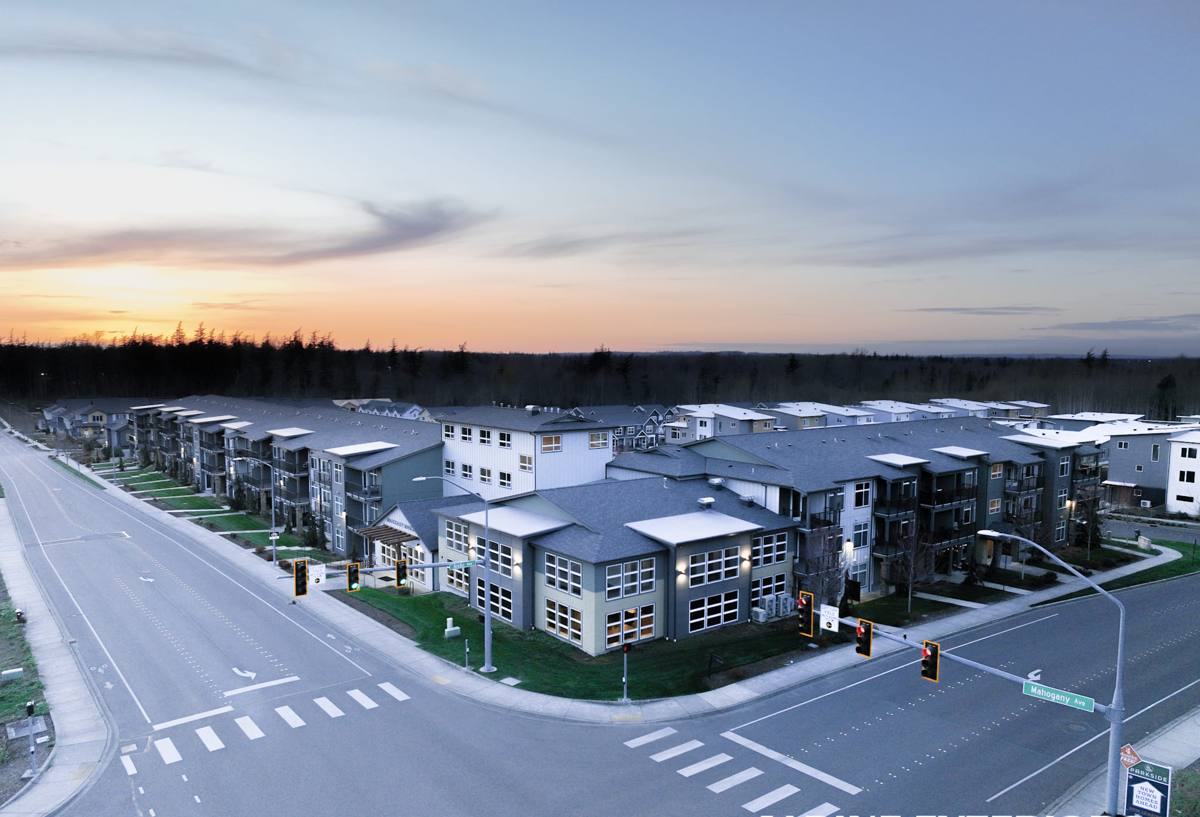
 Semiahmoo Exterior
 Why California Creek Homes Take a Different Kind of Beating
California Creek sits close enough to Semiahmoo Bay and Drayton Harbor that homes here deal with a combination most siding was never designed for: salt-laden air off the water, wind-driven rain that hits walls sideways instead of straight down, and long stretches of gray, damp weather that keep exterior surfaces wet for days at a time. Add in the tree cover common to this part of Whatcom County and you get a fourth factor — moss and algae season that can run from fall through spring.
None of this is unusual for northwest Washington. But it adds up faster on a wall system that isn't built for it. Salt air accelerates corrosion on fasteners and trim. Driving rain finds gaps in flashing and caulk that would never leak in a drier climate. Moss holds moisture directly against the siding surface for weeks, which is a slow but steady path to rot on wood-based products. A siding choice that works fine in a dry inland climate can struggle here within a decade.
What We Actually Install: James Hardie Fiber Cement
We install James Hardie fiber cement siding exclusively. We don't offer vinyl, LP SmartSide, Cemplank, Allura, primed spruce, or cedar as alternatives, and we're upfront about why: none of them hold up to this specific combination of salt exposure, sustained moisture, and moss as consistently as Hardie's fiber cement over a full service life. Fiber cement is made from cement, sand, and cellulose fibers — it doesn't have the organic wood content that gives moss and rot something to feed on, and it doesn't degrade the way vinyl can under long-term UV and thermal cycling.
For this specific area, we typically spec Hardie's HZ5 climate-engineered product line, which is formulated for wetter, more moisture-exposed regions. It resists moisture-related damage better than Hardie's HZ10 line built for hot-dry climates, and it holds ColorPlus factory-applied finish exceptionally well in conditions where field-applied paint would fail faster.
Why Factory Finish Matters Near the Water
ColorPlus is baked on at the factory in multiple coats under controlled conditions, not brushed or sprayed on site. In a salt-air environment, that matters more than it would inland — field-applied paint has a harder time curing properly in persistent coastal humidity, and it's the first thing to show chalking, fading, or peeling when it does fail. A factory finish gives you a more consistent, longer-lasting color that isn't dependent on the weather window during your installation week.
What Correct Installation Actually Involves
Fiber cement is only as good as the installation behind it. The material can perform for decades, or it can fail early, and the difference almost always comes down to details most homeowners never see once the siding is up. On a property exposed to driving rain like this one, we treat these as non-negotiable:
- Correct water-resistive barrier (house wrap) installed and lapped properly before any siding goes on
- Flashing at every window, door, and roof-to-wall transition, installed to shed water outward, not trap it
- Rainscreen or proper drainage gap where conditions call for it, so bulk water has somewhere to go besides the wall cavity
- Manufacturer-specified fastener spacing and depth — over-driven nails crack the board and under-driven ones work loose over time
- Proper clearance from grade, decks, and roof lines so siding never sits in standing water or gets buried by landscaping
- Caulking only where James Hardie's install guide calls for it — not as a substitute for missing flashing
- Butt joints and corners sealed and finished per manufacturer spec, since these are the first places water finds a way in
Every one of these steps is described in James Hardie's own installation manual. The material's warranty depends on following it. That's a big part of why we don't subcontract this work out to whoever's available — our crews install Hardie repeatedly, in this exact climate, and know where this region's weather tends to expose a shortcut.
What We See Go Wrong on Older Homes in This Area
When we're called out to look at siding problems on homes near California Creek and the wider Semiahmoo area, a handful of patterns show up again and again:
Moss holding moisture against the wall. On wood-based or improperly ventilated siding, moss doesn't just look bad — it keeps the surface damp for extended periods, which is exactly what accelerates rot underneath.
Failed caulk joints doing the work flashing should be doing. Caulk is a maintenance item, not a waterproofing system. When it's used to cover for missing or improperly lapped flashing, the wall looks fine right up until it isn't.
Fastener corrosion and staining. Salt air is hard on standard fasteners. Streaking below nail heads is often an early sign that the wrong fastener spec was used for a coastal property.
Paint failure on field-finished siding. Persistent humidity makes it difficult for site-applied paint to cure evenly, and coastal exposure speeds up chalking and fading once it does.
Our Process, Start to Finish
- On-site assessment. We walk the exterior, check for existing moisture damage, moss buildup, and flashing condition, and look at what's actually happening behind the current siding where accessible.
- Written estimate. You get a clear scope of work — what's being removed, what's being replaced, which Hardie product and finish, and what happens with trim, flashing, and water-resistive barrier.
- Prep and tear-off. Old siding comes off, the sheathing gets inspected for hidden rot before anything new goes on, and any needed repairs are addressed before we move forward.
- House wrap and flashing. This is the layer that actually keeps water out — it goes on correctly the first time, not as an afterthought.
- Hardie installation. Fastening, spacing, and joint treatment follow James Hardie's installation manual, adjusted for this property's specific exposure to wind and rain direction.
- Final walkthrough. We go over the finished job with you, including what routine maintenance looks like going forward.
Cost Factors to Expect
Every home is different, but the variables that move the price on a fiber cement job in this area are fairly consistent. This isn't a quote — it's a guide to what you're actually paying for:
| Factor | Why It Affects Cost |
|---|---|
| Extent of existing damage | Hidden rot found during tear-off means sheathing repair before new siding can go on |
| Home size and wall complexity | More corners, dormers, and transitions mean more flashing detail and labor time |
| Siding profile and texture | Lap, shingle, and panel styles differ in material and labor cost |
| ColorPlus vs. primed product | Factory finish costs more up front but removes a full paint job from your near-term maintenance |
| Trim and accessory scope | Fascia, soffit, and trim board replacement is often bundled in for a consistent, weathertight result |
| Site access | Tree cover, tight lot lines, and sloped grade near the creek can add setup time |
Maintaining Fiber Cement in a Marine Climate
Fiber cement is low-maintenance compared to wood, but "low-maintenance" isn't "no-maintenance," especially with salt air and moss pressure working against it year-round. A short annual routine goes a long way:
- Rinse the siding once or twice a year to clear salt residue and organic buildup before moss gets a foothold
- Keep gutters clear so overflow doesn't run down the wall face repeatedly
- Trim back vegetation and tree cover that keeps sections of the wall shaded and damp
- Check caulk joints at trim and penetrations annually and re-caulk as needed — this is genuinely routine upkeep, not a sign of failure
- Look at fastener heads and cut edges periodically for early signs of moisture intrusion
- Address any moss on the surface promptly rather than letting it establish
Why It Matters That We Already Work This Neighborhood
Siding installation looks similar on paper everywhere in the Pacific Northwest, but the details that actually matter — how much wind-driven rain a given wall face takes, how aggressive moss growth gets under the tree cover here, how salt air behaves this close to the water — are learned by working this specific stretch of Whatcom County repeatedly, not by reading a spec sheet once. A crew that installs Hardie siding across Semiahmoo and the surrounding area knows which walls need extra flashing attention and which detailing shortcuts show up as callbacks two winters later. That's the difference between siding that looks right at handoff and siding that's still performing after fifteen years of this climate.
If you're planning a siding project on a California Creek home, we're glad to walk the property with you and put together a clear, no-pressure estimate — no obligation, just a straight look at what your home actually needs.