 Semiahmoo Exterior
 Why Board & Batten Fits Blaine Harbor
Board and batten has a long history on Pacific Northwest homes, and it's easy to see why it keeps showing up in Blaine Harbor: the strong vertical lines read well against the water views and mature trees in this part of Semiahmoo, and the style pairs naturally with the mix of coastal cottages, newer builds, and larger view homes along the harbor. It's also a style that either flatters or exposes a house's underlying construction quality fast, because the seams, shadow lines, and butt joints are visible from the street in a way that lap siding hides.
That visibility matters more here than in a dry inland climate. Homes near Blaine Harbor take on salt-laden air off the water, driving rain that comes in sideways during winter storms, and a moss season that can run most of the year in shaded, north-facing exposures. Any siding installed here has to handle constant moisture cycling and airborne salt without trapping water behind the boards or feeding the moss and algae that thrive in this microclimate. Board and batten done wrong — wrong materials, wrong fastening, no drainage plane — turns into a maintenance problem within a few winters. Done right, it's one of the more durable and low-maintenance looks available for a harbor-facing home.
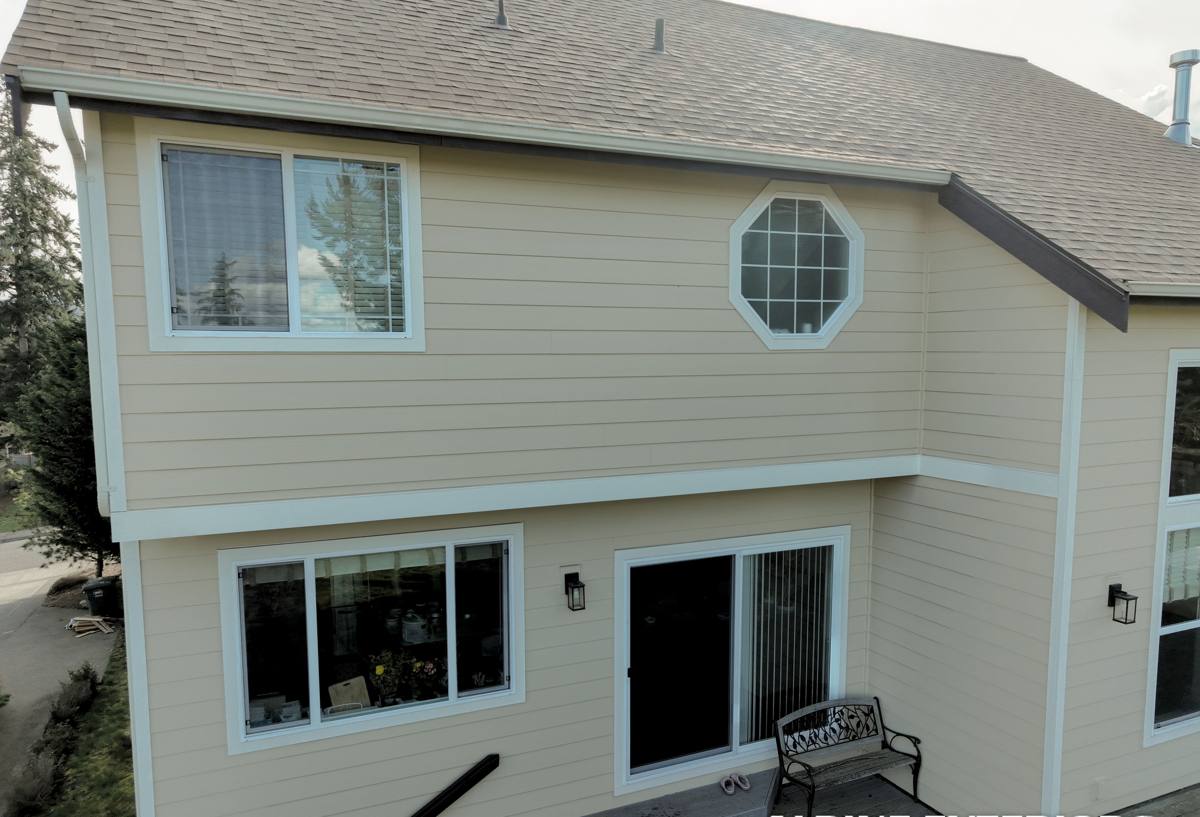
What the Salt Air and Rain Actually Do to Siding
Whatcom County's marine exposure isn't just "more rain than average" — it's a combination of factors that stresses siding in specific ways:
- Salt aerosol settles on exterior surfaces and accelerates corrosion of exposed fasteners, hinges, and any unprotected metal trim.
- Wind-driven rain off the strait pushes water horizontally into vertical seams and butt joints, which is exactly where board and batten is most vulnerable if it isn't detailed correctly.
- Prolonged dampness in shaded areas keeps wood-based products at moisture content levels that invite rot, swelling, and moss growth for much of the year.
- Freeze-thaw cycling, while milder here than inland, still stresses any siding that has already absorbed moisture into its core.
None of this is unique to Blaine Harbor — it's the reality for most of Whatcom County's waterfront and near-waterfront neighborhoods. But homes sitting closer to open water get a more concentrated version of it, which is why the siding choice and the installation detailing both matter more here than a few miles inland.
What Correct Board & Batten Construction Requires
The Layout Itself
True board and batten is a two-layer system: wider base boards (or panels) installed first, then narrower battens fastened over the vertical seams to cover the joints and create the signature shadow-line pattern. The spacing, batten width, and reveal all affect both the look and the water-shedding performance, so this isn't a detail to eyeball on site — it should be planned before the first panel goes up.
Drainage Comes Before Aesthetics
Every board and batten installation we do starts with a drainage plane behind the siding, not just a weather-resistive barrier stapled flat to the sheathing. A rainscreen gap lets any water that does get past the cladding drain and evaporate instead of sitting against the wall assembly. In a climate with this much sustained moisture, skipping the rainscreen is the single most common reason board and batten fails early — it's not usually the siding material itself that rots, it's the wall behind it.
Flashing and Fastening
Vertical siding creates more horizontal joints and terminations than lap siding does at windows, doors, and roof lines, and each one needs proper flashing, not just caulk. Fasteners have to be corrosion-resistant and set to the manufacturer's specified pattern and depth — overdriven or underdriven fasteners are a leading cause of premature siding failure near coastal exposure, since a nail head that's proud of the surface catches water and one that's overdriven crushes the material and opens a path for moisture.
Why We Only Install James Hardie for This Application
Board and batten is available in vinyl, engineered wood, cedar, and fiber cement, and we get asked fairly often why we don't offer the cheaper options. The honest answer is that we've standardized on James Hardie fiber cement for every siding style we install, board and batten included, because it's the product that holds up consistently in this specific climate without asking the homeowner to take on ongoing maintenance risk.
| Material | How It Handles Salt Air & Moisture | Long-Term Trade-Off |
|---|---|---|
| Vinyl board and batten | Won't rot, but expands and contracts significantly with temperature swings and can warp or become brittle over time | Seams and battens can loosen or gap; limited color and profile depth compared to fiber cement |
| Cedar board and batten | Naturally attractive but absorbs moisture readily; prone to moss, mildew, and checking in prolonged damp conditions | Needs regular refinishing and sealing to stay ahead of this climate's moisture load |
| Engineered wood (e.g. LP-type products) | Resin-treated to resist moisture, but the wood-strand core is still vulnerable if the factory edge seal is compromised on site | Cut edges and fastener penetrations need careful field sealing every time |
| James Hardie fiber cement | Non-combustible, dimensionally stable, engineered for wet climates, doesn't feed moss or rot | Requires correct installation to spec (fastening, gapping, flashing) to deliver on its warranty |
We're not going to tell you vinyl or engineered wood siding is junk — plenty of it is installed and performs adequately for its expected lifespan. But we've made a professional decision to put our name behind one product system, install it correctly every time, and stand behind that work, rather than offering four different materials with four different maintenance profiles and warranty structures. For a harbor-facing home dealing with salt air and near-constant moisture, Hardie is the product we're comfortable recommending without hedging.
The Hardie Products We Use for Board & Batten
James Hardie's HZ5 product line is engineered specifically for wetter, cooler climates like the Pacific Northwest, which covers Blaine Harbor. For board and batten, we typically work with:
- HardiePanel vertical siding as the base layer, giving a smooth or stucco-textured field panel with factory-primed or ColorPlus finished surfaces.
- HardieTrim boards installed as the battens, cut and fastened to the specified reveal for consistent shadow lines.
- Factory ColorPlus finish where the homeowner wants a baked-on, UV-stable color that doesn't need field painting — a real advantage in a climate where repainting means working around a lot of rainy weeks.
Every board, panel, and batten arrives pre-engineered to a consistent thickness and moisture content, which is part of why the finished result holds its lines better over time than field-cut wood battens milled on site.
Our Installation Process in Blaine Harbor
The process doesn't change much house to house, but the details we pay closest attention to are the ones this climate punishes if skipped:
- Inspect and repair existing sheathing — any hidden water damage from the old siding gets addressed before anything new goes up.
- Install a weather-resistive barrier and a rainscreen drainage gap behind the new siding.
- Flash all windows, doors, and roof-to-wall transitions before panels go on.
- Install HardiePanel base layer plumb and level, with correct fastener spacing and clearance from grade and roof lines per manufacturer spec.
- Fasten HardieTrim battens over the seams at the specified reveal and pattern.
- Caulk and seal only where the manufacturer's installation instructions call for it — not as a substitute for proper flashing.
- Final inspection for fastener pattern, gap consistency, and finish quality before walkthrough.
We also factor in the specific exposure of each wall. A wall facing open water or prevailing wind gets the same materials as a sheltered wall, but we're more deliberate about flashing details and clearances on the exposed sides, since that's where wind-driven rain concentrates.
Maintenance and Longevity in This Climate
One of the practical advantages of fiber cement board and batten here is how little ongoing maintenance it asks for compared to wood. It won't feed moss the way cedar can, and it doesn't need the periodic sealing or refinishing that keeps wood-based sidings performing. That said, "low maintenance" isn't "no maintenance" — a yearly rinse to clear salt residue and organic buildup, and a visual check of caulking at penetrations, goes a long way toward getting the full service life out of the installation. We're happy to walk a homeowner through what to watch for during that first year after install.
Cost Factors for Board & Batten Projects in Blaine Harbor
Board and batten typically costs somewhat more than standard lap siding to install, mainly because of the extra labor in the two-layer batten system and the additional flashing detail at seams. The real range for any given home depends on several factors:
| Factor | Why It Affects Cost |
|---|---|
| Wall condition underneath | Sheathing repair or rot remediation found during tear-off adds labor before new siding can go on |
| Batten spacing and reveal | Tighter batten spacing means more material and more fastening labor per square foot |
| Finish choice | Factory ColorPlus finish costs more upfront than primed panels that require field painting, but saves on repainting labor later |
| Wall complexity | Dormers, multiple stories, and water-facing exposures with extra flashing detail add time |
| Access and site conditions | Waterfront lots with limited staging area or steep grades can add setup time |
We give straightforward, itemized estimates rather than a single flat number, so a homeowner can see exactly what's driving the cost on their specific house.
Why Local Experience in Blaine Harbor Matters
A crew that's worked in and around Blaine Harbor knows what this specific stretch of Semiahmoo throws at a house — which exposures take the worst of the wind-driven rain, where moss tends to establish first, and how salt air affects fastener choice and flashing details differently than it would on a drier, more inland Whatcom County property. That local pattern recognition shows up in small decisions during installation that generic experience doesn't always catch. It also means we're a known, reachable crew if a question comes up after the job is done, rather than an out-of-area installer who's already moved on to the next region.
If you're weighing board and batten siding for a home in Blaine Harbor, we're glad to walk the property, talk through what your specific exposures call for, and put together a clear, no-pressure estimate. Use the form below to get started.