 Semiahmoo Exterior
 Why Decks Wear Out Faster in Blaine
Blaine sits right on the water at the top of Whatcom County, and that location cuts both ways. The views are part of why people build decks here in the first place, but the same marine exposure that makes the setting great is hard on wood, fasteners, and coatings. Salt-laden air moves off Semiahmoo Bay and Drayton Harbor and settles on every exposed surface, including your deck. Combine that with long stretches of driving rain in fall and winter, plus a moss and algae season that can run eight months or more in shaded yards, and you get decks that age noticeably faster than the same structure would inland.
We see the pattern over and over on Blaine properties: a deck that looks fine from a distance but has soft joists underneath, rusted-out fasteners holding railings together, or ledger board connections that have been quietly rotting behind the siding for years. Replacement isn't always about a deck that "looks old" — it's often about structure that's failed in ways you can't see from the top.
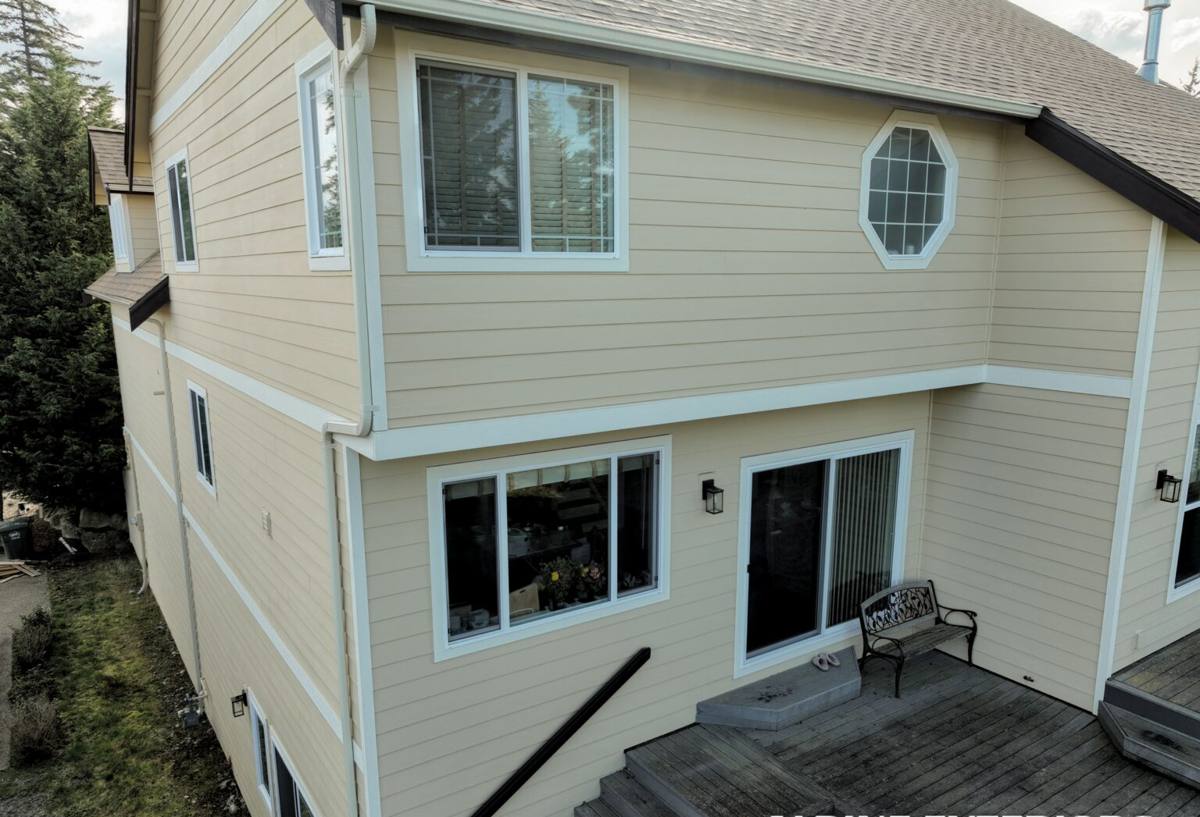
What Blaine's Climate Actually Does to a Deck
Salt Air and Metal Fasteners
Standard galvanized nails, screws, and joist hardware corrode faster in coastal air than manufacturers' ratings assume for inland use. Once a fastener starts rusting, it loses holding strength long before it looks obviously bad. This is one of the most common hidden failure points we find on decks near the water.
Driving Rain and Water Intrusion
Whatcom County's winter storms don't just fall straight down — wind-driven rain gets pushed sideways into ledger boards, stair stringers, and any spot where deck boards meet the house. Water that gets behind flashing or into end-grain cuts sits there because it has nowhere fast to drain, which is exactly what starts rot.
Moss, Algae, and Trapped Moisture
Shaded decks, north-facing decks, and anything under tree cover in Blaine grow moss and algae readily. Beyond the slip hazard, moss holds moisture directly against the wood surface for months at a time, which accelerates decay in both the decking boards and the framing underneath if boards are laid tight with poor drainage gaps.
Signs Your Blaine Deck Needs Replacement, Not Repair
- Soft or spongy spots when you walk across the deck, especially near the house or stairs
- Visible rust streaks running down from fasteners or metal connectors
- A ledger board pulling slightly away from the house, or gaps opening up at that seam
- Railing posts that wiggle at the base — often a sign the post attachment has rotted
- Persistent green or black staining that keeps returning within weeks of cleaning
- Boards that are cupping, splitting, or have widening gaps beyond normal seasonal movement
- A deck more than 20-25 years old that was built before current code required specific ledger fastening and joist hardware
If you're only seeing one or two of these, repair may still make sense. Several together, especially anything involving the ledger connection or main support posts, usually means the framing has been compromised and a patch job would just be delaying a bigger problem.
What a Correct Deck Replacement Involves Here
A deck replacement done right for this climate isn't just swapping old boards for new ones. It starts underneath.
Structure First
We evaluate ledger board attachment, joist spacing and condition, post footings, and beam sizing against current code — not just what was allowed when the original deck went in. Older Blaine decks were often built to a lighter standard than what's required now, and a full replacement is the right time to bring the structure up to a level that will actually hold up to coastal weather for the next few decades.
Flashing and Water Management
The ledger-to-house connection is the single most important detail on any deck near the water. Proper ledger flashing that sheds water away from the house band joist, combined with a drainage gap or membrane system where needed, is what keeps driving rain from turning into rot behind the wall. This detail gets rushed on a lot of budget builds — we don't skip it.
Fastener and Hardware Selection
For a marine environment like Semiahmoo Bay, we use corrosion-rated fasteners and structural connectors rated for the type of decking and treated lumber involved — not the base-grade galvanized hardware that's fine for a dry inland lot but starts failing early here. This is a small cost difference at build time and a large difference in how long the deck lasts.
Decking Material Suited to the Site
Shaded, north-facing, or tree-covered lots need decking and gap spacing chosen with moss and slow drying in mind. Full-sun waterfront decks have different priorities — UV and heat cycling matter more there. We walk the site and factor that into the material and spacing recommendation rather than using one default spec everywhere.
Decking Material Options for Blaine Homes
| Material | How It Handles This Climate | Maintenance | Typical Lifespan |
|---|---|---|---|
| Pressure-treated wood | Good rot resistance when properly sealed; needs regular upkeep in salt air and rain | Annual cleaning and resealing recommended | 15-20 years with maintenance |
| Cedar | Naturally rot- and insect-resistant, ages to a silver-gray patina; still needs sealing near the coast | Periodic cleaning and sealing to prevent moisture staining | 15-20 years |
| Composite decking | Resists moisture absorption and rot well; some early composite products had issues with moss and mildew in shaded, damp settings | Occasional washing; no sealing or staining | 25-30+ years, per manufacturer warranty |
| PVC/capped polymer decking | Fully non-absorbent surface, handles driving rain and salt exposure with minimal issue | Occasional washing | 25-30+ years, per manufacturer warranty |
There's no single "best" material for every Blaine property — it depends on sun exposure, budget, and how much upkeep you want to do. We'll walk you through the honest trade-offs for your specific site rather than push whatever has the best margin.
Why We Don't Cut Corners on Ledger Flashing or Fastener Grade
It would be cheaper and faster to skip a proper ledger flashing detail or use standard-grade hardware on a waterfront deck. Some crews do. We don't, for a simple reason: the failures those shortcuts cause don't show up for a few years, by which point the homeowner is dealing with rot damage to the house structure itself, not just the deck. Our standard on any Blaine or Whatcom County coastal project is corrosion-rated hardware and a properly flashed ledger connection as a baseline, not an upgrade option. It costs a bit more up front and saves a much larger repair bill later.
Our Deck Replacement Process
- On-site assessment — We inspect the existing deck's framing, ledger connection, and footings to confirm replacement is the right call and identify any hidden damage.
- Design and material selection — We talk through decking material, layout, railing style, and any code requirements for your specific lot, factoring in sun/shade exposure.
- Permitting — Deck replacements in Whatcom County typically require a permit; we handle that process so the finished structure is properly documented.
- Demolition and structural rebuild — Full removal of the old deck, followed by new footings, framing, ledger flashing, and hardware built to current code.
- Decking, railing, and finish work — Installation of your chosen decking material with proper board spacing and drainage in mind for this climate.
- Final walkthrough — We go over the finished deck with you, including basic care guidance specific to the material you chose.
Why Hiring a Crew That Already Works Blaine Matters
Deck construction detail that's correct for a dry inland lot isn't automatically correct for a property fifty yards off Semiahmoo Bay. A contractor who mostly works away from the water may not default to corrosion-rated hardware, may not think through moss-prone shaded spans, or may not size flashing details for the kind of driving rain Whatcom County gets off the Strait and the Sound. We work this area regularly, so those aren't afterthoughts — they're the baseline spec we start from. That familiarity also means we're realistic about permitting timelines and site conditions specific to Blaine and the surrounding Semiahmoo area, so there are fewer surprises once the project starts.
Cost Factors to Understand Before You Budget
| Factor | Why It Affects Cost |
|---|---|
| Deck size and shape | More square footage and complex layouts (multiple levels, angles) mean more material and labor |
| Decking material chosen | Composite and PVC cost more upfront than pressure-treated wood but require less long-term maintenance |
| Structural condition found underneath | Rotted framing, damaged ledger connections, or bad footings add rebuild work beyond surface replacement |
| Height and stairs | Elevated decks with stairs and extra railing require more structural work than a low, ground-level deck |
| Site exposure | Waterfront, shaded, or hard-to-access lots may need upgraded hardware or extra site prep |
| Permitting requirements | Permit fees and any required inspections are part of a code-compliant replacement |
We give you real numbers after seeing your deck and site, not a rough guess from a photo. Every property here handles water and salt exposure a little differently.
If your Blaine deck is showing soft spots, rust stains, or persistent moss, or if it's simply reaching the age where the framing underneath is a question mark, we're glad to take a look. Reach out for a free, no-pressure estimate — we'll tell you honestly whether you're looking at a repair or a full replacement, and walk you through the options for your specific site.