 Semiahmoo Exterior
 Board & Batten Siding in a Bellingham Climate
Board and batten has become one of the most requested looks for homes in and around Bellingham — the vertical lines read as modern on a new build and as classic farmhouse on an older one, and it works on everything from a full elevation to an accent gable over a garage or entry. But the look is only half the story. Whatcom County sits in a marine environment where salt-laden air off Semiahmoo Bay and the Salish Sea, long stretches of driving rain, and a moss season that can run most of the year all work against a wall system that isn't built for it. A board and batten profile done wrong doesn't just look tired in a few years — it can trap moisture behind the battens and fail from the inside before anyone notices from the curb.
This page is about doing board and batten correctly for homes in the Bellingham area, in one material: James Hardie fiber cement. We'll walk through what the climate actually demands, what a correct installation involves, and why we don't offer this style in wood, vinyl, or engineered wood substitutes.
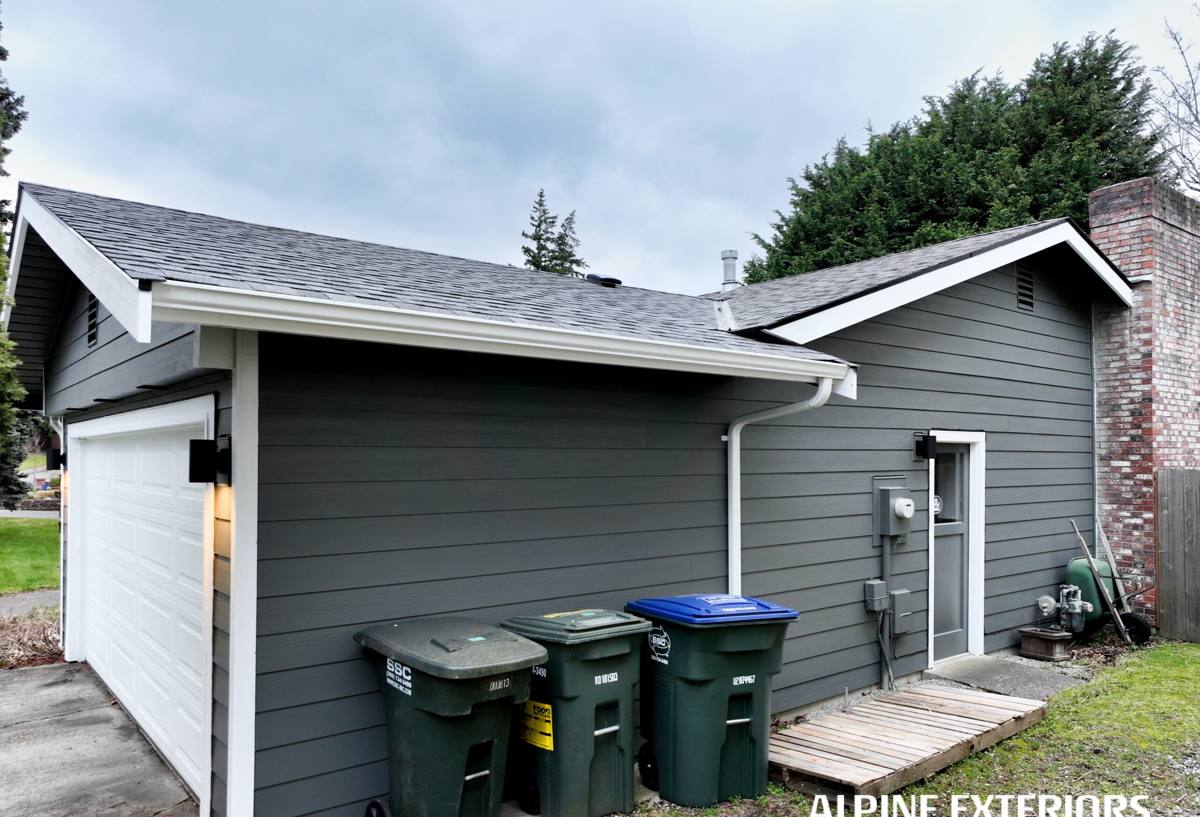
What This Climate Actually Does to Vertical Siding
Salt Air and Corrosion
Proximity to the water means airborne salt settles on siding, trim, and — critically — on fasteners. Board and batten has more exposed fastener lines than lap siding because the battens themselves are nailed through into the substrate below. Any fastener that isn't rated for a coastal, corrosive environment becomes the weak point: it rusts, bleeds a stain down the batten, and eventually loosens the board it's supposed to hold.
Driving Rain
Bellingham doesn't just get rain — it gets rain pushed sideways by wind off the water. Vertical board and batten has seams running with the water flow rather than shedding it in overlapping courses the way horizontal lap siding does. That's not a flaw in the style, but it means the water management behind the boards — the water-resistive barrier, flashing at every horizontal transition, and the gap behind the battens — has to be right, because there's less forgiveness if it isn't.
Moss and Sustained Moisture
Moss doesn't just grow on roofs here. On north-facing walls and shaded elevations that stay damp for weeks at a stretch, moss and algae will colonize any siding material that holds surface moisture, and board and batten's vertical grooves and shadow lines give it more places to take hold if the substrate isn't resistant to moisture absorption in the first place.
Why We Only Install This in James Hardie Fiber Cement
Board and batten is available in real wood, engineered wood (like LP SmartSide), vinyl, and fiber cement. Each has a case to make, but in a coastal Whatcom County climate the trade-offs stack up against everything except fiber cement, which is why we standardized on James Hardie for every board and batten job we do.
- Cedar and primed spruce look beautiful new, but solid wood battens and boards absorb moisture at the end grain and in any check or crack in the finish. In a climate with this much sustained dampness, that means more frequent repainting, more risk of rot at the base and around penetrations, and a shorter practical lifespan than most homeowners expect from a "natural" material.
- Engineered wood (LP SmartSide and similar) is more moisture-resistant than raw wood but is still a wood-strand product with an engineered resin coating. If that coating is compromised — at a cut edge, a fastener hole, or a scuff during install — the strand core underneath is still wood, and wood-based cores swell and can deteriorate once water gets past the surface. We won't install a product where the failure mode, if the coating is ever breached, is the substrate absorbing water.
- Vinyl board and batten is low-maintenance and inexpensive, but it's a thin plastic panel that flexes, fades under UV, and becomes brittle in cold, damp conditions over time. It also can't be painted to refresh a color the way fiber cement can, and it doesn't hold up to the same wind-driven rain loads as a rigid panel system.
- James Hardie fiber cement is cement, sand, and cellulose fiber — non-combustible, dimensionally stable, and engineered specifically for wet climates in its HZ5 product line. It doesn't rot, it resists moss and algae better than wood-based products, and the factory-applied ColorPlus finish is baked on and warrantied against fading and cracking, so we're not relying on a field-applied coat of paint to be the only thing standing between the board and the weather.
Material Comparison for Bellingham Conditions
| Material | Moisture Behavior | Salt Air / Coastal Fit | Long-Term Maintenance |
|---|---|---|---|
| James Hardie fiber cement | Does not rot or swell; climate-engineered HZ5 formulation | Strong — cement composition is not corroded by salt | Occasional wash; factory finish reduces repainting |
| Cedar / primed spruce | Absorbs moisture at grain, checks, and cut edges | Moderate — needs diligent sealing and upkeep | Frequent repainting and caulk maintenance |
| Engineered wood (LP SmartSide) | Resistant while coating is intact; wood core if breached | Moderate — coating is the only barrier | Coating inspection and touch-up over time |
| Vinyl | Does not absorb water but can trap it behind panels | Weak — flexes and fades under UV and salt exposure | Low, but cannot be refinished; replace when failed |
What a Correct Board & Batten Installation Involves
The style is simple to look at, but the assembly behind it has more parts than a standard lap job, and skipping any one of them is where board and batten siding gets a bad reputation it doesn't have to earn.
The Wall Assembly, Not Just the Boards
A correct installation starts behind the siding: a properly lapped and taped water-resistive barrier, flashing integrated at every window, door, and horizontal trim transition, and a drainage gap so any moisture that does get past the surface has somewhere to go and dry out rather than sitting against the wall sheathing.
Battens Over Panel, Not Boards Butted Together
We install this as a panel-and-batten system — a solid Hardie panel base with vertical battens fastened over the seams — rather than individual boards butted edge to edge. This gives the wall fewer actual seams for water to find and puts the shadow-line look on top of a continuous water barrier instead of relying on tight board-to-board joints to keep water out.
Fasteners and Hardware
Every fastener is corrosion-resistant and installed per Hardie's fastening schedule — spacing, edge distance, and depth all matter, especially at the batten lines where fasteners are visible and load-bearing at the same time. This is the detail that matters most in a salt-air environment, because a fastener failure here shows up as staining and loosening long before the board itself is at risk.
Trim, Caulking, and Terminations
Where board and batten meets trim, corners, and the foundation, the termination has to be detailed so water sheds away from the wall rather than wicking up into the bottom of the boards. This includes proper clearance off grade, roof lines, and decks — a common shortcut on lower-cost jobs that shows up as rot or staining at the base within a few years.
Our Process for a Bellingham Board & Batten Job
- On-site assessment: We look at your home's specific exposure — which elevations take the most weather off the water, existing moisture or moss issues, and what's behind your current siding.
- Design and layout: We plan batten spacing, panel layout, and trim details to fit your home's proportions before any material is ordered.
- Tear-off and wall prep: Existing siding comes off, and we inspect and repair the sheathing and water-resistive barrier underneath before anything new goes on — this step is where most long-term problems get caught or missed.
- Installation to manufacturer spec: Panels, battens, flashing, and fasteners are installed per James Hardie's published fastening and clearance requirements, not shortcuts.
- Final detailing and walkthrough: Trim, caulking, and terminations are finished and reviewed with you before we call the job done.
Living With Board & Batten in This Climate
Once it's installed correctly, James Hardie board and batten in Bellingham is genuinely low-maintenance — it isn't maintenance-free, and no exterior product honestly is in a marine climate. Expect to rinse off accumulated grime and moss spores on shaded or north-facing walls periodically, keep gutters and downspouts clear so water isn't sheeting down the wall, and keep an eye on caulking at trim joints over the years the way you would with any siding system.
Signs It's Time to Replace Existing Siding
- Soft spots, staining, or visible gaps at the base of boards or battens
- Persistent moss or algae growth that returns quickly after cleaning
- Paint that's peeling or bubbling rather than just fading
- Visible warping, cupping, or separation at seams and corners
- Rusty streaking below fastener lines
Why Local Experience With This Style Matters
Board and batten's water management depends entirely on details that don't show up in a walk-around estimate — flashing behind the battens, drainage gap depth, fastener selection. A crew that installs this system regularly in Whatcom County's specific combination of salt exposure, driving rain, and moss pressure knows where those details actually get tested by the weather here, versus a crew installing the same style in a drier or inland climate where those choices matter less. That's the difference between board and batten that looks good for two seasons and board and batten that holds up for decades.
If you're considering board and batten siding for your Bellingham home, we're happy to walk your property, look at your specific exposure, and talk through what a correct installation looks like for your house. Reach out for a free, no-pressure estimate using the form below.