 Semiahmoo Exterior
 Why Bellingham Siding Takes a Beating
Bellingham sits where the Salish Sea meets the North Cascades foothills, and that combination is hard on exterior siding. Homes close to the water deal with salt-laden air that accelerates corrosion on fasteners, flashing, and trim. Homes tucked under tree cover deal with near-constant shade, slow-drying surfaces, and a moss season that can run eight months out of the year. And almost every home in Whatcom County deals with wind-driven rain that doesn't just fall straight down — it gets pushed sideways into seams, butt joints, and anywhere a weather barrier was cut corners on.
Siding repair here isn't just cosmetic work. It's moisture management. A cracked panel or an open joint that would be a minor issue in a dry climate can turn into trapped water, soft sheathing, and interior damage in this one, especially over a wet fall and winter. That's the lens we bring to every repair call in Bellingham: fix what's damaged, but more importantly, figure out why it got damaged in the first place.
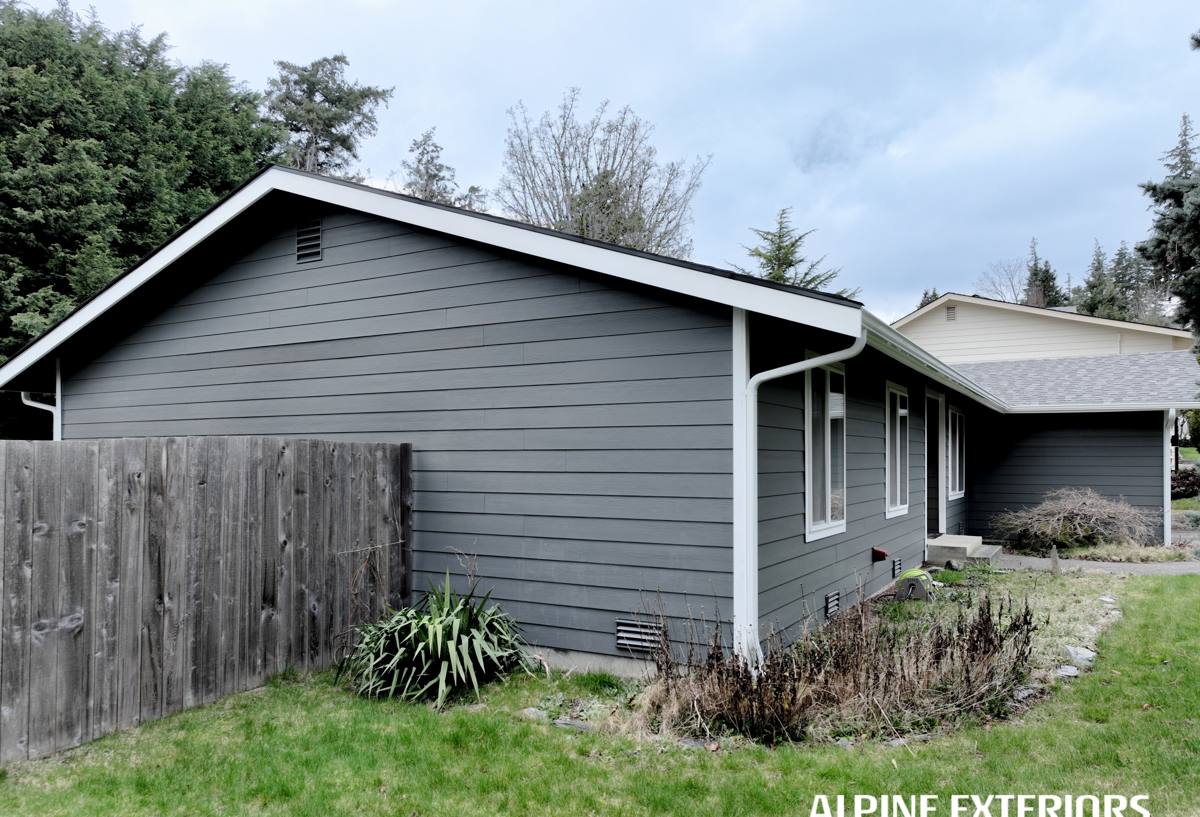
The Damage Patterns We See Most in Bellingham
Every siding repair call is a little different, but the pattern of failures in this area is pretty consistent. Understanding the cause matters as much as the fix, because a repair that ignores the cause just buys you a few more years before the same spot fails again.
| Damage Type | Common Local Cause | What Correct Repair Involves |
|---|---|---|
| Soft or delaminating panels | Prolonged moisture exposure behind siding, often from a failed seal or missing flashing | Remove affected panel, inspect and repair the weather-resistive barrier, replace with matched material |
| Moss and algae staining | Shaded, slow-drying north and east-facing walls under tree canopy | Clean surface correctly (no pressure damage), assess whether moisture is only surface-level or has penetrated the substrate |
| Corroded or backed-out fasteners | Salt air exposure near Semiahmoo and the bay, combined with non-rated fastener use in older installs | Replace with corrosion-resistant fasteners rated for coastal exposure, reseat or replace the panel |
| Open or failed caulk joints | UV and temperature cycling plus wind-driven rain forcing water into gaps | Remove old sealant fully, confirm the joint design is correct before resealing, not just recaulking over a bad detail |
| Cracked or split boards | Impact damage, or wood/composite siding reaching the end of its service life in a wet climate | Section replacement matched to existing coursing, with an honest conversation if the whole run is due for replacement |
What a Correct Siding Repair Actually Involves
A lot of siding "repair" in this region is really just cosmetic patching — caulk over a gap, paint over a stain, a new piece nailed over a soft spot. That kind of work looks fine for a season and then fails again, often worse, because the underlying moisture problem was never addressed.
Diagnose Before You Patch
Before any repair, we want to know why that spot failed. Was it a flashing detail that was never installed correctly? A butt joint with no back-up material behind it? A gap where two trades didn't coordinate their work? If we don't answer that question, the repair is temporary no matter how good the patch looks.
Check What's Behind the Siding
Siding is the outer layer of a larger moisture-management system that includes the weather-resistive barrier, flashing at windows and penetrations, and proper drainage behind the cladding. When we open up a damaged section, we're checking that system, not just the visible panel. If the barrier behind the siding has failed, replacing the siding alone doesn't fix the problem — it just covers it back up.
Match the Material, Not Just the Color
Repairs stand out when the replacement piece doesn't match the existing siding's profile, reveal, or finish. On homes with James Hardie siding, we use Hardie product to make the repair, matched to the existing plank width and ColorPlus finish where possible so the repair blends in rather than becoming a visible patch. On homes with other siding types, we'll tell you honestly if a clean match is realistic or if the repair is going to be visible — that's information you deserve before we start, not after.
Use Fasteners and Flashing Rated for This Climate
Given the salt air exposure this close to the water, standard fasteners corrode faster than they should. Correct repair work uses fasteners and flashing rated for coastal or high-moisture exposure, not whatever was on the shelf. It costs a little more up front and saves you from repeating the same repair in five years.
Repair vs. Replacement — Knowing Where the Line Is
Not every damaged section needs a full re-side, and not every problem area should just get patched. Part of an honest repair estimate is telling you which situation you're actually in.
- Repair makes sense when: damage is isolated to one or two areas, the underlying structure and weather barrier are sound, and the siding material is still within its useful service life.
- Replacement makes more sense when: damage keeps recurring in the same general areas, moisture has reached the sheathing or framing in multiple spots, or the siding is an older material that's simply reached the end of what it can be reasonably repaired.
- A hybrid approach works when: most of the siding is sound but one wall or elevation — often the side that takes the worst of the wind-driven rain or the most shade — is chronically failing and worth replacing on its own.
When a home's siding has reached the point where repair is just delaying the inevitable, we'll say so plainly. We only install James Hardie fiber cement as a replacement material — we don't install vinyl, LP SmartSide, or other engineered wood products. That's a standard we hold to because of how those materials perform over years of Whatcom County's wet, marine climate, not because we're trying to upsell you. If a repair is the right call, we'll do the repair.
Signs Your Bellingham Home May Need Siding Repair
Some warning signs are obvious. Others are easy to miss from ground level or behind landscaping. Worth checking for, especially heading into the wet season:
- Soft or spongy spots when you press on the siding, especially near the bottom courses
- Visible gaps at seams, corners, or where siding meets trim, windows, or doors
- Persistent green or black staining that comes back quickly after cleaning
- Peeling or bubbling paint, which often points to moisture trying to escape from behind the surface
- Cracked, warped, or separated boards, particularly on the north and west-facing walls
- Rust streaks running down from fastener heads or flashing
- Interior signs like a musty smell, discoloration on interior walls, or trim that's warping near an exterior wall
Our Repair Process
We keep the process straightforward and try to avoid surprises once work is underway.
1. On-Site Inspection
We look at the damaged areas along with the rest of the exterior, because problem areas rarely exist in isolation. We're checking coursing, flashing details, caulk joints, and drainage, not just the spot you called about.
2. Honest Diagnosis
We'll explain what caused the damage in plain language, and what we found (or didn't find) behind the surface. If it's a simple fix, we'll say so. If it points to a bigger issue, we'll show you why.
3. A Clear Repair Plan
You'll get a scope of work that describes what's being repaired, what material is being used, and why. No vague line items.
4. The Work Itself
Removal of damaged material, inspection and repair of anything behind it, correct reinstallation with climate-appropriate fasteners and flashing, and a finish that matches the surrounding siding as closely as the material allows.
5. Follow-Up
We'll point out anything else we noticed during the repair that's worth keeping an eye on, so you're not caught off guard by it later.
Why a Crew That Already Works Bellingham Matters
Siding repair is detail work, and the details that matter here are specific to this area. A crew that mostly works drier inland climates may not think twice about a marginal flashing detail that's a real problem once you're this close to the water and getting this much wind-driven rain. Familiarity with how Whatcom County homes are typically built, how moisture moves through them in this climate, and what tends to fail first on a Bellingham-area home saves you from a repair that looks right but doesn't hold up.
It also means faster response. Storm damage, a sudden leak, or a soft spot you just noticed doesn't wait for a convenient time, and a local crew can typically get eyes on the problem sooner than a company driving in from out of the area.
Get an Honest Look at Your Siding
If you've noticed a soft spot, a persistent stain, an open seam, or you're just not sure whether that damaged section needs a patch or something more, we're glad to take a look. We'll give you a straight answer about what's causing it and what it actually takes to fix it right — no pressure, no inflated scope. Reach out below for a free estimate.