 Semiahmoo Exterior
 Siding Built for Cherry Point's Coastline, Not Just Any Whatcom County Address
Cherry Point sits on the exposed edge of Whatcom County's coastline, where homes take a different kind of beating than houses even a few miles inland. Salt-laden air off the water, wind-driven rain that hits siding sideways instead of straight down, and a moss season that seems to stretch longer every year all combine to shorten the life of the wrong siding material — and to punish sloppy installation of the right one. If you're planning a siding project here, the material matters, but the workmanship behind it matters just as much.
This page focuses on one thing: what it actually takes to install siding correctly on a Cherry Point home, and why we do it with James Hardie fiber cement and nothing else.
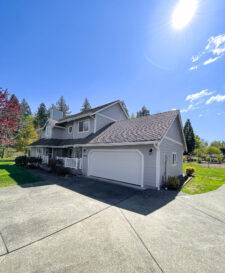
What Cherry Point's Climate Actually Does to Siding
Salt Air
Airborne salt from the water doesn't just affect metal fasteners and flashing — it accelerates the breakdown of paint films, softens caulk joints faster than manufacturers' published lifespans suggest, and works into any seam or gap in the siding envelope. Materials that rely on a factory coating to keep moisture out need that coating to hold up under salt exposure for decades, not years.
Driving Rain
Storms coming off open water rarely fall straight down. Wind pushes rain sideways and upward under laps, around trim, and into any joint that wasn't sealed or flashed correctly. On a coastal property, water management isn't a nice-to-have detail — it's the entire job. A siding system that looks fine on a calm day can be failing quietly behind the surface if the flashing and drainage plane underneath weren't done right.
A Long Moss Season
Shade, moisture, and mild temperatures give moss and algae a long growing window here — often most of the year on north-facing walls and anywhere tree cover blocks the sun. Moss holds moisture directly against the siding surface, and on materials sensitive to sustained dampness, that's a slow but steady path to rot, delamination, or coating failure.
What a Correct Siding Job Involves Here
Good siding installation in this environment is really a water-management system with a finished surface on top. The visible siding gets the attention, but the parts nobody sees are what determine whether the job lasts.
- Weather-resistive barrier: a continuous, properly lapped house wrap or building paper installed shingle-style so water sheds down and out, never inward.
- Rainscreen gap: a drainage space behind the siding lets any water that gets past the surface drain and dry instead of sitting against the wall sheathing.
- Flashing at every penetration: windows, doors, hose bibs, vents, and roof-to-wall transitions all need flashing detailed to shed water past the siding, not trap it behind.
- Correct fastening: the right fastener type, length, and spacing for the specific Hardie product, driven at the manufacturer's specified depth — not just "close enough."
- Proper clearances: siding held up off decks, patios, and grade so it isn't sitting in standing water or constant splash-back.
- Sealed and caulked correctly: using sealants rated for the exposure, at the joints that actually need them — not everywhere, which can trap moisture instead of releasing it.
Skip or rush any one of these steps and the siding material almost doesn't matter — water will find its way in eventually. This is why we treat installation quality as equal in importance to product selection.
Why We Only Install James Hardie Fiber Cement
We install James Hardie fiber cement siding exclusively. We don't install vinyl, LP SmartSide, Cemplank, Allura, primed spruce, or cedar. That's a deliberate standard, not a lack of options, and in a climate like Cherry Point's, the reasoning holds up.
Non-Combustible Core
Hardie's fiber cement composition is non-combustible, which matters for insurance considerations and peace of mind regardless of what's driving the weather that day.
Engineered for This Climate
James Hardie makes climate-specific HZ product lines, and the HZ5 formulation is engineered for wetter, more moisture-exposed regions like the Pacific Northwest coast. That's a meaningful distinction from a one-size-fits-all product — the board itself is formulated with local conditions in mind.
ColorPlus Factory Finish
The ColorPlus finish is baked on at the factory under controlled conditions, producing better adhesion and UV resistance than a field-applied coat of paint. In salt air, where coatings degrade faster, starting with a stronger factory finish is a real advantage — and it comes backed by its own finish warranty separate from the product warranty.
Dimensional Stability
Fiber cement doesn't expand and contract with moisture and temperature the way wood-based or vinyl products can. In an environment with constant humidity swings, salt exposure, and temperature shifts between sun and shade, that stability keeps joints tighter and paint lines cleaner for longer.
A Strong, Transferable Warranty
James Hardie backs its siding with a long-term limited warranty that's transferable to a new owner if you sell — a detail future buyers and their inspectors do pay attention to on a coastal property.
None of this means other products are without merit for other situations. It means that, on the coastline conditions we see around Cherry Point, we've concluded Hardie fiber cement is the material we're willing to put our name behind.
Fiber Cement vs. Other Common Siding Materials in a Coastal Climate
| Factor | James Hardie Fiber Cement | Vinyl | Wood (Cedar/Primed Spruce) |
|---|---|---|---|
| Salt air resistance | Formulated for coastal exposure (HZ5) | Can become brittle and fade faster in coastal UV/salt exposure | Requires ongoing sealing/painting to resist salt and moisture |
| Moisture behavior | Dimensionally stable, resists moss-related moisture damage when installed with proper drainage | Doesn't rot, but seams and J-channels can trap water | Prone to rot and moss-related decay without diligent maintenance |
| Fire resistance | Non-combustible | Combustible | Combustible |
| Finish durability | Factory-baked ColorPlus finish, separately warrantied | Color is through-body but can chalk and fade | Field-applied paint/stain, needs recoating every few years |
| Typical maintenance | Periodic washing, occasional caulk inspection | Low, but hard to repair when cracked or faded | Regular painting/staining and moss/mildew treatment |
Our Installation Process
- On-site assessment: we inspect existing siding, sheathing, and trim for hidden moisture damage before quoting anything — problems behind the wall need to be addressed first, not covered up.
- Tear-off and sheathing check: old siding comes off and we evaluate the wall sheathing underneath, repairing or replacing any sections compromised by past moisture intrusion.
- Weather barrier and rainscreen installation: a continuous, correctly lapped weather-resistive barrier goes on, followed by the drainage gap that keeps this a true rainscreen system.
- Flashing: windows, doors, and all penetrations get flashed to manufacturer and code specifications before a single piece of siding goes up.
- Hardie installation: siding, trim, and accessories installed to James Hardie's fastening and clearance specifications — the details that keep the warranty valid and the wall dry.
- Final detailing and caulking: joints sealed with climate-appropriate sealants, touch-up work completed, and site cleaned up.
- Walkthrough: we go over the finished work with you before calling the job done.
What Drives the Cost of a Siding Installation
| Factor | Why It Matters |
|---|---|
| Home size and wall complexity | More corners, gables, and dormers mean more cutting, flashing, and labor time |
| Current condition of sheathing | Hidden rot or moisture damage found during tear-off adds repair scope before new siding can go on |
| Hardie product line chosen | Lap siding, panel siding, and shingle-style products vary in material cost and installation time |
| Trim and accessory scope | Corner boards, window trim, and fascia detailing add labor and material |
| Site access | Steep grades, limited equipment access, or tight lot lines can affect labor time |
We provide a written estimate after seeing the home in person — broad ranges quoted over the phone rarely hold up once tear-off reveals what's actually underneath the old siding.
Signs a Cherry Point Home May Need New Siding
- Persistent moss or algae growth that returns quickly after cleaning
- Soft spots, bubbling, or visible warping in the siding surface
- Paint that's peeling or failing faster than expected between coats
- Visible gaps at seams, corners, or trim joints
- Water stains or discoloration on interior walls near exterior corners
- Siding that feels damp or spongy to the touch after dry weather
Any one of these on its own isn't necessarily an emergency, but on a property exposed to this much salt air and rain, it's worth having someone look before small issues become structural ones.
Living With Hardie Siding in a Salt-Air, Moss-Prone Environment
Once installed correctly, Hardie siding is low-maintenance, but "low" isn't "none." An occasional gentle wash removes salt residue and slows moss and algae buildup before it takes hold. Keeping nearby vegetation trimmed back improves airflow and sun exposure on shaded walls, which is often the single biggest factor in how fast moss returns. Caulked joints are worth a visual check every year or two, since sealant is the one component that ages faster than the siding itself. None of this is demanding work, but staying ahead of it is what keeps a coastal siding job looking good well into its warranty period instead of just its first few years.
Why Hiring a Crew That Already Works Cherry Point Matters
Siding installation isn't uniform across Whatcom County. A crew used to inland, more sheltered lots doesn't automatically bring the same instincts for wind-driven rain, salt exposure, and prolonged shade-driven moss growth that a coastal property like this deals with. Knowing to prioritize the rainscreen gap, to flash more conservatively at penetrations, and to recognize early moisture damage during tear-off comes from having done this specific kind of job, in this specific kind of weather, more than once. That local familiarity is part of what you're paying for when you hire a contractor — not just the ability to hang siding, but the judgment to do it right for where the house actually sits.
If you're weighing a siding project for a Cherry Point property, we're happy to take a look and walk you through what we'd recommend — no pressure, no obligation. Use the form below to request a free estimate.