 Semiahmoo Exterior
 Point Roberts Sits in a Climate That Punishes the Wrong Siding Choice
Point Roberts occupies a small peninsula bordered by water on three sides, which means homes here take on more salt-laden marine air than most inland properties in Whatcom County. That salt air works its way into seams, fasteners, and any spot where a siding product's protective coating has worn thin. Add in the driving, wind-pushed rain that comes off the water during fall and winter storms, plus the deep shade and near-constant dampness that many Point Roberts lots have from mature trees, and you get a long moss season that keeps siding wet for weeks at a stretch.
None of this is unusual for the Pacific Northwest coast, but it's more concentrated in a peninsula community than it is a few miles inland. Siding on a Point Roberts home isn't just holding back rain — it's standing up to a near-constant cycle of moisture, salt exposure, and shaded dampness that never fully dries out between storms.
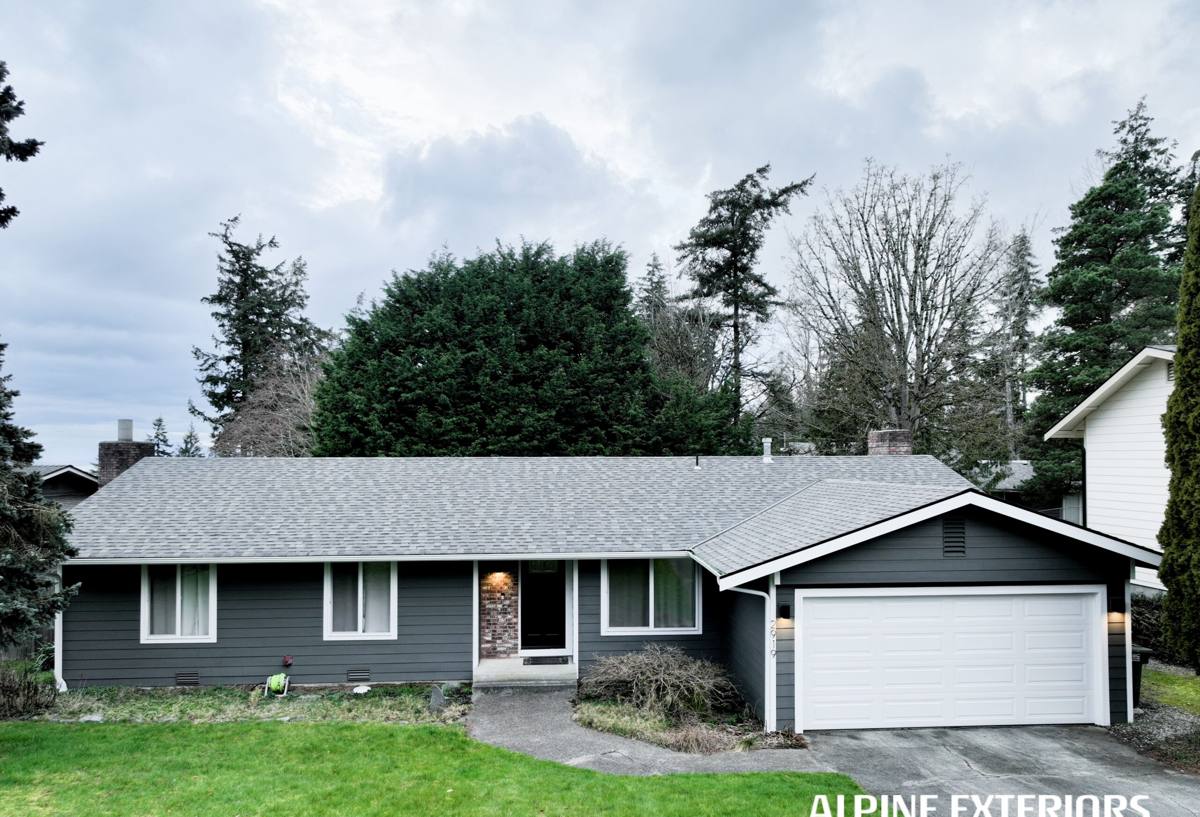
What Point Roberts Homes Actually Need From Their Siding
Given that climate profile, siding on this peninsula needs to do three things well: resist moisture intrusion at every seam and penetration, hold its finish without chalking or fading under salt exposure, and resist the buildup of moss and algae that thrives in shaded, damp conditions. A product that only handles one or two of these well will show problems within a handful of years — usually starting at butt joints, corner boards, and anywhere water is allowed to sit rather than shed.
Low-maintenance matters more here than in a lot of places, too. Point Roberts is a bit of an outlier geographically within Whatcom County, and that affects how often a homeowner wants to be dealing with repainting, caulk touch-ups, or moisture repairs. Siding that holds up with minimal upkeep isn't a luxury on this peninsula — it's the practical choice.
Why We Install Only James Hardie Fiber Cement
We standardized on James Hardie fiber cement siding for every home we work on, including Point Roberts, and we don't install vinyl, LP SmartSide, primed spruce, cedar, or other fiber cement brands. That's not a marketing position — it's a practical one, built around how these products actually perform in a wet, salt-exposed marine climate over the long run.
The HZ5 Engineering Advantage
James Hardie engineers its siding by climate zone, and the HZ5 product line is built specifically for the wetter, more moisture-intensive Pacific Northwest conditions — including the freeze-thaw swings and prolonged damp periods that a peninsula climate like Point Roberts sees more of than drier regions. That's a meaningful difference from a one-size-fits-all siding product that isn't engineered around regional moisture exposure at all.
ColorPlus Factory Finish vs. Field-Painted Siding
James Hardie's ColorPlus finish is baked on at the factory under controlled conditions, which gives it stronger fade and chalk resistance than field-applied paint — an important detail in an area with heavy salt air, since airborne salt accelerates the breakdown of standard paint finishes. It also carries a longer finish warranty than most homeowners get from a repaint. For a home exposed to marine air most of the year, that factory-cured finish is doing real work, not just looking good on day one.
What a Correct Fiber Cement Siding Installation Involves
Fiber cement siding is only as good as the installation behind it. James Hardie publishes detailed installation specifications, and skipping steps to save time is where most siding failures actually start — not with the material itself.
Moisture Management Details That Matter Most Here
In a climate like Point Roberts', the details that keep water out matter more than they would somewhere drier. That includes correct weather-resistive barrier installation behind the siding, properly lapped and sealed flashing at windows, doors, and roof-to-wall transitions, and maintaining the minimum clearance James Hardie specifies between the bottom of the siding and grade, decks, roof lines, and other horizontal surfaces. Skipping any of these lets moisture behind the siding, where it can sit against sheathing and framing for weeks in a climate this damp.
Common Installation Mistakes We Avoid
We see the same handful of shortcuts cause problems repeatedly on fiber cement jobs that weren't installed to spec: face-nailing where blind-nailing is called for, gaps left unsealed at butt joints, siding installed too close to grade or roofing, and fasteners driven at the wrong depth or spacing. Every one of these is avoidable, and every one of them becomes a bigger problem faster in a salt-air, high-moisture environment than it would in a mild, dry climate.
Our Point Roberts Installation Checklist
- Weather-resistive barrier installed and lapped correctly before any siding goes up
- Flashing set at every window, door, and roof-to-wall intersection
- Manufacturer-specified clearances maintained at grade, decks, and roof lines
- Fasteners driven to correct depth and spacing, blind-nailed where specified
- Joints and penetrations sealed with a product compatible with ColorPlus finish
- Final walkthrough to confirm caulking, trim, and touch-up work meet spec
How Our Process Works on a Point Roberts Project
We start with an on-site assessment of the existing siding and sheathing, since a peninsula climate can hide moisture damage behind siding that looks fine from the outside. From there we scope the project, spec the right James Hardie product line and profile for the home, and schedule the work.
Planning Around Point Roberts' Access
Point Roberts is geographically separated from the rest of Whatcom County — by land, it's reached by driving through Canada — which means material delivery and crew scheduling take a bit more planning than a typical job elsewhere in the region. We build that into the timeline up front rather than discovering it mid-project, so material staging and crew logistics don't become a surprise delay once work has started.
Fiber Cement Siding Options and Cost Factors
James Hardie offers several profiles, and the right one depends on the home's style and exposure. Cost varies by profile, trim complexity, home size, and how much of the existing siding and sheathing needs to be removed and repaired first.
| Product Line | Best Use | Key Factor for Point Roberts |
|---|---|---|
| HardiePlank Lap Siding | Most common home styles | Widely used, strong track record in wet marine climates |
| HardiePanel Vertical Siding | Modern or mixed-material designs | Fewer horizontal laps means fewer potential water-entry points |
| HardieShingle | Accent areas, gables, dormers | Adds texture without sacrificing moisture performance |
| HardieTrim | Corners, fascia, window trim | Matches siding durability so trim doesn't fail first |
Beyond the product line itself, the biggest cost drivers are usually how much of the old siding and sheathing needs to be replaced due to hidden moisture damage, the amount of trim and detail work on the home, and site access. We walk through all of that during the estimate so there are no surprises once work begins.
Maintaining Fiber Cement Siding in a Salt Air, Moss-Prone Climate
James Hardie siding is low-maintenance compared to wood or vinyl, but "low-maintenance" doesn't mean "no maintenance" — especially in a climate that stays damp and shaded for long stretches.
- Rinse the siding once or twice a year to clear salt residue and airborne debris before it builds up
- Trim back vegetation and tree limbs that keep sections of siding shaded and slow to dry
- Check caulking at joints and trim annually and touch up any cracked or separated sections
- Clear gutters and downspouts regularly so water isn't overflowing onto siding below
- Address any moss or algae growth promptly rather than letting it establish and hold moisture against the surface
Why It Matters That Your Crew Already Works in Point Roberts
A contractor who hasn't worked on this peninsula before is learning its quirks on your home. A crew that's already familiar with Point Roberts' access logistics, its salt-air exposure, and how quickly moss and moisture problems show up here can plan the project correctly from the start — from material staging to flashing details to the follow-up service a warranty actually depends on. That local familiarity is part of what separates a siding job that holds up for decades from one that starts showing problems in year five.
Get a Straight Answer on Your Point Roberts Siding Project
If your home's siding is showing wear, or you're planning ahead before the next wet season sets in, we're glad to walk the exterior with you and give you an honest read on what it needs. Request a free, no-pressure estimate using the form below.