 Semiahmoo Exterior
 Siding for the Peace Arch Area: A Different Kind of Exposure
The Peace Arch area sits right where Semiahmoo Bay meets the Canadian border, and that location puts homes here in one of the more demanding exterior-siding environments in Whatcom County. Salt-laden air moves in off the water on a regular basis, driving rain gets pushed sideways by wind instead of falling straight down, and a moss season that runs most of the year keeps shaded and north-facing walls damp for long stretches at a time. None of that shows up as a single dramatic event. It shows up years later, as premature caulk failure, swollen trim, streaked finishes, or siding that's holding moisture it was never supposed to hold.
This page is specifically about James Hardie fiber cement siding for homes in and around Peace Arch — what this particular climate demands from a siding system, what a correct installation actually involves, and why working with a crew that's already spent time on this stretch of coastline matters more here than it would on a more sheltered inland lot.
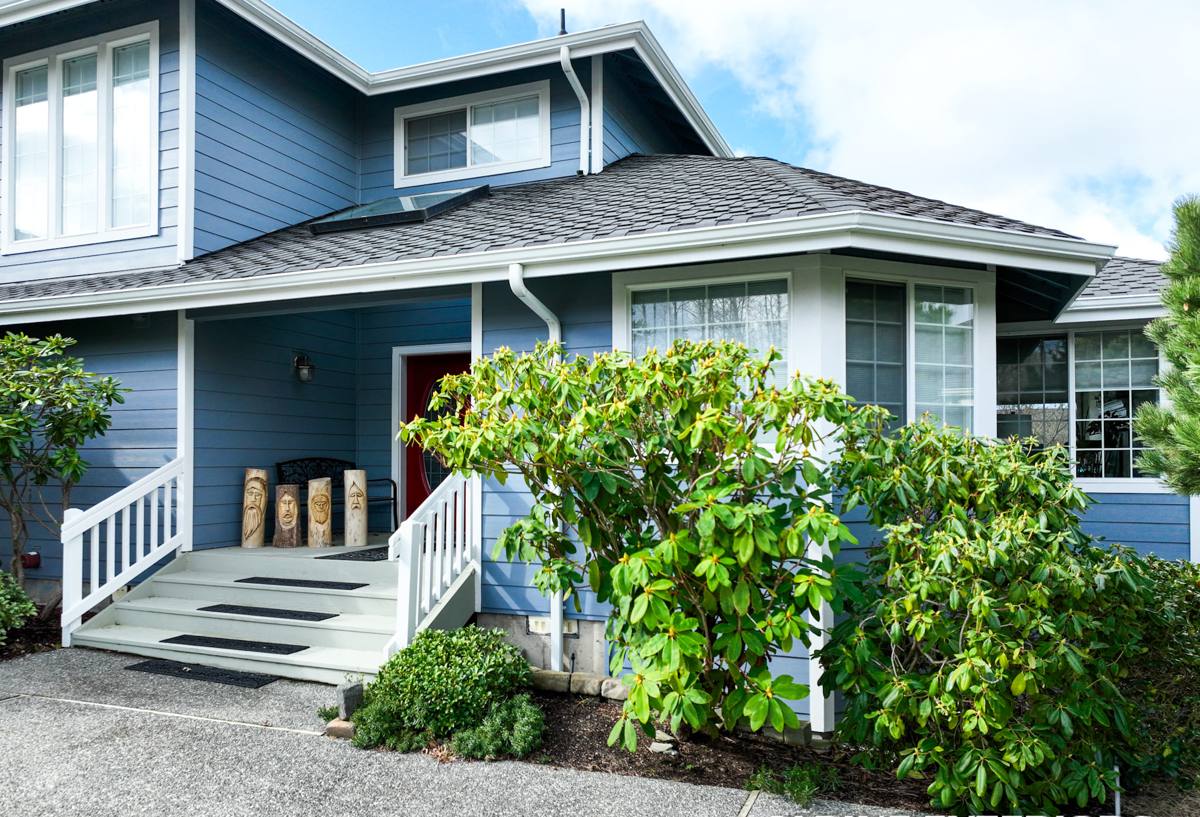
What Salt Air, Driving Rain, and Moss Do to a Peace Arch Home
Salt Air From the Bay
Proximity to Semiahmoo Bay means airborne salt is a constant, low-level factor on any exterior surface here, not an occasional coastal event. Salt accelerates corrosion on fasteners, hinges, and exposed metal trim, and it shortens the working life of paints and coatings that aren't built to handle repeated wetting with salt-bearing moisture. Hardware and finishes that would perform fine a few miles inland can start showing wear noticeably sooner this close to the water.
Driving Rain With Real Force Behind It
Open water and open wind exposure near the border mean rain here often arrives at an angle rather than straight down. Wind-driven rain gets forced into laps, seams, and fastener penetrations that a calmer inland site would rarely test. Flashing details, caulk joints, and clearances that are technically adequate on paper can still leak if they weren't built with this kind of lateral water pressure in mind.
A Long Moss and Mildew Season
Mild year-round temperatures, high humidity, and shaded exposures on the north and east sides of a house add up to a moss season that runs longer here than in drier parts of Washington. Moss and mildew aren't just cosmetic — on any siding material that can absorb or hold moisture, sustained dampness underneath a moss mat leads to softening, swelling, and eventually rot at seams and cut edges. The longer a wall stays wet, the more that risk compounds year over year.
Why James Hardie Is the Right Fit for This Specific Climate
We install James Hardie fiber cement siding exclusively. We don't install vinyl, LP SmartSide, Cemplank, Allura, primed spruce, or cedar, and that's a deliberate professional standard rather than a limitation on what we're able to do. In a salt air, high-rain, long-moss environment like Peace Arch, the materials that tend to run into trouble share a common weakness: they either absorb moisture directly, rely on a coating or paint film to keep water out indefinitely, or expand and contract enough with humidity swings that seams gradually open up over time.
- Non-combustible fiber cement core: Doesn't feed a fire the way wood-based siding products can, which matters for both safety and, in many cases, insurance considerations.
- Factory-applied ColorPlus finish: Baked on under controlled conditions rather than brushed on in the field, and it resists the fading, chalking, and moisture intrusion that salt air and constant humidity accelerate in a field-applied paint.
- Climate-engineered HZ product lines: Hardie builds different formulations for different climate zones. The HZ5 line is engineered for regions with heavy moisture exposure and freeze-thaw cycling, which describes the Peace Arch and broader Semiahmoo area well.
- Dimensional stability: Fiber cement doesn't swell, cup, or warp the way engineered wood products can after repeated wetting through a long wet season.
- Strong transferable warranty: Hardie backs its product with a substantial warranty structure, provided the installation follows their published specifications.
Every one of the products we don't install has a legitimate place in the broader market, and plenty of homeowners elsewhere are satisfied with them. On an exposed, salt-air property near the water, though, we've made the call that we'd rather stand fully behind one system than offer a cheaper alternative that quietly shifts long-term maintenance and moisture risk onto the homeowner.
What a Correct Installation Involves in This Climate
Fiber cement only performs the way it's engineered to when it's installed to Hardie's actual specifications, and in a wind-driven-rain environment like this, the installation details matter more than they would somewhere calmer. That includes the correct fastener type and spacing for the local exposure category, proper clearance between the bottom of the siding and grade or hardscape, a properly lapped weather-resistive barrier underneath, and flashing at every window, door, and penetration detailed to shed water outward rather than trap it behind the cladding.
What We Check on Every Peace Arch Job
- Fastener type, length, and spacing set for coastal wind exposure, not a generic inland default
- Weather-resistive barrier lapped correctly, shingle-style, so water sheds down and out at every seam
- Flashing integration at windows, doors, and roof-to-wall transitions, since these are the most common leak points under wind-driven rain
- Correct clearance from grade, decks, and patios so lower courses aren't sitting in standing moisture
- Caulk joints and butt seams sealed to Hardie's spec, not just to a visual standard
- Field-cut edges primed and sealed before they're closed up behind trim or J-channel
Skipping or shortcutting any one of those steps can undercut how the material performs, regardless of how good the product itself is. We've seen Hardie siding installed loosely still develop moisture problems in this climate — the material is only as reliable as the installation behind it.
ColorPlus Finish and Moss Resistance on Shaded Walls
The Peace Arch area's tree cover and building spacing mean a lot of homes here have at least one wall that stays shaded and damp for most of the fall through spring stretch. That's exactly the condition moss and mildew need to take hold. James Hardie's factory-applied ColorPlus finish doesn't stop moss from ever forming on a wall, but it does resist the surface breakdown that lets moss and algae gain a foothold on a lower-quality or field-painted finish, and it holds its color and integrity through repeated wet-dry cycling far longer than a brushed-on paint job typically does. Regular gentle cleaning still matters on shaded elevations, but the finish itself isn't the weak point the way it can be with other siding systems.
Our Process for Peace Arch Siding Projects
We start with an on-site walk of the existing siding, looking specifically at how the current system has handled salt exposure, wind-driven rain, and shaded moisture over time — where caulk has failed, where trim has swollen, and where moss has taken hold longest. From there we put together a clear written scope covering material, fastening, flashing details, and timeline before any work begins.
- Assessment: Walk the exterior, check for existing moisture damage, and note wall orientations that see the most wind-driven rain or shade.
- Prep and detailing plan: Confirm weather-resistive barrier condition, flashing needs at openings, and fastener spec for the property's specific exposure.
- Installation: Install James Hardie fiber cement to manufacturer spec, with flashing and drainage detailing built for this climate rather than a generic inland standard.
- Final walk-through: Check seams, caulk lines, and flashing details before calling the job complete, and walk the homeowner through basic care.
Cost Factors on a Peace Arch Siding Project
Every property is different, and we won't quote a number without seeing the house, but the factors below are what actually move the cost on a Hardie siding project in this area.
| Factor | Why It Affects Cost Here |
|---|---|
| Existing moisture or rot damage | Water-damaged sheathing or framing found during tear-off needs repair before new siding can go on |
| Wall exposure and orientation | Walls facing open water or prevailing wind often need more careful flashing and detailing than sheltered walls |
| House shape and trim detail | More corners, windows, and architectural trim mean more cutting, fitting, and flashing points |
| Siding profile and finish | Lap width, board-and-batten, and specialty ColorPlus finishes carry different material costs |
| Access and site conditions | Tight lots, slopes, or landscaping near the foundation affect setup, staging, and labor time |
Why Hiring a Crew That Already Works Peace Arch Matters
A contractor who regularly works this stretch of coastline near Semiahmoo already understands how salt air, wind-driven rain, and a long moss season behave differently here than they do a few miles inland. That familiarity shows up in decisions a homeowner never sees directly — which fastener grade gets used, how much lap a flashing detail gets, where an extra bead of sealant goes because a wall takes rain from an unusual angle. Those are exactly the details that separate a siding job that looks fine on install day from one that's still performing correctly a decade later.
Questions Worth Asking Before You Hire
- What siding material do you install, and why, and is it backed by a written manufacturer warranty?
- Do you carry current Washington contractor licensing and active liability insurance?
- How do you detail flashing at windows, doors, and roof-to-wall transitions for wind-driven rain?
- Have you worked on homes specifically in the Peace Arch or greater Semiahmoo area before?
- Can I get a clear, written scope of work before signing anything?
If you're weighing a siding project for a Peace Arch area home, we're glad to walk the exterior with you and give you an honest read on what it actually needs. Reach out below for a free, no-pressure estimate.