 Semiahmoo Exterior
 Building New in Marietta Means Building for the Bay
Marietta sits close enough to Semiahmoo Bay and Drayton Harbor that the weather off the water shapes almost every exterior decision on a new home, and windows are no exception. When you're framing a new build, the window package isn't something to bolt on at the end of the job — it's part of the structural envelope, tied into the house wrap, the flashing, and the siding sequence from day one. Get it right during rough-in and you have a window system that sheds salt-laden rain for decades. Get it wrong, and the mistakes get buried behind trim and siding, only to show up as rot or fogged glass five or ten years down the road.
New construction gives you one real advantage over a retrofit: the wall is open. There's no old window to work around, no hidden rot to guess at, and no compromise forced by an existing rough opening. That's the whole reason to do this stage carefully — you only get one clean shot at it.
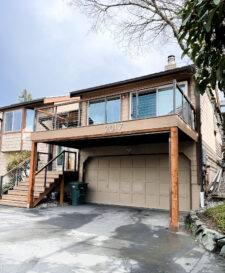
What Whatcom County's Climate Actually Does to a Window System
Semiahmoo and the surrounding Whatcom County shoreline get a specific combination of stressors that inland Washington homes simply don't deal with in the same way:
- Salt air corrosion — airborne salt off the bay accelerates corrosion on unprotected fasteners, cheap cladding, and lower-grade hardware. It works slowly, but it works constantly.
- Driving, wind-driven rain — storms off the water rarely fall straight down. Wind pushes rain sideways into wall assemblies, which means flashing details and sill pans matter far more here than in a calm, dry climate.
- A long moss and mildew season — persistent damp shade for much of the year means organic growth on sills, tracks, and exterior trim if drainage and airflow aren't designed in from the start.
None of these are exotic problems. They're steady, cumulative ones, and a new-construction window package built for a drier or more sheltered climate will underperform here even if it's a good product on paper.
Why This Matters More on New Construction
On a retrofit, a homeowner can often see a failing window — fogged glass, a soft sill, a drafty seal. On new construction, if the flashing or sequencing is done wrong, the failure doesn't show up until the interior finishes and siding are already in place. That's the risk we're managing during rough-in: getting the water management right before it's covered up for good.
Choosing a Window Frame Material for a Marietta Build
There's no single "best" frame material — the right call depends on budget, maintenance appetite, and how exposed the elevation is to weather off the bay. Here's how the common options actually compare for a coastal Whatcom County build:
| Frame Material | Salt Air / Moisture Behavior | Maintenance | Typical Trade-offs |
|---|---|---|---|
| Vinyl | Won't corrode; good baseline moisture resistance | Low — occasional cleaning | Lower upfront cost; can flex on very large openings |
| Fiberglass | Excellent — dimensionally stable, resists both salt and moisture cycling | Low | Higher upfront cost; strong long-term value on exposed elevations |
| Aluminum-clad wood | Good exterior protection, but any breach in the cladding exposes wood to rot | Moderate — cladding seams need periodic inspection | Attractive interior wood finish; installation sensitivity is higher near salt air |
| Bare aluminum | Prone to corrosion and condensation without thermal breaks | Higher | We generally steer new builds here away from it on bay-facing walls |
For most Marietta new-construction projects, we lean toward vinyl or fiberglass on exposed, bay-facing walls, and we're comfortable specifying clad-wood where the architecture calls for it — as long as the flashing detail around every seam is done correctly, since that's where clad products earn or lose their reputation over time.
Correct Flashing and Sequencing — Where New Construction Is Won or Lost
The window unit itself is rarely where a new-construction install fails. The failures we get called to inspect almost always trace back to sequencing: what went in before the window, what went in after, and whether water has a continuous path back out of the wall if it ever gets past the exterior cladding.
What a Correct Install Sequence Looks Like
- Rough opening is checked for square, level, and correct dimension before anything else happens.
- A sloped sill pan is installed at the base of the opening so any water that reaches the sill drains outward, not into the framing.
- House wrap is integrated with the window flange using a shingle-lap method — each layer overlaps the one below it, so water always sheds downward and outward, never into a seam.
- Flashing tape seals the head, jambs, and sill in the correct order, with the head flashing last so it laps over the side flashing.
- The window is set plumb, square, and level, then fastened per the manufacturer's schedule — not just "enough screws to hold it."
- Backer rod and exterior sealant finish the perimeter, sized and installed to allow for expansion without failing.
- Interior air-sealing (foam or sealant, not just insulation) closes the gap between the frame and the rough opening to stop condensation-driving air leaks.
Every one of those steps is standard trade knowledge — none of it is proprietary. What separates a durable install from a callback in three years is whether the crew actually follows the sequence on every window, on every elevation, including the ones facing away from the street where it's easy to rush.
Our Process for Marietta New-Construction Window Work
We coordinate directly with the framing and siding schedule so windows go in at the right point in the build — not too early, when the opening isn't finalized, and not so late that it holds up the weather-tight milestone.
- Plan review: we check window schedules against the actual framed openings before units arrive, catching sizing conflicts before they become job-site problems.
- Pre-install inspection: every rough opening is checked for square and proper blocking before a window goes in.
- Installation: sill pan, flashing, and fastening done to the sequence above, elevation by elevation.
- Weather-tight sign-off: we walk the exterior with the builder or homeowner once flashing and sealant are complete, before siding closes it up.
- Final adjustment: sashes are checked for smooth operation and tight seals after interior trim and exterior siding are finished, since both can shift a frame slightly.
Energy Code and Performance in a Coastal Marine Climate
Washington's energy code sets minimum performance targets for new-construction glazing, and homes in this part of Whatcom County are in a marine climate zone where wind-driven moisture and steady coastal humidity matter as much as raw insulation value. We help builders and homeowners choose U-factor and solar heat gain ratings that meet code and make sense for a bay-facing home — that usually means prioritizing a tight, well-sealed frame and quality low-E glazing over marginal upgrades that don't address the real local stressor, which is moisture management more than raw cold.
What We Watch For Beyond the Code Minimum
Meeting code is the floor, not the goal. On an exposed elevation facing Semiahmoo Bay, we'll often recommend a slightly higher-spec unit or extra attention to flashing detail on that wall alone, rather than uniformly upgrading every window on the house. It's a more honest way to spend a construction budget than treating every opening the same regardless of exposure.
Before Your Windows Go In: A Homeowner's Checklist
If you're managing a new build in Marietta, these are worth confirming with whoever is installing your windows, regardless of who you hire:
- Is a sloped sill pan being installed under every window, not just the ones on exposed walls?
- Is house wrap integrated with window flanges in proper shingle-lap order?
- What fastener material is being used, and is it rated for coastal/salt-air exposure?
- Will there be a weather-tight walk-through before siding closes up the flashing?
- Are frame materials matched to each elevation's actual sun and rain exposure, not a single spec for the whole house?
- Is interior air-sealing part of the install, or just exterior caulking?
Why Hiring a Crew That Already Works Marietta Matters
A window crew that mostly works drier, inland jobs will still know how to install a window correctly on paper — but they haven't spent years watching how a bay-facing wall in Whatcom County actually behaves through a wet fall and a mossy winter. That experience shows up in small decisions: which elevations get the extra flashing lap, which fastener spec holds up against salt air, and where moss and algae are likely to collect on sills and tracks if drainage isn't detailed correctly. We work new-construction projects around Semiahmoo and Marietta regularly, so those calls are routine for us rather than guesswork.
Get a Straightforward Estimate
If you're planning a new build in Marietta and want a window package sized correctly for the site's exposure — not a generic spec sheet — we're happy to walk the plans with you and give you a straightforward, no-pressure estimate using the form below.