 Semiahmoo Exterior
 Marietta's Waterfront Climate Puts Real Demands on Siding
Marietta sits close to the water in the Semiahmoo area of Whatcom County, and that proximity shapes what siding has to survive here. Salt-laden air moves inland off the water and settles on exterior surfaces year-round, accelerating corrosion on fasteners, trim, and any material that isn't built to handle it. Add in Whatcom County's long stretch of driving rain — wind-driven, not just falling straight down — and siding has to shed water sideways as well as vertically, at every seam, corner, and penetration.
Then there's moss. The combination of shade, moisture, and mild temperatures that defines this part of Washington creates an extended moss season, often running most of the year on north-facing walls and anywhere airflow is limited. Moss holds moisture against a wall long after the rain stops, and it doesn't care what the siding is made of — it just needs a damp surface to take hold. Siding replacement in Marietta isn't a cosmetic decision. It's a chance to correct water and moisture problems that generic, one-size-fits-all installation practices tend to leave behind.
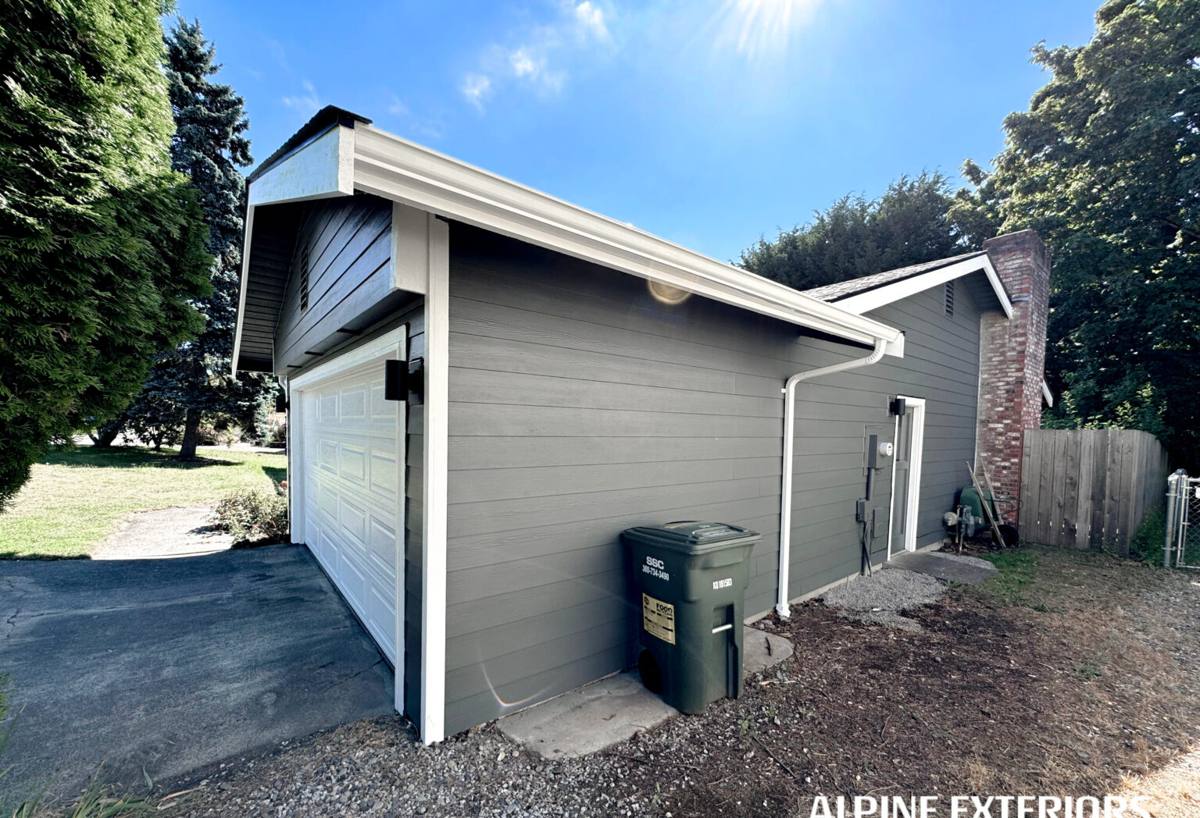
Signs Your Marietta Home's Siding Needs Replacing, Not Just Patching
Not every siding problem calls for a full tear-off. But in a salt air, high-rain environment, small issues tend to compound quickly once moisture gets behind the surface. Here's what usually signals it's time for replacement rather than another round of caulk and touch-up paint:
- Soft or spongy spots when you press on the siding, especially near the bottom courses or under windows
- Persistent moss or algae growth that returns within weeks of cleaning
- Paint that's bubbling, peeling, or failing faster than a normal repaint cycle would suggest
- Visible warping, cupping, or separation at panel seams
- Rust streaking from fasteners or trim, a common sign of salt air corrosion
- A musty smell or visible staining on interior walls that share an exterior wall with problem siding
- Siding that's original to a home built more than 20-25 years ago, particularly wood-based products
If you're seeing more than one or two of these, especially on walls facing prevailing wind and weather, it's worth having someone look at the sheathing underneath, not just the surface.
What a Correct Siding Replacement Actually Involves
Tear-Off and What's Underneath
A proper replacement starts with full removal of the old siding, not installation over it. This is the only point in the project where the sheathing, framing, and existing water-resistive barrier are fully visible. In a climate like this one, that inspection matters — hidden rot, compromised sheathing, or a degraded barrier are common findings on older Marietta-area homes, and they have to be addressed before new siding goes up. Covering over a problem doesn't fix it, it just hides it for a few more years.
Weather-Resistive Barrier and Flashing
Behind every well-installed siding job is a continuous drainage plane: a weather-resistive barrier lapped correctly, flashing at every window, door, and penetration, and a drainage gap where the siding system calls for one. This is the part of the job that's invisible once it's done, and it's also the part that determines whether wind-driven rain stays out or works its way in over the next decade. Skipping or rushing this step is the single most common reason siding fails early in wet coastal climates.
Material Selection and Fastening
The siding material itself needs to be rated for the moisture and salt exposure it will actually face, and it needs to be fastened according to the manufacturer's specification for this climate zone — not generic spacing. Incorrect nailing patterns and under- or over-driven fasteners are a leading cause of premature siding failure, regardless of what brand is on the wall.
Trim, Caulking, and Detailing
The last 10% of a siding job — corner trim, joint treatment, caulking at transitions — is where most of the long-term water problems either get prevented or get built in. This detailing has to account for driving rain and salt exposure specifically, which means using compatible, climate-rated sealants and trim materials, not whatever's fastest to install.
Comparing Siding Materials for a Marietta Waterfront Property
Homeowners in this area are usually weighing the same handful of materials. Here's how they hold up against salt air, driving rain, and moss specifically:
| Material | Salt Air Resistance | Moisture/Moss Behavior | Maintenance Burden |
|---|---|---|---|
| James Hardie fiber cement | Non-combustible, dimensionally stable, engineered for marine/moisture climates (HardieZone HZ5) | Doesn't swell, rot, or feed moss growth the way wood-based products can | Low — factory ColorPlus finish holds up without a repaint cycle on the same timeline as wood |
| Vinyl siding | Can become brittle and discolor faster under salt exposure and UV | Seams and J-channels can trap moisture behind the panel | Low upfront, but prone to warping and cracking over time in this climate |
| Engineered wood (LP SmartSide) | Wood-based core is vulnerable if edges or cuts aren't fully sealed | Can swell or delaminate at exposed edges if moisture gets in | Moderate — depends heavily on installation quality and ongoing sealant maintenance |
| Primed spruce / cedar | Natural wood, no inherent salt or moisture resistance | Readily supports moss and algae growth; prone to cupping and rot | High — regular repainting, staining, and moss treatment needed |
Every one of these materials can be installed poorly or well — installation quality matters as much as material choice. But in a salt air, high-moss environment, the material's baseline tolerance for moisture and its dimensional stability set the ceiling on how long that good installation actually lasts.
Why We Install Only James Hardie Fiber Cement
We made a decision to standardize on James Hardie fiber cement siding, and we don't install vinyl, LP SmartSide, Cemplank, Allura, primed spruce, or cedar. That's not a marketing position — it's a professional standard based on what actually holds up in this climate over decades, not just years.
James Hardie's fiber cement is non-combustible, which matters increasingly in Washington. It's manufactured with a climate-engineered HZ5 product line built specifically for regions like ours that see sustained moisture, freeze-thaw cycling, and wind-driven rain — the panels are formulated to resist moisture absorption and stay dimensionally stable rather than swelling, cupping, or warping the way wood-based sidings can. The factory-applied ColorPlus finish is baked on under controlled conditions, which gives it better fade and wear resistance than a field-applied paint job, and it comes with a real transferable warranty backing both the substrate and the finish.
None of that means other products are without merit — vinyl is inexpensive and low-maintenance in mild climates, engineered wood has real strengths in dry regions, and cedar has genuine aesthetic appeal. But given what Marietta's salt air, driving rain, and moss season do to a home over 20-plus years, we'd rather install one product we can stand behind fully than offer several and let cost be the only deciding factor.
Our Process for Marietta Siding Replacement Projects
The steps don't change much from house to house, but the details we pay attention to are specific to this area:
- On-site assessment — we look at existing siding condition, sheathing access points, moss and moisture patterns on each elevation, and any prior water intrusion signs
- Full tear-off — old siding and, where needed, damaged sheathing come off completely, giving us a clean, visible substrate
- Sheathing and framing repair — any rot or damage found during tear-off gets addressed before anything new goes back on
- Weather-resistive barrier and flashing installation — installed and lapped to shed wind-driven rain, with particular attention to window and door flashing
- James Hardie installation — fastened to manufacturer spec for this climate zone, with correct clearances at grade, decks, and roof lines
- Trim, caulking, and finish detailing — the sealants and trim choices account for salt exposure and sustained moisture
- Final walkthrough — checking every elevation, corner, and penetration before we call the job done
What Affects the Cost of a Marietta Siding Replacement
Every home is different, so we won't quote a number without seeing the property, but the main factors that move a quote up or down are consistent:
- Home size and number of stories, which affects both material quantity and access/scaffolding needs
- Condition of the existing sheathing — hidden rot found during tear-off adds repair scope
- Amount of trim, corner detail, and architectural complexity on the exterior
- Whether the current siding is being removed down to the studs or there's an existing layer to account for
- Siding profile and ColorPlus color selection within the James Hardie lineup
- Site access — waterfront and hillside lots in this area sometimes require extra staging
Because we only install one product line, our estimates are straightforward — there's no upsell ladder between a "basic" and "premium" material tier. The variable is almost always the condition of what's underneath the old siding and the complexity of the home itself.
Why Hiring a Crew That Already Works This Area Matters
Siding installation guidance from a manufacturer is written for a national audience. Applying it correctly in Marietta means understanding how sustained salt air affects fastener choice, how wind-driven rain off the water changes flashing priorities compared to a drier inland location, and how a long moss season changes maintenance recommendations we give homeowners after the job is done. A crew that regularly works Semiahmoo-area homes has already seen how James Hardie siding performs here specifically — not just in a manufacturer's climate zone map, but in practice, on this stretch of coastline, through multiple wet seasons. That experience shows up in the small decisions: where extra flashing goes, how tight the drainage gap needs to be, and which elevations need the most attention during install.
Caring for Your New Siding After Installation
James Hardie fiber cement is low-maintenance compared to wood or vinyl, but "low-maintenance" doesn't mean "no maintenance" in a climate like this one. A periodic rinse-down helps keep salt residue and early moss growth from building up, especially on shaded or north-facing walls. Keeping gutters clear and vegetation trimmed back from the siding reduces the moisture load the material has to deal with. Beyond that, correctly installed Hardie siding with its factory finish is built to go long stretches without needing attention — which, given how much this region's weather asks of an exterior, is most of the point.
If your Marietta home's siding is showing signs of wear, or you're just ready to stop patching and do it right, we're happy to take a look and give you a straightforward, no-pressure estimate. Fill out the form below and we'll get in touch.