 Semiahmoo Exterior
 Full Siding Replacement in Lynden: What the Job Actually Involves
There's a real difference between patching a few damaged boards and replacing a home's siding from the ground up, and Lynden homeowners eventually run into that distinction whether they're ready for it or not. Lynden sits inland from the coast, out among Whatcom County's farmland and tree-lined lots, but it still sits inside the same marine weather system that shapes exterior work across this whole part of the state. Salt air carried in off the water, driving rain that hits walls sideways instead of straight down, and a moss season that can run most of the year all take a toll on siding here, and eventually that toll adds up to more than spot repair can fix.
We're based out on the Semiahmoo side of Whatcom County, and Lynden is regular territory for us — different setting than the open water we work next to at home, but the same core pressures: sustained moisture, salt-laden air moving inland, and long stretches without much drying time between storms. This page is specifically about full siding replacement for Lynden properties: how to tell when a home has crossed from "repair" into "replace," what a correct replacement job actually involves, and why we do that work exclusively in James Hardie fiber cement rather than offering a menu of cheaper alternatives.
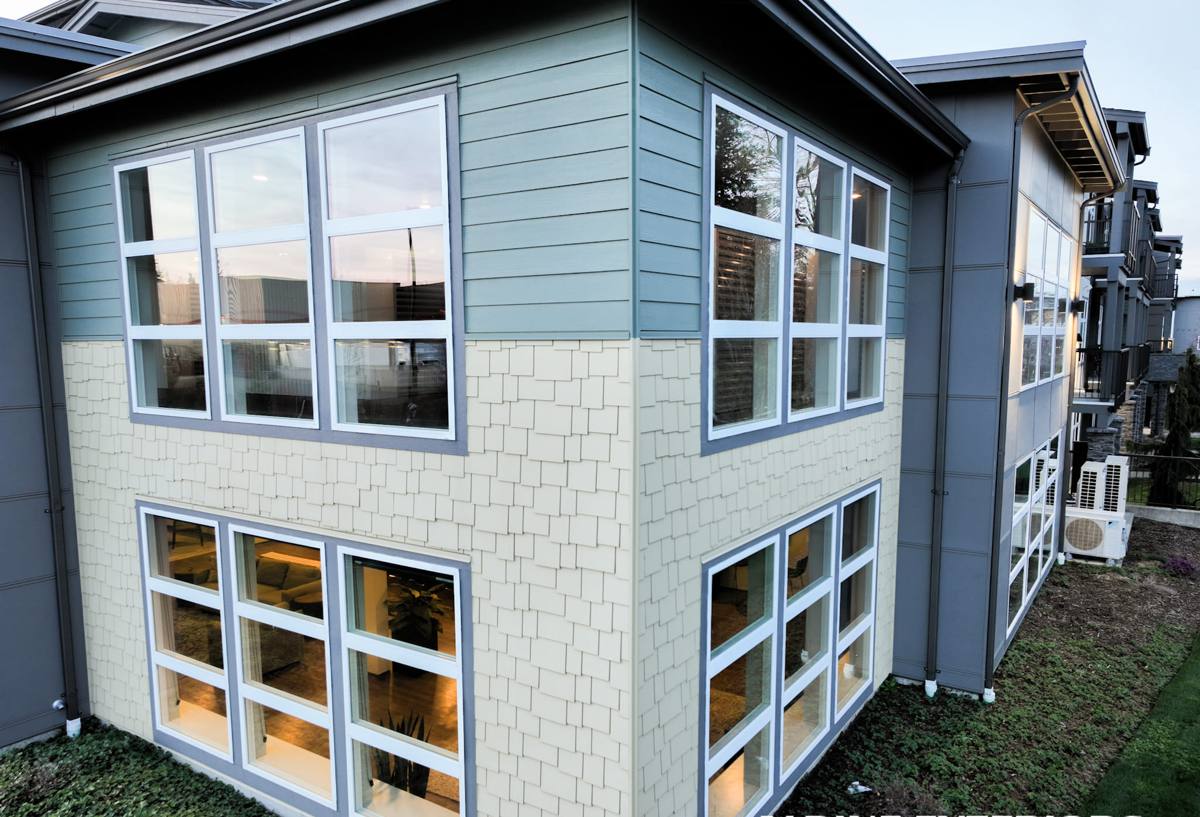
How to Tell a Lynden Home Needs Full Replacement, Not Just Repair
Not every siding problem calls for a full tear-off. A cracked panel from a windstorm, a small area of rot around one window, or a section of trim that's pulled loose can often be repaired without touching the rest of the wall. Full replacement becomes the right call once the damage or age is widespread enough that repair would just be a temporary patch on a system that's failing as a whole.
Signs Pointing Toward Full Replacement
- Moisture damage or soft, spongy siding showing up in multiple areas rather than one isolated spot
- Siding that's original to the house and 20 to 25 years old or more, with no documented replacement history
- Warping, cupping, or delamination spread across several walls rather than a single panel
- Rot discovered at one section that, once opened up, turns out to be present behind other areas of siding too
- Repeated moss or mildew regrowth on multiple walls within weeks of cleaning, suggesting the material itself is holding moisture rather than shedding it
- Interior signs — musty smells, staining, or soft drywall — tracing back to more than one exterior wall
When damage is this widespread, repair work ends up chasing problems one at a time while the rest of the wall keeps aging on the same failing material. A full replacement resets the whole exterior at once, on a known installation standard, instead of leaving a patchwork of old and new sections behind.
What a Correct Full Siding Replacement Involves
Complete Tear-Off, Not Overlay
We remove the existing siding down to the sheathing rather than installing new siding over the old material. Overlaying might save a day of labor, but it buries whatever condition the wall is already in — including any rot, trapped moisture, or failed weather barrier — under a new layer that will eventually show the same problems again.
Full Sheathing and Structural Inspection
With the old siding off, every wall gets checked for soft or rotted sheathing, compromised framing, and signs of long-term moisture intrusion. This is the one point in a project's life where the wall is fully open and inspectable, and it's the wrong place to cut corners. Any damaged sheathing gets replaced before anything new goes up.
Weather-Resistive Barrier Replacement
A full tear-off is also the point where the house wrap or weather-resistive barrier gets replaced across the entire structure, not just patched around new work. Given how much siding failure in this region traces back to water getting behind the cladding rather than through it, this layer matters as much as the siding itself.
Flashing at Every Penetration
Windows, doors, hose bibs, light fixtures, vents — every point where something interrupts the wall plane needs correctly lapped flashing tied into the new weather barrier. This is the detail that's easiest to rush and hardest to inspect once siding is back up, which is exactly why it gets treated as a required step rather than an option.
Installation to Manufacturer Specification
James Hardie's warranty is contingent on installation following their published spec — fastener type and spacing, clearance from grade and rooflines, correct field-cutting, and proper joint treatment. We install to that standard as the baseline on every job, not as an upgrade tier.
Why We Replace Siding With James Hardie Fiber Cement Only
We don't offer LP SmartSide, vinyl siding, Cemplank, Allura, primed spruce, or cedar as replacement options, and that's a deliberate professional standard rather than a limited product lineup we're stuck with. Each of those products has legitimate uses and satisfied owners elsewhere. Our decision comes down to what actually holds up through repeated wet seasons in this part of Whatcom County, on the kind of full-exposure walls a replacement project resets from scratch.
- Non-combustible core: Fiber cement doesn't feed a fire the way wood-based siding can, which carries real weight for both safety and insurance underwriting.
- Factory-applied ColorPlus finish: The color is cured onto the board under controlled factory conditions rather than brushed on after installation, and it resists fading and chalking far longer than field-applied paint.
- Climate-engineered HZ formulation: Hardie's HZ5 product line is built for regions with significant moisture exposure and freeze-thaw cycling, which describes Lynden and the rest of this part of the county closely.
- Dimensional stability: Fiber cement doesn't swell, cup, or warp the way engineered wood siding can after repeated wetting cycles across a long moss season.
- A strong transferable warranty: Hardie backs the product with one of the more substantial warranty structures in the industry, provided the installation follows their spec — which is exactly what a full replacement lets us do correctly from the first course.
A full replacement is the one point in a home's life where the entire exterior can be brought up to one consistent standard at once. Choosing a lower-cost material at that moment doesn't just save money upfront — it quietly resets the clock on the same maintenance and moisture risks the old siding eventually ran into.
What Drives the Cost of a Full Siding Replacement
Every replacement estimate is specific to the house, but the same handful of factors move the number on most Lynden projects. Understanding them ahead of time makes it easier to read an estimate and ask the right questions about it.
| Cost Factor | Why It Matters |
|---|---|
| Total wall square footage and number of stories | More surface area and taller walls mean more material, more staging, and more labor time |
| Sheathing condition once old siding is off | Rot or moisture damage found underneath adds repair scope that can't be accurately priced until the wall is open |
| Amount of trim and detail work | Corner boards, window and door trim, and roofline detailing all add labor beyond flat wall area |
| James Hardie product line and color selected | Lap, shingle, and panel profiles, plus factory-finish colors, carry different material costs |
| Site access and staging | Tight lots, landscaping, or limited driveway access for material delivery and dumpster placement can add time |
| Whether roofing, window, or trim issues are addressed at the same time | Bundling related repairs into the same project is often more efficient than handling them separately later |
Our Replacement Process, Start to Finish
1. On-Site Assessment and Written Estimate
We walk the full exterior, note which walls show the most wear, and look for early signs of what we'll likely find once tear-off begins. The estimate comes from that inspection, not a flat per-square-foot number.
2. Permitting
Full siding replacement typically requires a permit, and we handle that process as part of the project so a Lynden homeowner isn't left navigating the local permitting office on their own.
3. Scheduling and Site Preparation
Before tear-off starts, we plan for material staging, dumpster placement, and protecting landscaping and walkways near the work area.
4. Tear-Off and Sheathing Repair
Old siding comes off, sheathing gets inspected and repaired where needed, and the weather barrier goes on fresh across the whole structure.
5. Installation to Spec
New James Hardie siding goes up following manufacturer fastening, clearance, and joint requirements, with flashing detailed at every penetration along the way.
6. Final Walkthrough
We walk the completed job with the homeowner, cover basic care and maintenance, and confirm the finished work matches what was estimated.
Living Through a Full Siding Replacement
A full replacement is a bigger disruption than a repair, and it helps to know what to expect going in rather than being surprised partway through.
- Expect noise and activity around the exterior of the home during working hours for the duration of the project
- Plan for a dumpster or material staging area to occupy part of the driveway or yard
- Move or cover outdoor furniture, planters, and anything fragile near the walls being worked on
- Pets may be more comfortable indoors or elsewhere during the loudest phases of tear-off
- Ask for a realistic timeline up front, and expect weather in this region to occasionally shift it
- Confirm who handles daily cleanup of debris and fasteners around the work area
Why Hiring a Crew That Already Works Lynden Matters
A contractor who works this part of Whatcom County regularly already has a feel for how Lynden's mix of open farmland and tree-sheltered lots plays out on an actual wall — which sides of a house dry out fast and which stay damp longest, how far salt-laden air travels inland on a given property, and which install-day details are worth the extra time so a homeowner isn't dealing with a callback two winters later. That local pattern recognition is the difference between a replacement that's technically done to spec and one that's actually built for how this specific climate behaves on this specific lot.
It also matters after the job is finished. A crew that's still working this area in five or ten years is a crew a homeowner can actually call if a warranty question or maintenance question comes up later, rather than chasing down a company that's moved on.
If your Lynden home's siding is showing widespread wear, or you're just not sure yet whether it needs repair or full replacement, we're glad to come take a look and give you a straightforward, no-pressure read on where it stands. Reach out using the form below for a free estimate.