 Semiahmoo Exterior
 James Hardie Siding, Installed for What Lynden's Climate Actually Does to a House
Lynden sits inland from the immediate coastline, but it still gets the same weather system that shapes exterior work across this part of Whatcom County: salt-tinged marine air drifting in off the Sound, driving rain that arrives sideways more often than straight down, and a moss season that can stretch across most of the year on shaded walls. A siding product and installation that hold up fine in a drier, calmer climate can start showing problems here within a handful of years. We install James Hardie fiber cement siding exclusively, and on Lynden homes specifically, the reasons come down to how that product and a correct installation actually perform against salt, wind-driven moisture, and sustained dampness.
This page focuses on one thing: James Hardie siding for Lynden homes specifically — what the climate demands, what a correct installation involves, how our process works, and why hiring a crew that already works this area on a regular basis changes the outcome.
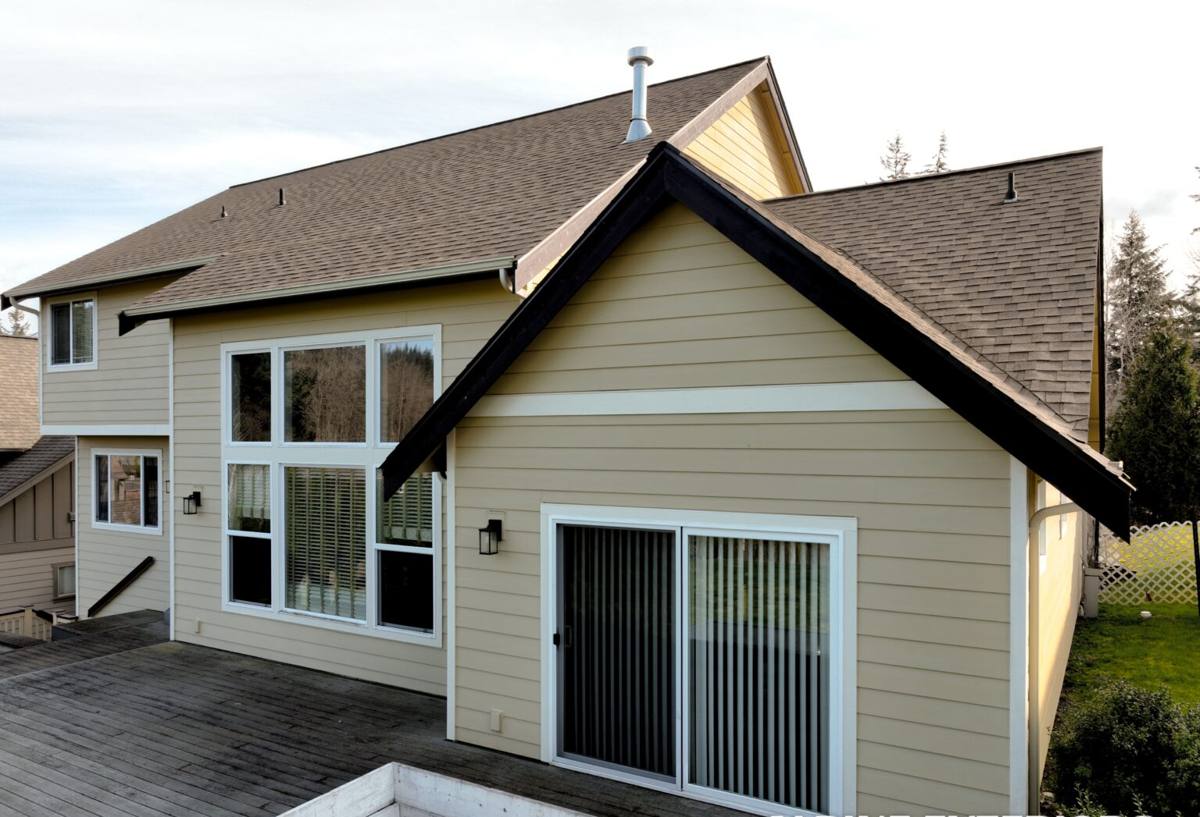
What Lynden's Climate Asks of a Siding System
Salt Air and Corrosion
Even away from the immediate shoreline, homes in this part of Whatcom County get a steady dose of salt-laden air. Salt accelerates corrosion in fasteners, flashing, and trim, and it degrades lower-grade finishes faster than a purely inland climate would. That means fastener choice and flashing material matter as much as the siding panel itself — a great siding product undermined by the wrong fasteners will still show rust streaks and failure points years before it should.
Wind-Driven Rain
Rain here rarely falls straight down for long. Wind pushes it sideways into laps, seams, and any gap in the water-resistive barrier behind the siding. That's a heavier moisture load on the wall assembly than a simple rainfall total suggests, and it's exactly the condition that exposes sloppy lap spacing, missing flashing, or caulk used where flashing should have been.
A Long Moss and Mildew Season
Mild temperatures, tree cover, and near-constant moisture add up to a moss and mildew season that runs long in this region. Shaded, north-facing walls are usually the first place it shows up. Any siding material that's porous or that holds moisture against the substrate becomes a growth surface over time, and once moss and mildew take hold, they hold moisture against the wall even longer — a cycle that compounds itself if the underlying material and installation weren't built to shed water in the first place.
Why James Hardie Specifically for This Area
We don't install LP SmartSide, vinyl siding, Cemplank, Allura, primed spruce, or cedar. Each has customers who are happy with it, and none of them are bad products in every application. But for a climate with this much sustained moisture and salt exposure, we've settled on James Hardie fiber cement as the one system we're willing to install and stand behind.
- Non-combustible core: fiber cement doesn't feed a fire the way wood-based or wood-derived siding products can, which matters for both safety and, often, insurance considerations.
- Factory-applied ColorPlus finish: the color is baked on under controlled factory conditions rather than brushed on in the field, so it resists fading and moisture intrusion longer than site-applied paint.
- HZ5 formulation: Hardie engineers its HZ product lines by climate zone, and HZ5 is built for regions with significant moisture exposure and freeze-thaw cycling — a good match for northern Whatcom County.
- Dimensional stability: fiber cement doesn't swell, cup, or warp the way engineered wood products can after repeated wet-season exposure.
- Strong transferable warranty: Hardie backs the product with one of the more substantial warranty structures in the industry, provided the installation follows their published specifications.
That last point matters as much as the product itself. A Hardie warranty is conditional on correct installation — wrong fastener pattern, missing clearances, or skipped flashing details can compromise coverage even though the siding itself is sound. That's part of why installation quality gets its own section below rather than being an afterthought.
James Hardie Product Lines Worth Considering in Lynden
| Product | Best Fit For | Local Consideration |
|---|---|---|
| HardiePlank lap siding | Most home styles, traditional or modern | Most common choice; wide color range in ColorPlus finishes |
| HardiePanel vertical siding | Modern facades, accent walls, gable ends | Works well paired with lap siding for visual contrast |
| HardieTrim boards | Window and door trim, corners, fascia | Matched material avoids the mismatched weathering you get mixing wood trim with fiber cement field |
| HardieShingle siding | Accent gables, Craftsman-style detailing | Adds texture without the moisture concerns of real wood shingle |
Most Lynden projects use HardiePlank as the primary field material, with HardieTrim boards at corners and openings so the whole envelope is one matched fiber cement system rather than fiber cement panels against wood or composite trim that weathers differently over time.
What a Correct Installation Actually Involves
The siding panel is only part of the system. In a climate that drives rain sideways into wall assemblies, the details behind and around the panel decide whether the wall stays dry or slowly takes on moisture over several seasons.
Water-Resistive Barrier and Flashing
A continuous, properly lapped water-resistive barrier goes on before any siding, with flashing integrated at every window, door, and penetration so water is directed out and down rather than trapped behind the cladding. This is the step that matters most in wind-driven rain conditions, and it's also the step that's invisible once the siding is up — which is exactly why it has to be done right the first time.
Fastening and Clearances
Hardie specifies fastener type, spacing, and penetration depth for a reason — done wrong, panels can crack, work loose, or let water track along the fastener shank. Clearance from grade, roofing, and decking surfaces also matters: siding installed too close to the ground or a deck surface stays wet longer and invites the moss and mildew growth this climate already encourages.
Joints and Caulking
Butt joints and trim transitions need to be treated per Hardie's specification, not just caulked over as a catch-all. Caulk is a maintenance item, not a substitute for correct flashing — a wall that relies on caulk to stay dry will eventually fail once that caulk ages and cracks, which happens faster in a climate with this much sun, rain, and temperature swing.
Signs an Existing Installation Was Done Right
- Consistent, tight reveal lines on lap siding with no visible waviness
- Caulk used sparingly at trim transitions, not as a gap-filler over missing flashing
- Visible clearance between the bottom siding course and grade, decking, or roofing
- No fastener heads left proud of the surface or overdriven into the panel
- Corners and trim boards matched in material and finish, not mixed with wood or composite
Our Process on a Lynden Siding Project
We start with a walk-through of the home, checking existing siding, sheathing condition where it's exposed, and any signs of past moisture intrusion around windows, corners, and low walls. From there:
- Estimate and scope: we assess whether the project is a full tear-off or, in some cases, an overlay, and flag any substrate repair we expect to find once the old siding comes off.
- Tear-off and substrate check: removing the old siding lets us actually see the sheathing and framing underneath rather than guessing at its condition — this is where hidden moisture damage from a prior installation often shows up.
- Water-resistive barrier and flashing: installed continuously and integrated at every opening before a single piece of siding goes up.
- Siding and trim installation: HardiePlank, panel, or shingle product installed to Hardie's fastening and clearance specifications, with matched HardieTrim at corners and openings.
- Final inspection: we check reveal consistency, fastener placement, and clearances before calling the job finished.
Cost Factors for a Lynden Hardie Siding Project
| Factor | Why It Matters |
|---|---|
| Tear-off vs. overlay | Tear-off costs more upfront but lets us verify and repair the substrate — important if there's any history of moisture intrusion |
| Home size and wall complexity | More corners, gables, and window openings mean more trim work and cut time |
| Product line selection | HardiePlank, panel, and shingle products carry different material and labor costs |
| Substrate repair | Rot or moisture damage found during tear-off adds scope that can't always be predicted before the walls are open |
| Trim and detail work | Matched HardieTrim at every corner and opening costs more than mixing in dissimilar trim materials, but avoids mismatched weathering later |
We don't quote off a generic price list, because the substrate condition behind existing siding is often the biggest variable — and that's not knowable until the old siding is off the wall.
Why a Crew That Already Works Lynden Matters
A contractor working across Whatcom County day to day sees how salt air, wind-driven rain, and moss actually play out on real houses over full seasons, not just how a product performs on a spec sheet. That shapes practical judgment calls: which wall orientations in this area tend to stay damp longest, where extra flashing attention pays off, and which shortcuts consistently show up as callbacks two or three winters later. It also means a crew that's already familiar with the permitting and inspection expectations local jurisdictions apply to siding replacement, so there are fewer surprises mid-project.
If your Lynden home needs new siding, or you're trying to figure out whether existing siding is failing versus just dirty, we're glad to take a look. Reach out using the form below for a free, no-pressure estimate.