 Semiahmoo Exterior
 Building a Deck That Actually Holds Up in Blaine
Blaine sits right on Semiahmoo Bay and Drayton Harbor, which means most homes here get some combination of salt-laden air, wind off the water, and long stretches of gray, wet weather every fall and winter. A deck built the way it might be built inland doesn't last the same way out here. Fasteners rust faster, wood stays damp longer between dry spells, and shaded sections of decking grow moss well before a homeowner expects it. None of that means a deck is a bad investment in Whatcom County — it just means the build has to account for the environment from the ground up, not as an afterthought.
This page covers what we look at specifically when we design and build a custom deck for a Blaine or greater Semiahmoo property: the materials that hold up, the structural details that matter most, and what our process looks like from first call to final walkthrough.
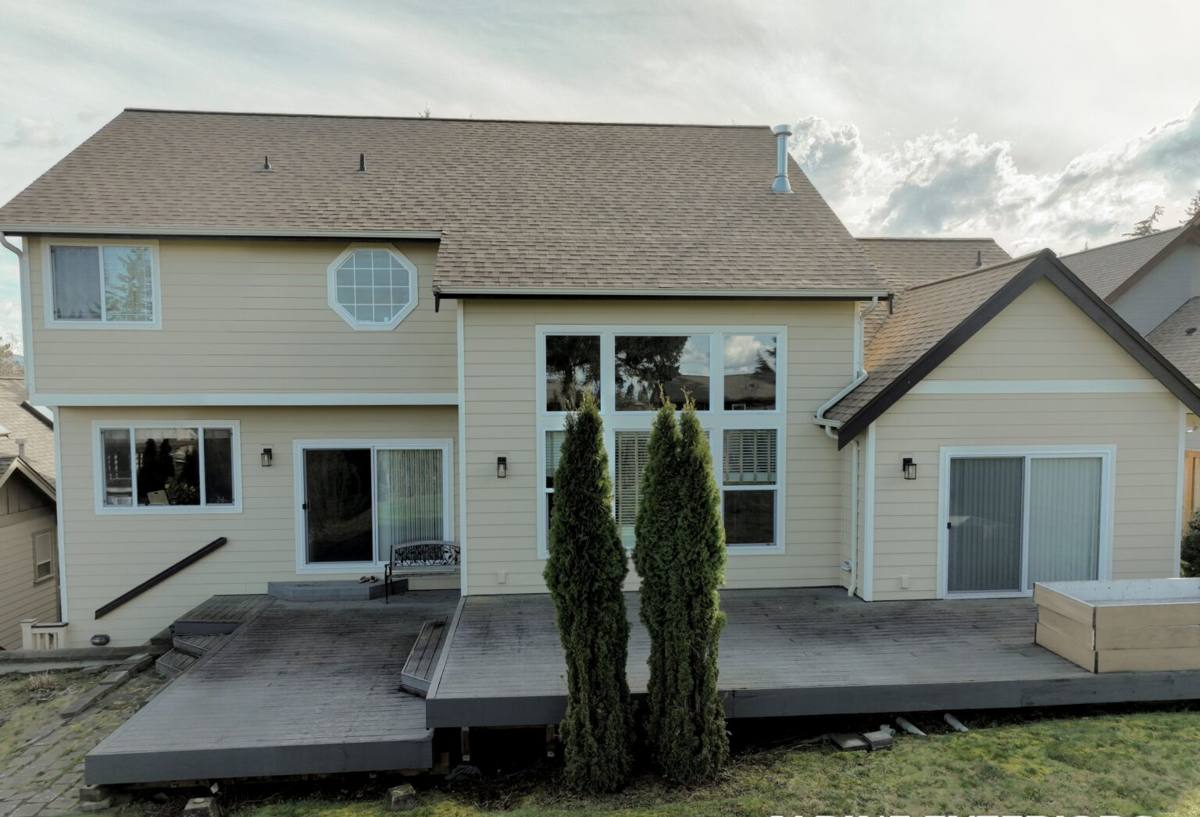
What Salt Air, Rain, and Moss Actually Do to a Deck
Coastal exposure doesn't damage a deck all at once — it's a slow, compounding process, and it tends to hit the same spots first.
Metal Fasteners and Hardware
Standard galvanized screws, nails, and joist hangers corrode noticeably faster within a few blocks of open water. Once a fastener starts rusting, it weakens, stains the surrounding wood or composite, and can eventually fail structurally. This is one of the most common issues we find on older decks we're asked to repair or replace in this area — the framing itself is often fine, but the hardware holding it together isn't.
The Ledger Board Connection
The ledger board — where the deck attaches to the house — is the single most important detail on any deck, and it's also the spot most likely to cause serious damage if it's flashed incorrectly. In a climate with as much driving rain as Whatcom County gets, water that finds its way behind an improperly flashed ledger board doesn't just rot the deck framing — it can work its way into the house's rim joist and wall framing, which turns a deck problem into a home repair problem.
Moss and Algae
Decks on the shaded or north-facing side of a house, or under tree cover, stay damp for days after a storm instead of drying out in an afternoon. That constant moisture is exactly what moss and algae need to establish, and once they take hold on wood decking, the surface becomes both unsightly and genuinely slippery underfoot.
Choosing Decking Material for a Semiahmoo Climate
There isn't one "correct" material for every deck — it depends on budget, how much upkeep the homeowner wants to do, and how exposed the deck is. Here's how the common options actually perform in our conditions.
| Material | Moisture & Rot Resistance | Moss/Algae Behavior | Maintenance | Typical Lifespan |
|---|---|---|---|---|
| Composite decking | Very good — won't rot or splinter | Can still grow moss in shaded, unwashed areas; doesn't absorb water like wood | Occasional washing; no staining or sealing | 25+ years |
| Cedar | Naturally rot-resistant but still needs sealing | Moss-prone if not maintained; ages to gray without upkeep | Sealing/staining every 1-2 years in this climate | 15-20 years with upkeep |
| Pressure-treated pine | Good if properly sealed; treatment protects against rot | Moss-prone in shade; grain holds moisture longer than composite | Sealing every 1-2 years, more attention to end cuts | 15-20 years with upkeep |
For homeowners who want the lowest long-term maintenance, we generally steer toward composite decking on exposed or shaded builds. For those who want a traditional wood look and are willing to keep up a sealing schedule, cedar or treated lumber are honest, reasonable choices — we just make sure the homeowner understands the maintenance commitment going in, rather than finding out three years later.
Footings, Framing, and Structure Built for Local Conditions
What's underneath the decking matters more than the decking itself when it comes to long-term performance. In Whatcom County, footings need to be set below frost depth and sized appropriately for the soil on the lot — clay-heavy or poorly draining soil, which is common on some Blaine properties, needs footings and drainage handled differently than sandy, fast-draining ground.
We also pay attention to wind exposure. Peninsula and waterfront-adjacent lots around Semiahmoo can see stronger, more consistent wind than properties further inland, which affects how we brace railing posts and attach the structure to the house. A deck that's structurally sound in a sheltered backyard isn't automatically sound on a more exposed lot.
- Joist tape or an equivalent moisture barrier on top of every framing member to slow rot at fastener penetrations
- Stainless steel or coated fasteners rated for coastal/corrosive environments, not standard-grade hardware
- Correctly flashed ledger board with proper flashing tape and a drainage gap where it meets the house
- Footings poured below frost depth and sized for the actual soil conditions on the lot, not a generic default
- Adequate under-deck ventilation and spacing between boards so water and debris don't sit and hold moisture
Railings and Hardware That Won't Rust or Fail
Railings take more weather exposure than almost any other part of a deck, and they're a safety component, not just a design one. We favor powder-coated aluminum or properly finished composite railing systems over bare or lightly coated metal, since bare metal railing hardware is one of the first things to show rust streaks near the water. Wood railings are still an option for homeowners who want that look, but they need the same sealing attention as wood decking — arguably more, since railing posts take direct rain from more angles than a flat deck surface.
Post attachment matters just as much as the railing material. On an exposed or elevated deck, we look closely at how posts are anchored to the framing below, not just bolted to the rim joist, since that connection is what actually keeps a railing from working loose over time.
Design Choices That Make Sense for Blaine Properties
Beyond structure, a few design decisions come up often on custom builds in this area:
Drainage Away From the House
Deck surfaces should be sloped slightly to shed water away from the house foundation, not toward it — an easy detail to get wrong and an expensive one to fix after the fact.
Sun and Shade Mapping
Before we finalize decking material and layout, we look at how sun and shade actually move across the specific lot through the year. A deck that's shaded most of the day is a stronger candidate for composite decking or a maintenance plan built around it, since that's exactly where moss takes hold first.
Wind-Aware Layouts
On more exposed sites, we'll sometimes discuss partial screening, solid lower railing sections, or orientation adjustments that cut down on wind without turning the deck into a fully enclosed space.
Our Process for a Custom Deck Build
Every custom deck we build in Blaine follows the same general path, though the details flex based on the property:
- On-site consultation — we walk the property, look at sun/shade patterns, existing drainage, and how the deck will connect to the house.
- Design and material selection — we go over decking, railing, and structural options honestly, including trade-offs, so the homeowner picks based on real information.
- Permitting — most deck projects in Whatcom County require a permit; we handle that process rather than leaving it to the homeowner.
- Construction — footings, framing, flashing, decking, and railing, in that order, with the ledger board and flashing details treated as non-negotiable.
- Final walkthrough — we go over the finished deck together and cover what maintenance, if any, the homeowner should plan on.
Before signing with any contractor for a custom deck, it's worth making sure the quote actually addresses the details that determine whether the deck lasts:
- Does the quote specify ledger board flashing method, or just say "attached to house"?
- Are fasteners specified as stainless or coastal-rated, or left unstated?
- Is footing depth specified, or left to a generic default regardless of soil type?
- Does the quote include permitting, or is that left for the homeowner to sort out?
- Is there a clear line on what's included in decking vs. railing vs. structure pricing?
Keeping a Blaine Deck Looking Good Year to Year
Even a well-built deck needs some seasonal attention in this climate. Composite decking mostly needs a rinse and occasional wash to keep moss from taking hold in shaded corners. Wood decking and railings need resealing roughly every one to two years, more often on sections that stay shaded or get heavy rain exposure. Keeping gutters and downspouts clear near the deck also helps — a lot of moisture problems we see start with water being dumped onto or near the deck from somewhere else on the house, not from rain falling directly on it.
Why Work With a Crew That Already Builds in Blaine and Semiahmoo
A deck built by someone unfamiliar with this coastal environment can look identical to a properly built one on the day it's finished — the difference shows up two, five, and ten years later, in rusted hardware, a soft ledger board, or decking that never quite dries out. We build decks in Blaine and across the Semiahmoo area regularly, so material choices, fastener grade, footing depth, and flashing details are handled correctly the first time, not adjusted after something fails.
If you're planning a custom deck in Blaine or anywhere around Semiahmoo, we're happy to walk the property with you and put together a straightforward, no-pressure estimate — just fill out the form below to get started.