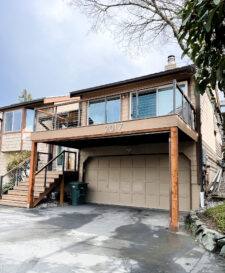
 Semiahmoo Exterior
 Why Cherry Point Decks Wear Out Faster Than the Instructions Say
Decking manufacturers write their maintenance schedules and lifespan estimates for an average American backyard — not for a headland sitting right on the Salish Sea. Cherry Point homes deal with a different combination of stresses: salt-laden air moving off the water, long stretches of driving rain, and a moss and algae season that runs longer here than almost anywhere else in Whatcom County. None of those factors are dramatic on their own, but stacked together year after year, they age a deck faster than the warranty paperwork assumes.
Salt air is the one people underestimate the most. It doesn't just sit on the surface — it works into fastener heads, joist hangers, and any exposed metal, accelerating corrosion in hardware that would last decades further inland. Add in near-constant moisture from rain and fog, and you get the second problem: wood and even some composite substrates that never fully dry out between storms. That's the environment moss and algae need to take hold, and once they do, they hold water against the deck surface and framing even longer, which is exactly what starts real rot rather than surface weathering.
Signs a Deck Needs Replacement, Not Just Repair
Not every tired-looking deck needs a full teardown. But in this climate, cosmetic problems often mask structural ones underneath, so it's worth knowing what actually points to replacement.
- Soft or spongy spots in decking boards, especially near the house or along drainage paths
- Rust streaking from fasteners, or fastener heads that have corroded and lost their grip
- A ledger board (where the deck attaches to the house) that's discolored, soft, or pulling away
- Persistent black or green staining that returns within weeks of cleaning
- Joists or beams that flex noticeably underfoot, or visible sagging between support posts
- Footings that have shifted, heaved, or show cracking at grade
- A deck older than 15-20 years that has never had the substructure inspected, only the surface refinished
If it's just surface graying or a few loose boards, repair is the honest answer and we'll say so. Replacement makes sense when the framing, ledger, or footings are compromised — patching those doesn't hold up long in this environment.
What a Correct Deck Replacement Actually Involves
Starting Below the Surface
A deck replacement done right starts with what you can't see once it's finished. That means checking footing depth and condition against current code, inspecting or replacing the ledger board and its flashing (the single most common failure point on decks attached to a house in a wet climate), and sizing joists and beams correctly for the span and expected load — not just matching what was there before if what was there before was undersized to begin with.
Hardware That Matches the Environment
Given the salt air near Semiahmoo, fastener and connector choice isn't a minor detail — it's one of the decisions that determines whether the new deck lasts 10 years or 25. We use stainless steel or heavy hot-dip galvanized fasteners and structural connectors rated for coastal exposure, not the standard-grade hardware that's fine 30 miles inland but corrodes early here.
Drainage and Airflow
Moss and rot both need standing moisture to get started. A correct replacement builds in proper board spacing, ledger flashing that actually sheds water away from the house, and grading or drainage beneath the deck so water has somewhere to go instead of sitting against framing. This matters more here than in a drier climate, and it's often the part that got skipped on the original build.
Decking Material Options for This Climate
There's no single "best" decking material — there's a best material for your budget, your maintenance appetite, and how much direct weather and salt exposure your specific deck gets. Here's how the common options actually compare in a Cherry Point setting.
| Material | Moisture / Salt Air Behavior | Maintenance | Typical Lifespan Here |
|---|---|---|---|
| Pressure-treated wood | Resists rot when properly maintained, but end grain and fastener holes are vulnerable entry points for moisture | Annual cleaning, periodic sealing/staining | 10-15 years |
| Cedar | Naturally moisture-resistant, but softer and more prone to surface checking under constant wet-dry cycling | Regular sealing to hold color and resist moss | 12-18 years |
| Capped composite | Handles moisture and salt exposure well; the cap layer resists staining and moss adhesion better than wood | Occasional washing, no sealing or staining | 20-30 years |
| PVC decking | Fully synthetic, essentially immune to rot; performs well in constant damp conditions | Occasional washing | 25-30+ years |
Uncapped composite (older-generation composite without a protective outer layer) is one product we steer away from recommending in this specific environment. It's not that it fails outright — it's that in a climate this wet and salty, it tends to absorb moisture at the core over time, which shows up as swelling, discoloration, and moss adhesion sooner than the capped versions. That's a maintenance and appearance trade-off worth knowing about before you buy, not a defect claim against any one brand.
Our Deck Replacement Process
- On-site evaluation. We inspect the existing deck, ledger, footings, and framing to confirm whether replacement (versus repair) is actually the right call.
- Honest scope and estimate. You get a clear breakdown of what's being replaced, what material is recommended and why, and what it costs — no surprise change orders for things we should have caught up front.
- Permitting. We handle the permit application and inspections required for the jurisdiction, so you're not the one tracking down paperwork.
- Careful demolition. Full tear-off of the old structure, checking the house connection point and any hidden framing damage once the old boards are off.
- Rebuild to current code. New footings or reinforced existing ones as needed, corrosion-resistant hardware, correctly flashed ledger, and framing sized for the actual load.
- Decking installation and finish work. Boards, railings, and stairs installed to manufacturer spec, with attention to spacing and drainage.
- Final walkthrough. We go over the finished deck with you and confirm everything meets the agreed scope before we call it done.
Permits and Code Considerations
Deck replacement in Whatcom County typically requires a permit once you're rebuilding the structure rather than just replacing surface boards, and inspections generally occur at the footing and framing stages before decking goes down. Guardrail height, baluster spacing, and stair requirements are governed by current building code and get checked during inspection. Requirements can vary depending on your specific jurisdiction and whether the deck is attached to the house, so we confirm the exact requirements for your property before pulling a permit rather than assuming they're the same as the last job down the road.
Living With a Deck in a Salt Air, High-Moisture Climate
Even a well-built deck needs some upkeep in this environment — the goal of a correct replacement is to reduce that upkeep, not eliminate it entirely. A short seasonal routine goes a long way toward protecting the investment.
- Sweep debris off the deck regularly, especially in fall when leaves and organic matter trap moisture and feed moss
- Rinse salt residue off hardware and railings periodically, particularly after storms with onshore wind
- Check gaps between boards each spring and clear out any buildup that's blocking drainage
- Address moss or algae as soon as it appears rather than waiting for it to spread — it's far easier to remove early
- Inspect the ledger board and any visible fasteners annually for corrosion or gaps
- Reseal wood decking on the manufacturer's recommended schedule, not just when it looks faded
Why a Crew That Already Works Cherry Point Matters
A deck built to a generic national spec sheet and a deck built for this specific stretch of Whatcom County coastline aren't the same project, even if the plans look identical on paper. A crew that regularly works in and around Semiahmoo knows which hardware grade actually holds up against the salt air here, how much drainage slope is realistic given the local rain patterns, and which materials are worth the extra upfront cost because they cut down on the moss and moisture problems that show up two or three years in. That local pattern recognition is hard to replace with a generic checklist, and it's usually the difference between a deck that needs attention again in a decade and one that doesn't.
If your deck in the Cherry Point area is showing soft spots, corroded hardware, or persistent moss you can't get ahead of, we're glad to take a look. Reach out for a free, no-pressure estimate — we'll tell you honestly whether you're looking at a repair or a full replacement, and walk you through the options that make sense for your home and budget using the form below.