 Semiahmoo Exterior
 Roofing in California Creek: What the Local Conditions Actually Demand
California Creek sits in that stretch of Whatcom County where the roofs take a beating from three directions at once: salt air coming off Semiahmoo Bay and Drayton Harbor, driving rain that blows in sideways during winter storms, and a tree canopy that keeps large sections of every roof in shade for months at a time. None of these are dramatic events. They're slow, steady conditions that work on a roof year-round, which is exactly why they get overlooked until a homeowner is dealing with a leak, a stained ceiling, or a roof that looks twenty years old at twelve.
An asphalt shingle roof installed correctly for this specific combination of conditions behaves very differently over its lifespan than one installed the same way you'd install it in a dry inland climate. The materials aren't usually the problem. The details — underlayment choice, fastener type, ventilation, flashing — are where a roof either holds up here or doesn't.
Salt Air and Metal Components
Proximity to saltwater accelerates corrosion on any exposed metal — nail heads, flashing, vent caps, gutter hardware. On a shingle roof this mostly shows up as rust streaking near flashing points and premature failure of cheaper fasteners. It's a slow process, but over ten or fifteen years it adds up, especially on the side of a roof that faces the water and catches the prevailing wind.
Driving Rain and Wind-Driven Exposure
Rain that falls straight down is easy for any roof to shed. Rain that comes in at an angle, pushed by wind off the water, finds every weak point in a roof system — under-lapped shingles, thin nailing patterns, valleys that weren't detailed properly, and flashing that relies on caulk instead of proper lapping. California Creek gets its share of both.
Moss, Shade, and a Long Wet Season
Tree cover keeps roofs shaded and slow to dry after rain, which is exactly what moss and algae need to take hold. Once moss establishes on a shingle roof, it holds moisture against the surface, lifts shingle edges as it grows, and shortens the roof's life if it isn't managed. This is one of the most common, most preventable problems we see on roofs in this area.
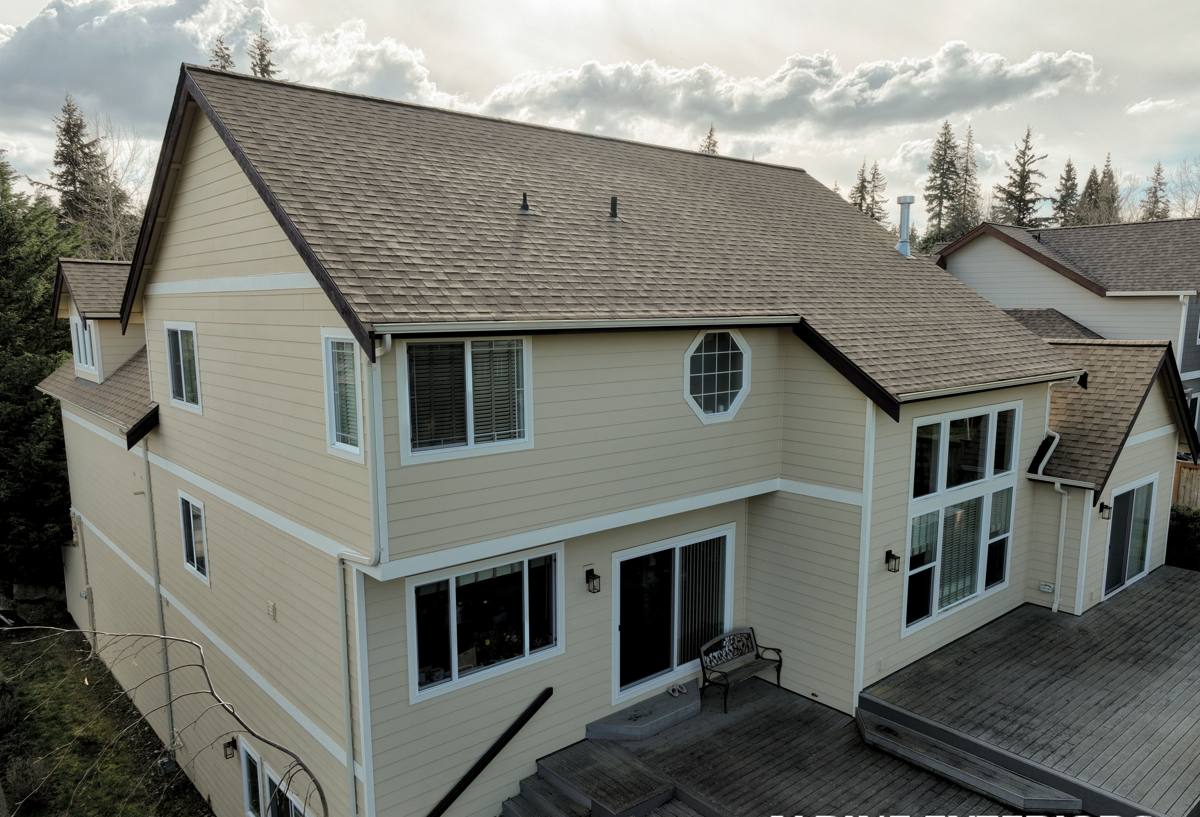
What a Correctly Built Asphalt Shingle Roof Involves Here
A roof that's going to hold up to salt air, wind-driven rain, and a long moss season needs a few things done right that aren't always visible once the job is finished.
Underlayment and Water-Resistant Barrier
A synthetic underlayment with strong water resistance, installed with proper overlap and sealed at every fastener, is the backup system that protects the roof deck if wind-driven rain ever gets past the shingles. In valleys and around penetrations, we use additional self-adhered membrane — this is the area most likely to leak on an underbuilt roof, and it's cheap insurance compared to the cost of a ceiling repair.
Ventilation That Matches the Climate
Balanced intake and exhaust ventilation keeps the attic dry and close to outdoor temperature. In a damp, shaded climate like this one, poor ventilation traps moisture in the attic, which shortens the life of the roof deck from underneath — a problem homeowners rarely see coming because it doesn't show up as a visible leak until it's advanced.
Flashing, Not Caulk
Step flashing at walls, proper counter-flashing at chimneys, and correctly lapped flashing in valleys should do the work of keeping water out — not a bead of sealant. Caulk fails; well-installed flashing doesn't need it to do its job. This is one of the fastest ways to tell a properly built roof from a rushed one.
Choosing the Right Shingle for a California Creek Home
Not every shingle product is a good fit for a shaded, damp, coastal-influenced lot. The table below lays out the honest trade-offs between the common options, without any brand name attached — the differences are about the class of product, not who makes it.
| Shingle Type | Typical Lifespan | Best Fit For | Trade-Offs |
|---|---|---|---|
| 3-tab shingle | 15–20 years | Budget-conscious projects, simple roof lines | Lower wind rating, less resistant to moss lifting the edges |
| Architectural (dimensional) shingle | 25–30 years | Most homes in this area — the standard choice | Higher upfront cost, but better wind and moisture performance |
| Algae-resistant (AR) shingle | Same as base product | Shaded lots with heavy tree cover, like much of California Creek | Slightly higher cost; reduces but doesn't eliminate the need for moss upkeep |
| Impact-rated shingle | 25–30+ years | Homes wanting extra durability and possible insurance credit | Higher material cost; not always necessary depending on exposure |
For most homes in this neighborhood, we recommend an algae-resistant architectural shingle. The upfront cost difference over a basic 3-tab is modest, and given how much shade and moisture this area gets, it's the option that holds its appearance and performance longest without extra maintenance.
Our Process for a California Creek Roof Replacement
- On-site inspection. We walk the roof and attic, not just look from the ground — deck condition, ventilation, flashing points, and moss/moisture history all get checked.
- Honest scope and quote. You get a written plan covering materials, underlayment, ventilation work, and flashing details — no vague "roofing package" line items.
- Tear-off and deck check. Old material comes off down to the deck so we can catch soft or water-damaged sheathing before it gets covered up again.
- Water barrier and flashing installed first. This is the layer that actually keeps a home dry; it goes in before a single shingle is nailed down.
- Shingle installation to manufacturer spec. Correct nailing pattern, exposure, and fastener count — not just "close enough," which is where premature wind damage usually starts.
- Final walkthrough. We show you the completed work, including ventilation and flashing details you won't see once you're back on the ground.
Common Problems We Run Into on Roofs in This Area
A few issues show up repeatedly on the roofs we inspect and repair around California Creek:
- Moss buildup along north-facing slopes and valleys shaded by trees
- Rust staining and early fastener failure near the water-facing side of the roof
- Nail pops and lifted shingle edges after winter windstorms
- Valley wear from years of concentrated water flow through an undersized or poorly lapped valley
- Attic moisture damage from ventilation that was undersized when the roof was last replaced
None of these are unusual for the area — they're the predictable result of the climate doing what it does. The point isn't to alarm anyone; it's that a roof built with these specific conditions in mind avoids most of this list entirely.
Keeping a New Roof Performing After Installation
An asphalt shingle roof built correctly for this climate still benefits from basic upkeep. This isn't a demand for constant maintenance — it's a short list that meaningfully extends the roof's life:
- Keep gutters and valleys clear of needles and leaf litter, especially heading into fall
- Have moss treated or removed before it establishes rather than after it's visibly thick
- Trim back overhanging branches where practical to reduce shade and debris on the roof
- Have the roof looked at after any major windstorm, even if nothing looks obviously wrong from the ground
- Schedule a periodic visual inspection every few years rather than waiting for a leak to prompt one
Why Hiring a Crew That Already Works This Area Matters
Asphalt shingle installation isn't unique to California Creek — the trade is the same everywhere. What's different here is knowing, before the first shingle goes down, which slopes will hold moss, which side of the house takes the worst of the wind-driven rain off the bay, and where ventilation tends to be undersized on older Whatcom County homes. A crew that works this area regularly builds those answers into the job by default instead of discovering them later as callbacks.
That local familiarity also shows up in smaller, practical ways — knowing what permitting looks like for the county, having a realistic sense of weather windows for scheduling a tear-off, and being reachable afterward if a question comes up rather than having moved on to a different region entirely.
What Affects the Cost of a Roof Replacement Here
Every roof is different, so we won't quote a number without seeing the job, but the main cost drivers on a California Creek re-roof are consistent: the size and pitch of the roof, how much of the deck needs to be replaced versus reused, the shingle class chosen, the amount of flashing and valley work involved, and how many layers of old roofing need to be removed first. A simple, accessible roof in good structural shape costs meaningfully less than a steep, cut-up roof line with deck repair needed — the honest answer is always "it depends on what we find," which is why the on-site inspection comes before any quote.
If you'd like a straight look at what your roof actually needs — no pressure, no inflated scope — we're happy to come out and walk it with you. The estimate is free, and you'll get a plain-English rundown of condition, options, and honest pricing before you decide anything.