 Semiahmoo Exterior
 Why a New Roof in Sumas Has to Be Built Differently
Sumas sits in a part of Whatcom County where the roof over your head does real work every month of the year. You've got salt-laden air moving in off the water, long stretches of driving rain, and a moss season that can run from fall through spring if a roof isn't set up to shed water and dry out fast. A roof that would hold up fine in a drier inland climate can start showing problems here in half the time — soft spots at the eaves, moss mats holding moisture against the shingles, fastener corrosion, and granule loss from repeated wet-dry cycling.
New roof installation isn't just "pick a shingle and nail it down." In this climate, the decisions that matter most are the ones you can't see once the job is done: how the deck was prepped, what underlayment went down, how the roof breathes, and whether water has a clear path off the structure at every valley, penetration, and eave. Get those wrong and even a premium shingle will underperform. Get them right and a mid-range material will comfortably outlast its rating.
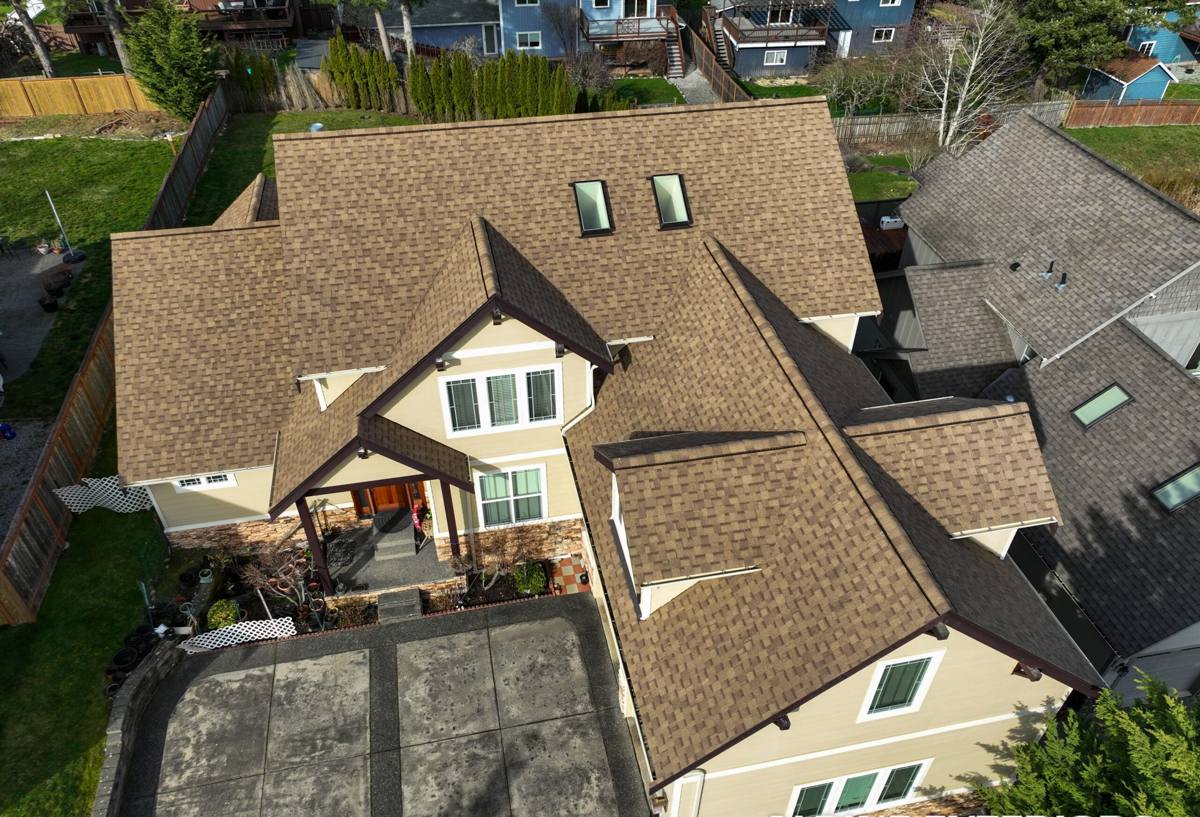
What a Correct New Roof Installation Actually Involves
A full roof replacement is a sequence of steps, and skipping or rushing any one of them is where most premature failures start.
Tear-Off and Deck Inspection
We remove the old roofing down to the deck rather than layering over it. That's the only way to actually see the plywood or OSB underneath. In this climate, deck damage usually shows up around old leak points, valleys, and chimney or vent flashing — areas that have been quietly wicking moisture for years. Any soft, delaminated, or stained sheathing gets replaced before anything new goes down. Roofing over a compromised deck just hides the problem under a new surface.
Underlayment and Water Protection
With the amount of driving rain Whatcom County gets, underlayment choice matters more here than in drier regions. We use synthetic underlayment as the primary water-resistant layer and add self-adhered ice-and-water membrane at the eaves, valleys, and around every roof penetration — the spots where wind-driven rain is most likely to find a way in. This isn't an upsell; it's the difference between a roof that sheds water and one that just slows it down.
Ventilation
Poor attic ventilation is one of the biggest hidden contributors to moss growth and premature shingle aging in this region. A roof that can't exhaust warm, moist air properly stays damper longer after every rain, which gives moss and algae exactly the conditions they need to take hold. We check and correct intake (soffit) and exhaust (ridge or box vents) balance as part of every installation, not as an afterthought.
Flashing and Details
Valleys, chimneys, skylights, and wall-to-roof transitions are where most leaks actually originate — rarely the open field of the roof. New, correctly lapped flashing at every one of these details is non-negotiable on a proper installation.
Roofing Materials: What Holds Up Locally
There's no single "best" roofing material — the right choice depends on your budget, your roof's exposure, and how much long-term maintenance you're willing to take on. Here's how the common options compare for a Sumas-area home.
| Material | Typical Lifespan Here | Moss/Moisture Behavior | Maintenance Load |
|---|---|---|---|
| Architectural asphalt shingle | 20–30 years | Good with proper ventilation; algae-resistant granules help on shaded slopes | Low to moderate |
| Standing seam metal | 40–50+ years | Sheds water and moss debris very well due to smooth, steep-shedding surface | Low |
| Cedar shake | 20–30 years with upkeep | Attractive but holds moisture in the grain; needs active moss and moisture management | High |
| Composite/synthetic shake | 30–50 years | Mimics wood appearance without the moisture absorption | Low to moderate |
We install cedar shake when a homeowner wants that look and understands the maintenance commitment, but we're upfront that in a climate with this much sustained moisture, it asks more of the owner than asphalt or metal do. That's a trade-off we explain honestly rather than talk anyone out of — it's your roof and your call.
Signs a Sumas Home Needs Replacement, Not a Repair
Not every roof problem calls for a full tear-off. But there's a point where patching stops being cost-effective and starts becoming money spent delaying the inevitable. Watch for:
- Granule loss heavy enough that you can see bare fiberglass mat on shingles
- Moss established across multiple slopes rather than just isolated patches
- Curling, cupping, or cracked shingles across a large portion of the roof
- Soft or spongy spots when walked, indicating deck rot underneath
- Daylight visible through the roof deck from inside the attic
- Repeated leaks in different locations after previous repairs
- A roof already past 20–25 years old with no major work done
If you're seeing one or two of these, a repair might still make sense. If you're seeing several at once, a repair is usually just deferring the same expense with interest.
What Drives the Cost of a New Roof
Every roof is priced individually, but the factors that move the number are consistent. We walk through these with every homeowner before quoting so there are no surprises.
| Factor | Why It Matters |
|---|---|
| Roof size and number of planes | More material and more seams to detail correctly |
| Pitch and access | Steeper or harder-to-reach roofs take longer and require more safety setup |
| Existing deck condition | Rot or delamination found during tear-off means added sheathing repair |
| Number of penetrations | Vents, skylights, and chimneys each need individual flashing work |
| Material selected | Asphalt, metal, and shake carry very different material and labor costs |
| Ventilation upgrades needed | Correcting inadequate intake/exhaust airflow adds scope but pays off long-term |
We're happy to give broad ranges over the phone, but an accurate number only comes from seeing the roof in person — deck condition especially can't be judged from the ground.
Our Installation Process
- Inspection and estimate — we assess the current roof, attic ventilation, and any problem areas, and give you a clear, written scope and price.
- Material selection — we go over the options that make sense for your roof's exposure and your budget, without steering you toward whatever's easiest for us to install.
- Scheduling and prep — we protect landscaping, walkways, and anything below the work area before tear-off starts.
- Tear-off and deck inspection — old roofing comes off, the deck is inspected, and any damaged sheathing is replaced.
- Underlayment and flashing — ice-and-water membrane at vulnerable areas, synthetic underlayment across the field, new flashing at every detail.
- Ventilation correction — intake and exhaust venting is balanced to reduce moisture retention going forward.
- Installation of the new roofing material — installed to manufacturer specification so warranties stay intact.
- Cleanup and final walkthrough — full site cleanup, including a magnetic sweep for stray fasteners, and a walkthrough so you know exactly what was done.
Why a Crew That Already Works in Sumas Makes a Difference
Roofing crews that mostly work drier inland areas sometimes treat ventilation and moss prevention as optional extras. Around here, they're core to whether the roof lasts its expected lifespan. A crew that regularly works Whatcom County homes has already seen how quickly an under-ventilated roof grows moss on the north-facing slope, how driving rain finds gaps in valley flashing that would never leak in calmer weather, and how salt-influenced air can accelerate corrosion on the wrong fastener type. That experience shows up in the small decisions made on your roof, not in anything you'd notice from a sales pitch.
There's also a practical side: a local crew can respond faster if something needs a follow-up look, understands the permitting expectations for the area, and isn't learning the region's weather patterns on your project.
Maintaining Your Roof After Installation
A correctly installed roof still benefits from basic upkeep in this climate. Keep gutters clear so water isn't backing up under the eaves. Have moss growth addressed early rather than letting it establish across a slope. And after any major windstorm, a quick visual check for lifted or missing shingles can catch a small problem before it becomes a deck-level repair. None of this requires a maintenance contract — just paying attention a couple of times a year.
Get a Straightforward Estimate
If your roof is showing its age or you just want an honest read on where it stands, we're glad to take a look. There's a form below — reach out for a free, no-pressure estimate on your Sumas home's roof.