 Semiahmoo Exterior
 Why Ferndale Siding Wears Differently Than Siding Inland
Ferndale sits close enough to the water that homes here take a different kind of beating than siding twenty miles inland. Salt-laden air off the Strait works into seams, fasteners, and any exposed wood edge, accelerating corrosion and paint failure in ways that don't show up on a typical siding warranty test. Add in Whatcom County's driving rain — the kind that comes in sideways during a fall or winter blow — and siding here has to shed water horizontally, not just vertically, on walls that get hit at an angle for days at a stretch.
Then there's the moss and algae season, which in this part of Washington isn't really a season — it's most of the year. Anything that holds moisture against a wall surface, or that has a rough, porous face for spores to grab onto, is going to green up faster in Ferndale than it would in a drier climate. That combination — salt exposure, sideways rain, and a long damp growing season — is exactly why a siding replacement done to a generic national standard often underperforms here within a few years, even when the product itself is decent.
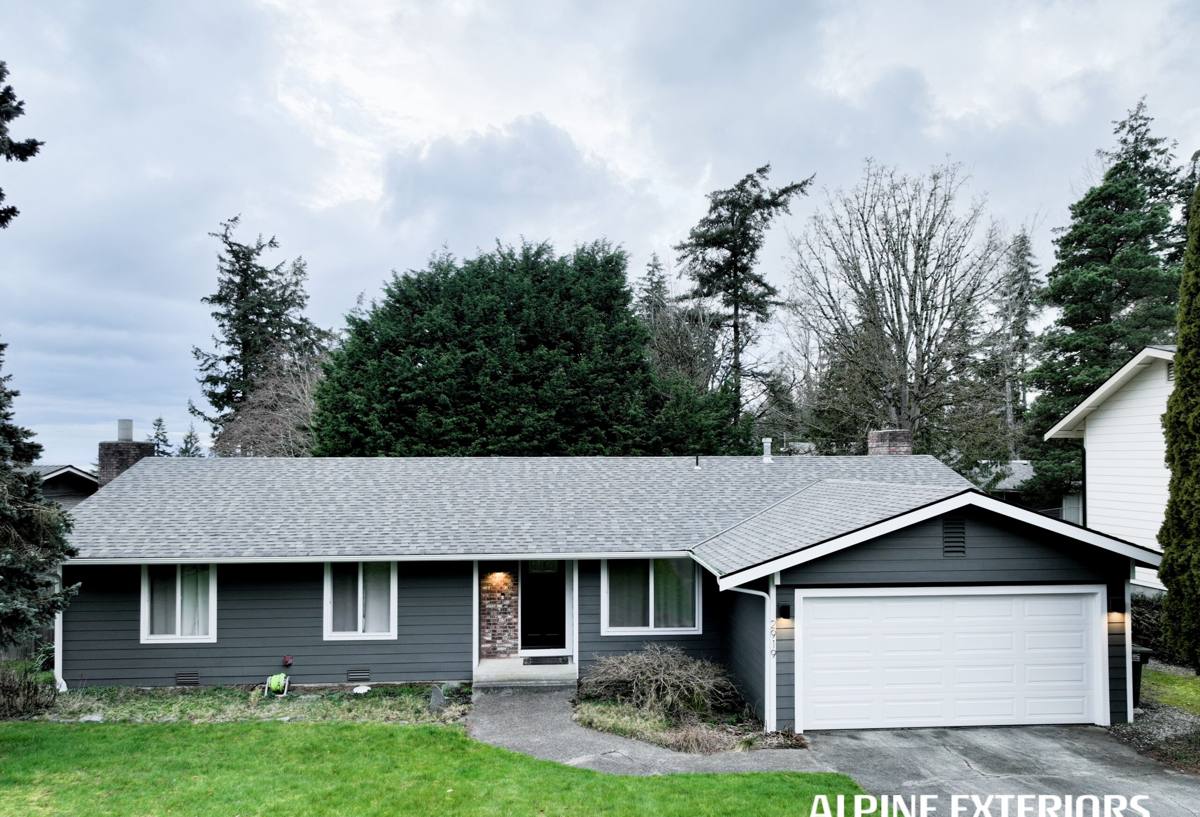
What a Correct Siding Replacement Actually Involves
Siding replacement is not just pulling off old boards and nailing up new ones. Done right, it's a full building-envelope job, and skipping steps is the single biggest reason siding fails early in a climate like this one.
Tear-Off and Substrate Inspection
Once the old siding is off, we inspect the sheathing underneath for rot, soft spots, and prior water intrusion — issues that are common on homes where siding was installed without a proper drainage plane. Any damaged sheathing gets replaced before anything new goes up. Covering over a compromised wall just hides the problem for the next owner.
Weather-Resistive Barrier and Drainage Plane
A correctly installed weather-resistive barrier, with a drainage gap behind the siding, gives incidental moisture a way to escape instead of sitting against the wall. In a market with this much driving rain, this layer matters as much as the siding itself.
Flashing at Every Penetration
Windows, doors, hose bibs, light fixtures, deck ledgers — every penetration through the wall plane needs proper flashing and integration with the barrier underneath. This is the detail work that separates a durable installation from one that looks fine for a year or two and then leaks.
Fastening and Clearances
Manufacturer-specified fastener spacing, correct nail penetration, and proper clearance from grade, roof lines, and decks all affect how long siding lasts. Butt joints get sealed or flashed correctly rather than just caulked and left.
Why We Install James Hardie and Nothing Else
We standardized on James Hardie fiber cement siding because it holds up to the specific stresses Ferndale throws at a wall. It's non-combustible, dimensionally stable in wet-dry cycling, and finished with ColorPlus factory coating that resists fading and moisture intrusion far better than field-applied paint on wood-based products. Hardie's HZ5 product line is engineered for wetter, harsher climates — a real advantage in a coastal Whatcom County location versus a siding line designed for a drier region.
We're not going to pretend every other siding product on the market is without merit — vinyl is inexpensive and low-maintenance in mild climates, and engineered wood products have their fans. But between moisture sensitivity, repainting cycles, and how each product actually performs after a decade of salt air and moss exposure, fiber cement is what we're willing to put our name behind and warranty. That's why it's the only siding we install, full stop.
Our Ferndale Siding Replacement Process
- On-site inspection of existing siding, trim, and any visible rot or moisture staining
- Written scope covering tear-off, sheathing repair allowance, barrier and flashing detail, and Hardie product selection
- Material order and lead-time confirmation — Hardie panels and trim are typically staged before demo begins
- Tear-off and substrate inspection, with photos of any hidden damage reviewed with the homeowner before covering it
- Weather-resistive barrier, flashing, and drainage plane installation
- Hardie plank, panel, or shingle installation to manufacturer fastening specs
- Trim, caulking at appropriate joints only, and final cleanup
- Walkthrough with the homeowner before we consider the job done
Because we already work in and around Ferndale, we know which wall orientations tend to take the worst weather locally and pay extra attention there — usually the sides facing open water or prevailing wind, where driving rain and salt exposure hit hardest.
Signs Your Ferndale Home Needs Siding Replacement Now
- Soft or spongy spots when you press on siding, especially near the bottom courses or under windows
- Paint that's bubbling, peeling, or needing repainting more often than every 5-7 years
- Persistent moss or algae growth that comes back within weeks of cleaning
- Visible gaps, warping, or buckling in panels or planks
- Rising energy bills with no other explanation, suggesting a compromised weather barrier
- Rot or staining visible at corners, seams, or trim boards
- Siding that's original to a home built more than 20-25 years ago
Any one of these on its own might be minor. Two or three together, especially on a wall that takes direct weather, usually means the underlying moisture management has already failed and painting or spot-patching won't fix it.
Comparing Siding Options for This Climate
| Product | Moisture Behavior in Coastal WA | Maintenance | Typical Lifespan Here |
|---|---|---|---|
| James Hardie Fiber Cement | Dimensionally stable, factory-sealed finish resists moisture intrusion | Occasional wash; no repainting for many years | 30+ years with correct install |
| Vinyl | Doesn't rot but can warp/crack in temperature swings; seams can trap moisture | Low, but limited repair options if damaged | 15-25 years |
| Engineered Wood (LP-type) | More moisture-sensitive at cut edges and fastener points | Requires diligent field sealing and repainting | Highly install-dependent |
| Cedar/Wood | Absorbs moisture readily; needs consistent sealing to resist rot | High — regular refinishing required | Variable, often shorter in salt air |
This table reflects general product behavior, not a claim about any specific manufacturer's failure rate. The honest summary is that fiber cement gives Ferndale homeowners the most margin for error against salt air, rain, and moss with the least ongoing upkeep.
Cost Factors for a Ferndale Siding Replacement
| Factor | Why It Moves the Price |
|---|---|
| Home size and wall complexity | More corners, gables, and dormers mean more cutting, flashing, and labor time |
| Substrate condition | Rotted sheathing found during tear-off adds repair scope not visible beforehand |
| Hardie product line chosen | Plank, panel, and shingle styles carry different material and install costs |
| Trim and accessory scope | Full trim replacement adds cost versus reusing sound existing trim |
| Access and site conditions | Tight lots, tall walls, or limited staging area affect labor time |
We give real numbers after seeing the specific home, not a phone-quote guess — too much of the final price depends on what's actually behind the old siding once it comes off.
Why a Crew That Already Works Ferndale Matters
Siding installation quality comes down to details that a crew either treats as routine or treats as optional. A crew that regularly works Ferndale and the surrounding Whatcom County coastline already knows how much drainage detailing a wall facing open water needs, how fastener corrosion resistance matters more here than inland, and how moss growth patterns should inform trim and clearance decisions. That's knowledge that shows up in fewer callbacks, not in anything you'd notice on day one.
It also means we're not learning a climate on your project. We size up which walls take the worst of the weather, plan the tear-off sequence around Northwest rain patterns, and build in the drainage and flashing detail that this specific coastline demands — not a generic install pulled from a warmer, drier market.
Maintenance After a Correct Siding Replacement
Fiber cement siding installed to spec is genuinely low-maintenance, but "low" doesn't mean "none." An occasional gentle wash removes surface grime and slows moss regrowth. Keeping gutters clear and grading away from the foundation reduces the splash-back that feeds algae at the lower courses. Caulking at sealant joints should be checked every few years, since sealant is the one component with a shorter service life than the siding itself. Beyond that, correctly installed Hardie siding is built to go a long time without needing attention — which, given how much upkeep older siding in this area tends to demand, is the whole point of doing the replacement right the first time.
If your Ferndale home's siding is showing wear, or you just want an honest read on whether it's a repair situation or a replacement situation, we're happy to take a look. Request a free, no-pressure estimate using the form below.